The Crisis of the Modern State: The Loss of Strategic Agency
Political existence is defined not by the presence of a legal entity or the fact of representative government, but by the existence of a subject capable of producing historical future.
rusnak.link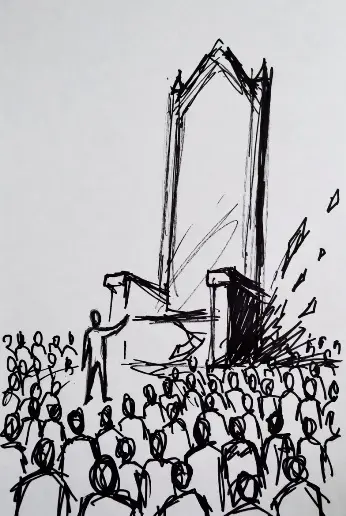
Abstract
This article examines the problem of the alienation of the political function within the modern state. It argues that the crisis of the modern state consists not merely in the growing autonomy of the bureaucratic apparatus, but primarily in the loss by political society of its capacity to remain the source of strategic project-making.
Political existence is understood as the ability of a political community to produce and realize historical projects, to institutionalize their outcomes, and thereby to sustain the continuity of its own historical existence.
Keywords
Political existence; political subject; political society; strategic project-making; alienation of the political function; modern state; sovereignty.
Introduction: Political Existence, Strategic Design, and Institutional Inertia
This study develops a conceptual framework based on the relationship between political existence, strategic design, and institutional realization.
Several terms used in this research require clarification, as they are employed in a specific analytical sense.
Political existence does not refer merely to the legal or institutional existence of a state. It denotes the capacity of a political community to remain an autonomous historical subject: to generate strategic meaning, formulate long-term goals, create collective projects, and transform them into political reality through institutions.
Political society refers not simply to the population governed by a state or to civil society in its sociological meaning. It denotes a community capable of acting as the source of political will, strategic thinking, and collective self-determination.
Strategic design refers not merely to planning, policy formation, or administrative goal-setting. It denotes the process through which a political community formulates a meaningful image of the future, identifies a direction of historical development, and organizes collective resources for its realization.
Strategic function refers to the capacity of a political system to produce long-term objectives, define historical direction, and transform political meaning into collective action. It differs from administrative functions, which primarily concern the implementation and maintenance of already established goals.
Historical project refers to a collective strategic vision embodied in institutions, political practices, and social transformations. It is not simply a program or policy document, but a broader form of historical self-organization.
Institutional inertia describes the condition in which institutions continue to reproduce established procedures, structures, and practices after the original strategic project that created them has weakened or disappeared.
Alienation of the political function refers to the process through which the capacity to formulate strategic goals gradually separates from the political community that originally created the institutional mechanisms intended to implement those goals.
Within this framework, modern political development is understood as an attempt to solve a fundamental problem: how to preserve the connection between the source of political meaning and the institutions responsible for its realization.
The modern political model separated three interconnected functions:
- the political society as the source of sovereignty and strategic meaning;
- representative institutions as mechanisms of political authorization and strategic decision-making;
- the professional state apparatus as an instrument of implementation.
This separation created significant advantages by increasing the capacity of complex societies to organize collective action. However, it also generated a structural risk: the gradual autonomy of institutions from the political subject that created them.
The central argument of this study is that the crisis of modern politics is not limited to the question of institutional efficiency or the distribution of power. The deeper problem concerns the preservation of the political community’s ability to produce strategic meaning and remain the author of its own historical future.
A political system may preserve formal sovereignty, constitutional procedures, and administrative effectiveness while gradually losing its capacity for strategic self-direction.
Therefore, this study argues that political freedom should be understood not only as the ability to choose political representatives, but also as the ability of a community to produce its own image of the future, transform it into a historical project, and maintain control over the institutions created for its realization.
1. From the Ancient Understanding of Res Publica to the Modern Understanding of the State
In Ancient Rome, there was no separation between “the state” and “society” in the modern sense of these concepts. The Roman republican political tradition did not perceive public authority as a separate administrative apparatus detached from the civic community and operating through the management of social resources.
It was precisely this later distinction between political society and the state apparatus that would create the possibility of their functional alienation, which will become the subject of further analysis.
The modern understanding of the state as a specialized professional administrative apparatus of governance, possessing mechanisms of coercion and other distinct institutional structures, was fully formed only in the modern era.
1.1. Political Community as a Mechanism of Managing Common Affairs
The foundation of the political order of Ancient Rome was not a state separated from society, but the civic community (civitas, populus Romanus) — a community of free citizens possessing political rights and participating in the formation of public order.
In the Roman republican tradition, authority was not understood as an external mechanism of governance imposed upon society. It was a function of the civic community itself. Magistrates, senators, and other holders of public authority were not regarded as an autonomous political corporation separated from society, but as temporary bearers of functions entrusted to them by the civic community.
The very concept of res publica did not mean the state apparatus in the modern sense, but rather the “common affair of the people” (res populi) — the sphere of matters belonging to the entire political community. As Cicero wrote, the republic was understood as a political community based on agreement regarding law and the common interest:
Res publica res populi est.
Thus, the fundamental distinction in the Roman political tradition was not between the state and society, but between the public (res publica) and private (res privata) spheres. The public sphere encompassed the affairs of the political community, whereas the private sphere concerned property, family, and the personal life of citizens.
1.2. The Professional Administrative Apparatus and Political Society as the Sovereign
The modern understanding of political society as an autonomous association of individuals, and the state as a separate professional administrative apparatus, emerged as a result of political thought in the modern era.
During this period, a new understanding of political order began to form: authority was no longer viewed as a natural property of the political community itself or as a hereditary function of the monarch. In a number of modern political theories, sovereignty gradually came to be associated with a political community of free citizens. For many thinkers, the state began to be understood as an institution created by human beings for the resolution of common affairs.
The human being was no longer viewed primarily as a member of a traditional estate-based or inherited social order, but as an autonomous individual endowed with natural rights. In the political sphere, this individual became a citizen — a bearer of political rights and a participant in the political community, who delegates certain political capacities to a distinct apparatus responsible for managing common affairs.
Within the emerging representative model, political authority gradually ceased to be understood as the personal instrument of a ruler and increasingly came to be perceived as a mechanism for realizing the political will of society.
1.3. Ancient and Modern Political Ontologies
The following discussion does not aim to provide an exhaustive description of the historical process. Rather, it identifies those structural transformations that are relevant for the subsequent analysis of political subjectivity.
The transition from the ancient understanding of res publica to the modern conception of the state represents a transformation of political ontology itself.
Ancient model:
Civic political community → public order → holders of temporary authority
In this model, the political community itself directly acts as the bearer of political authority, while governing functions are temporarily delegated to particular individuals who remain members of this political community.
Modern model:
Political society of autonomous citizens → delegation of authority → professional representative-administrative state apparatus
However, for the purposes of this study, the modern model requires a more detailed differentiation of political functions. Within it, not only is the state apparatus separated from political society, but political representation is also distinguished from administrative governance.
Expanded structure of the modern model:
Political society → delegation of authority → political representation (strategic political actors) → administrative state apparatus
2. The Modern State: Stability and Progress
All social functions can, in a certain sense, be divided into two categories: those that must be continuously performed in order to preserve the stability of social existence, and those that transform this existence in a particular direction.
The discussion below is no longer concerned with reconstructing historical institutions as such, but rather with their functional interpretation from the perspective of the political tasks they perform.
One may assume that in Ancient Rome the preservation of political order and its everyday stability was ensured by magistrates, whereas the resolution of extraordinary long-term challenges became the function of the dictator, who was appointed to achieve a specific strategic objective.
It can be argued that precisely in the modern era this division between the inertial and the strategic dimensions acquired particular significance. This political solution became one of the foundations of modernity itself — the continuous modernization of society.
It will be shown further that the absence of such an institutionalized strategic function became one of the causes contributing to the transition from the republican period to imperial rule. To some extent, the same perspective can also be applied to the political balancing of Athens between the concentration of strategic authority and the attempt to establish a form of collective civic governance.
In the Italian republics, this problem appeared in a different form. For example, in Venice, the emergence of the figure of the Doge can be interpreted as an institutional differentiation of a bearer of strategic functions distinct from everyday administration.
In a certain sense, the modern state represents a synthesis of the Roman Republic and the imperial models of the Principate and the Dominate.
This may appear paradoxical, but a closer examination of what the Founding Fathers created reveals that it was, in fact, a functionally improved political model capable of combining some of the most significant Roman practices: the creation of stable civic-administrative structures and the formation of strategic dimensions of imperial governance capable of addressing long-term developmental challenges.
2.1. The Formation of the Higher Representative Sphere: the Representative of the People, the Elected Administrator, and the Popular Judge
There may be different reasons for the emergence of political representation. For example, the management of common affairs required certain individuals to be separated from everyday occupations and dedicated to public tasks. If, as in Rome, the king who previously exercised political authority is removed, a fundamental question arises: who will perform these functions?
The entire society cannot govern directly at every moment. The political community is therefore compelled to distinguish from within itself those who will act on its behalf. Someone must issue decisions, give orders, and resolve disputes; therefore, it becomes necessary to determine those who will perform public functions — through lot, election, or other methods recognized by the community.
If we examine the history of Greece or Rome, we can identify hundreds of different names designating such functions, observe various systems and forms of social organization, and recognize the significance of institutional solutions developed by these civilizations, as well as the scale of civic conflicts surrounding the formation of public authority and the methods by which common problems were addressed through it.
2.2. The Strategic Function: The Emperor
However, representative administration alone says nothing about progressive development or about the resolution of society’s strategic challenges.
One may assume that military affairs have always required not only the solution of static tasks, but also the consideration of long-term actions aimed at achieving victory over a particular opponent. It is from this context that the Greek concept of strategy emerged, implying the mobilization and utilization of resources over an extended period in order to achieve a defined objective.
The resolution of strategic problems was reflected in the Roman practice of appointing a temporary dictator during periods of war or other extraordinary circumstances — a figure entrusted with implementing a long-term course toward victory or solving another strategic challenge.
In such a scenario, we no longer encounter merely the administrative regulation of everyday life aimed at preserving cyclical existence. The strategic function represents a fundamentally different conception, in which directed long-term thinking emerges: political strategy and its various forms.
In Rome, primarily in relation to military challenges, this function was performed by the temporary military leader — the dictator (often acclaimed as imperator). The strategic function embodied by this figure was later institutionalized in the person of the emperor. As the temporary strategic function gradually transformed into a permanent one, it became one of the foundations of imperial power. The necessity of addressing strategic problems over the long term eliminated the model of temporary appointment: strategic challenges became permanent.
Eventually, the emperor concentrated in his hands not only the strategic dimension but also the static functions of the political system: the position of supreme political authority, supreme military command, highest administrative authority, supreme judicial authority, the office of pontifex, and other major public powers.
Temporary strategic function → permanent strategic function → imperial authority.
It should also be clarified that the Senate, consuls, and other public representatives of the Roman people also participated in the formulation of strategic decisions. However, their activity was primarily collegial in nature. As Rome expanded, the need for continuous control over strategic matters and for unified operational decision-making created a demand for permanent strategic leadership.
This is why the temporary dictator gradually gave way to the permanent figure of the emperor, who concentrated the strategic function of the state within his own authority.
At the same time, the execution of static administrative functions at various levels continued within the framework of public self-government. This remained the case in Imperial Rome for a long period, relying on the institutional foundations developed during the republican era — various elected offices and civic structures.
It may be suggested that the problem of Imperial Rome was somewhat different from the way it is often interpreted today, when the conflict between the emperor and the Senate is primarily examined through moral or institutional categories.
Within the framework proposed here, the emperor was not simply an accidental deviation from republican principles; rather, he became a necessary institutional response to a transformed political reality. Rome had ceased to exist merely as a city-state and had become a vast territorial power, where military and other long-term strategic challenges continuously emerged across different regions.
2.3. The Problems of Strategy Production in Imperial Rome
It should be noted that during the period of the Principate, strategic decisions still received political legitimacy through the Senate, whereas during the period of the Dominate such a mechanism was no longer required.
Thus, the strategic function gradually became an internal matter of the emperor and his circle. However, the main problem was no longer merely the implementation of strategy, but rather the production of strategic thinking itself.
Rome institutionalized the subject responsible for implementing strategy, but it did not institutionalize the production of strategy itself.
Several fundamental problems of strategy production in the Roman Empire can therefore be identified:
- The function of implementing strategy was defined, but where was strategy itself produced? Where was the institution responsible for generating strategic thought? How was strategic decision-making organized? How did competing strategic programs of development emerge and compete with one another? In other words: “What is strategy?”
- Perhaps the emperor was occupied with other matters or was simply incapable of fulfilling the strategic function? In other words, the emperor could become the holder of strategic authority without actually being a strategist. The question then becomes: “Does the strategist exist?”
- Where was the consent of society to participate in the strategic enterprise? How was strategy legitimized? Perhaps such an enterprise was destructive, the result of arbitrary rule and distorted judgment by the ruler. Perhaps strategy served the private interests of a limited group of individuals or represented the will of some external strategist. The question therefore becomes: “Where is the mechanism of social consent to strategy?”
If the consent of the civic community is absent, strategic action affecting the lives of all citizens becomes a violation of their freedom and political rights.
Therefore, the implementation of a strategic function without the participation of society transforms that function into unlimited arbitrariness.
2.4. Progressive Development: The Politician as Strategist
One may assume that in the modern era a solution was found to the strategic problem of progressive development: the meaning of the representative politician’s function, and of the mandate received from the people, lies not merely in the administration of common affairs, but primarily in the formulation and implementation of a long-term strategy for the development of society.
Without such a long-term orientation, it is impossible to speak of the full function of political representation in the modern era.
The right to central political authority in modernity — expressed, for example, in the function of the president within presidential systems of government — functionally inherits the role that was performed in Rome by the military dictator and later by the emperor.
However, the fundamental difference of the modern model lies in the fact that the holder of the strategic function must be elected for a limited period, propose a strategic program of development to society, and receive a mandate for its implementation through political procedures.
The politician-strategist is not merely someone who understands political and strategic complexity. It is someone capable of producing new modes of thinking, developing strategic programs of development, and transforming strategic intent into historical and political reality.
At the same time, the preliminary procedures of the modern political system should ensure competition and the emergence of those capable of acting as strategists rather than administrators whose logic is: “Tell me what needs to be built, and I will build it.”
2.5. The Formation of a Professional State Apparatus
However, the politician-strategist must have the ability to implement their intentions, which have received public legitimacy through political procedures.
For this purpose, they require not only public support and access to common resources, but also an instrument of implementation — a professional state apparatus possessing the necessary capabilities to address strategic tasks.
The professionalization of the state apparatus in the modern era became a necessary condition for the effectiveness of the strategic model of development. The increasing complexity of social processes required specialization, division of labor, and the emergence of experts in various fields of administration.
However, within the framework of the proposed model, the primary reason for the formation of a professional administrative apparatus was not merely the need for specialization. Its creation was connected with the development of an institutional mechanism subordinated to the strategic objectives of the political community — a mechanism that could be modified, reformed, or replaced if it ceased to effectively implement established political goals.
At the same time, the professional state apparatus is not an independent producer of strategy. Its purpose is the competent implementation of strategic decisions developed by political leadership and legitimized by society.
Therefore, in the modern model, the politician produces strategy, while the state apparatus ensures its implementation.
3. Will and Implementation
The idea of distinguishing between a political conception and the apparatus responsible for its implementation was not an invention of the modern era. The separation between the bearer of strategic functions, the executor of political will, and the administrator existed long before modernity.
In the Roman Empire during the periods of the Principate and the Dominate, and later in Byzantium and the major European monarchies, complex administrative structures emerged that ensured the implementation of the will of supreme authority. In various historical forms, a similar functional distinction can be found much earlier — in the states of the Ancient East, including Mesopotamia and Egypt.
3.1. Political Society as Sovereign and Strategist: Politicians and Administration as Executors
The fundamental difference of the modern political model did not consist in the creation of a professional administrative apparatus or systems of delegation, but rather in a transformation of the source of sovereignty — the entity that formulates the political conception and determines the direction of development.
In imperial and monarchical systems, the bearer of sovereign will was the ruler or a narrow political elite, while the administrative apparatus ensured the implementation of their decisions. Modern political theory transferred the center of political thought to the political society of free citizens.
Political society itself came to be understood as the source of strategic thinking and the bearer of political will, whereas political representation and the state apparatus came to be understood as delegated mechanisms for implementing this will and the strategy formulated by society.
At the same time, the idea of a collective bearer of political will did not suddenly emerge in the modern era. Its elements can be traced back to ancient republics and to the republican cities of Renaissance Italy, where political communities participated in determining the directions of their own development.
The novelty of the modern political model did not lie in the emergence of professional administration or the delegation of power. Rather, it consisted in the explicit transfer of the function of strategic project formation from a personalized sovereign to the political community of autonomous citizens, together with the institutional separation of functions between political society, political representation, and the state apparatus.
3.2. The Problem of Functional Separation
In ancient poleis, and later in the republican trading cities of late medieval Italy, strategic and administrative functions were primarily carried out by representatives of the political community itself. This model ensured a direct connection between the formation of political conception and its implementation, reducing the risk of separation between power and society.
However, the absence of a clear distinction between political will and executive function created an internal problem.
Since the political community simultaneously acted as the source of political conception and directly exercised political authority, struggles over political direction often transformed into struggles for control over the very mechanism of implementation.
Under such a synthesis, changes of political leadership did not always occur through stable procedures of transferring authority. Instead, they could be accompanied by conflicts between political factions, exile, persecution, or the violent elimination of political opponents.
In Rome, this problem manifested itself particularly in the crises associated with Marius, Sulla, and Caesar, when extraordinary powers could transform into instruments for maintaining personal authority, leading to political repression and civil conflicts.
Thus, earlier political models attempted to ensure the realization of a common conception through the close integration of political society and the mechanisms of governance. However, this synthesis possessed its own limitations: it reduced the risk of the alienation of power from society, but simultaneously created the danger of the usurpation of political functions by particular groups and the transformation of struggles over political direction into struggles for control over the mechanism through which that direction was implemented.
Within the proposed model, the modern political system resolves this problem differently: not through the fusion of political society and the administrative apparatus, but through their institutional separation.
The modern model presupposed the creation of clear boundaries between the sovereign and the executor, mechanisms of delegation, control, replacement of officeholders, and political accountability.
Such separation created the possibility of distinguishing the production of strategy from its professional implementation without destroying the unity of the political system.
4. The New Political Reality and the Problem of Strategic Project Formation
The transition from the ancient understanding of res publica to the modern understanding of the state meant not merely a transformation of political institutions, but the formation of a new political reality.
4.1. The Free Nation as a New Ontological Reality
Initially, this ontological transformation had a liberating character. First of all, at the level of political thought, it made it possible to overcome estate privileges, establish the principle of equality of citizens before the law, create mechanisms of political representation, and, most importantly, through constitutional ontology, to form a new political reality — the political nation.
Prior to the emergence of this mode of ontological thinking, such a political entity did not exist within metaphysical reality.
4.2. The Shift of the Source of Sovereign Will and Strategic Project Formation
At the same time, the very source of sovereign will and strategic project formation was transformed. The sovereign function gradually shifted from the monarch to a society of free citizens, which acquired the ability to determine the directions of common development.
This transformation meant not only a change in the bearer of power, but also a change in the way political futures were formed. Political conception ceased to be the exclusive function of an individual ruler or a narrow elite and became the domain of the political community.
4.3. A New Mode of Producing the Strategic Future
The main consequence of this transformation was the emergence of a new mode of producing the political future. A society of free citizens became not merely a collection of individuals possessing political rights, but a space of competition between different forms of strategic thinking, where various actors could formulate alternative visions of the future, propose solutions, and determine directions of development.
This meant the ability to define goals of common development, create political projects, generate new solutions in economic, social, scientific, military, and political spheres, and implement them through a professional administrative apparatus created by society.
Within this structure, society itself acted as the source of strategic conceptions, while the state apparatus served as the mechanism of their implementation.
Modernity created a mechanism for producing the strategic future, but at the same time it created the possibility of the alienation of this mechanism from society.
Alongside this achievement, however, a new problem emerged: to what extent can society realistically maintain control over the apparatus it created and remain the actual subject of strategic project formation?
5. The Competitive Advantage of a Free Society: Search, Error, and Correction
The advantage of such a model of political organization was its ability to produce new solutions and adapt more rapidly than societies that lacked comparable institutional mechanisms for strategic search.
The distinctive feature of such “strategic existence” was not only the ability to propose alternative ideas, but also the creation of an institutional environment for their open competition, testing, and selection.
5.1. Political Competition as Competition Between Strategies
The replacement of political leadership occurred through established procedures rather than through the physical elimination of defeated political actors and their surrounding networks. Those who proposed new ideas or alternative models of development were not destroyed as political competitors but retained the opportunity to participate in the open competition of different strategic visions within established political institutions.
This logic lies at the foundation of the liberal political tradition. Freedom of thought, speech, association, and various forms of social competition were understood not merely as individual rights, but also as mechanisms for producing, testing, and selecting the most viable solutions for development.
A new strategic idea could become the basis of political direction only after receiving public recognition through mechanisms of representation and elections. Political leadership could propose a path of development, but its implementation required legitimation by the political community.
Thus, a competitive society transformed political struggle from a struggle for possession of power into a struggle for the production and realization of different projects of the future.
5.2. Correction of the Course Rather Than Civil Conflict
If a political, entrepreneurial, or other project proved unsuccessful, this generally resulted in a change of leadership or a correction of course rather than the elimination of its participants from political or economic life.
The ability to make mistakes without permanently losing the right to participate in social activity created conditions for continuous competition between projects and strategies.
This principle of competitive production of solutions became one of the foundations not only of political development but also of economic dynamism. Unlike systems where political defeat could mean the removal of the carriers of alternative strategic visions, a free society developed an institutional mechanism that allowed alternative solutions to be openly proposed, tested, rejected, and, when necessary, returned to public discussion.
Participants in such a process understood in advance the rules of competition, the possible consequences of their actions, and the procedures for revising previously adopted decisions. This ensured the continuity of strategic search.
5.3. The Right to Make Mistakes and Free Thought
The ability to make mistakes, correct them, and repeatedly propose new solutions created conditions for the continuous production of the future. It was precisely this capacity that allowed society to generate new forms of activity, technologies, strategies, and models of organization.
The distinctive feature of such a society was that alternative thinking was not regarded as a threat requiring elimination, but as a potential source of future solutions.
This is why the liberal political tradition developed mechanisms for protecting freedom of expression. One of the most well-known examples is the First Amendment to the Constitution of the United States, which creates conditions for open competition between ideas, including protection for forms of expression that may be unpopular, controversial, or even offensive to parts of society.
Therefore, the ability of society to preserve openness to error and alternative thinking becomes not merely a political value, but a condition for preserving its strategic function.
6. An Example of the Modern State
In this sense, the creation of the United States of America can be considered one of the most significant examples of the shift of sovereignty: from the monarchical principle of sovereignty toward a political community of free citizen-owners.
The colonial elites of the thirteen British colonies proceeded from the idea that power should not be an external force derived from the monarch, but rather an instrument for managing common affairs, created by a society of free people — primarily citizens capable of independent political judgment and participation in the governance of public matters.
Within this model, government ceased to be the bearer of sovereign authority and became a delegated mechanism created by citizens to perform functions defined by them.
A society of free property owners, through constitutional mechanisms, created a system of government, determined its powers, established the principles of taxation, and controlled the activities of the state apparatus through political representation.
This is why the American constitutional model was built not only around the creation of new institutions of power, but also around the institutionalization of a mechanism through which the political community could preserve control over the structures of governance it had created.
At the same time, this process did not represent an immediate transition to the modern understanding of political society as the totality of all people living within the territory covered by a given political system. The political subject of the eighteenth century was primarily understood as a limited group of free male property owners possessing political rights, while a significant part of the population remained excluded from political participation.
6.1. The Narrow Political Subject
The early modern political model had a contradictory character. On the one hand, the limited circle of political participants created conditions for a high concentration of strategic thinking and the formation of effective political environments capable of producing alternative development projects.
It was precisely these narrow political communities that acted as the carriers of sovereign political thought and strategic action: they formulated ideas, discussed strategic alternatives, and proposed new models of social organization.
On the other hand, a significant part of the population remained excluded from the process of forming the general strategic direction of social development.
In this context, the early modern model combined two contradictory characteristics: a high capacity of certain political groups for political project-making and the limited scope of those who could act as carriers of sovereign strategic vision.
6.2. Delegation of Power, Procedures, and the Preservation of Political Subjectivity
The political community, which at the early stage of the modern model remained a relatively limited and status-defined circle of active citizens capable of directly participating in political decision-making, not only formulated strategic ideas but also determined the principles of organizing the apparatus of power: the procedures for selecting officeholders, the boundaries of their authority, and mechanisms of accountability.
The delegation of power did not mean the final transfer of sovereignty. Society retained the ability to control the activities of representatives, evaluate the implementation of adopted decisions, and, through established political procedures, change those exercising authority in cases of loss of trust or failure to accomplish assigned tasks.
The administrative apparatus remained an instrument for implementing the political will of the community, acting within the limits of the authority granted to it.
Precisely the strict observance of procedures became the mechanism preserving the connection between delegated power and its source. These procedures made it possible to change officeholders without destroying the political order itself and ensured the possibility of continuous correction of the political course.
Thus, the modern model did not assume the elimination of the distinction between society and the administrative apparatus, but rather the continuous reproduction of the connection between the source of political purpose and the mechanism of its implementation.
6.3. The Mechanism of Stability in the Implementation of Strategic Will
Representative government as a system of delegated political authority ensured the realization of the political will of the community of free citizens. Within this system, different state institutions performed different functions of forming, implementing, and controlling political decisions aimed at preserving the stability of the established order.
The specific ways of organizing these functions could differ significantly across various modern political systems. Separation of powers, parliamentary procedures, presidential or other forms of institutional organization were not ends in themselves, but different mechanisms for ensuring the transmission of political will, its implementation, and control over the actions of representatives.
The legislative branch within this model determined general directions of development, established the fundamental principles of social organization in legal norms, defined the boundaries of state and social institutions, and exercised political oversight over the implementation of adopted decisions.
The executive branch ensured the practical realization of goals defined by the political community, managed public resources, and performed administrative functions within the established order.
The judicial branch ensured the preservation of legal order, supervision of compliance with established rules, and protection of the principles upon which the political system was founded.
Thus, differences between specific institutional forms did not eliminate the general principle: the political community remained the source of strategic will, while state institutions served as mechanisms for its transmission, implementation, and control.
7. Procedural Legitimation of Power as Competition Between Political Strategies
In such a political model, where there is no monarch or another person possessing the right to rule by birth, representative power receives legitimacy not from hereditary status, but through procedures established by the political community.
This is precisely why the origin of power is understandable to all participants in the political process: everyone knows why these particular individuals received the right to temporarily exercise political leadership, how they obtained this mandate, and on what basis they represent society.
Compliance with procedures is not merely a formal requirement but also a mechanism for limiting arbitrariness. If the source and the procedure through which authority is obtained cease to be recognized by the political community, delegated power transforms from a public mandate into an independent appropriation of political functions.
However, procedural legitimacy alone is insufficient. In the modern political model, the right to exercise leadership is also connected with the ability to propose a particular direction of development to society and obtain support for a specific strategic vision.
Initially, in the early modern model, political competition was primarily a competition between strategic projects of the future. The limited circle of political participants viewed power not only as the management of an existing order but also as the ability to determine the long-term direction of society’s historical development.
Arguments concerning special meritocratic qualities, exceptional knowledge, or the natural right of certain individuals to govern may explain the reasons for public support of particular candidates, but they are not, by themselves, the source of legitimacy of public authority in a democratic system. Legitimacy emerges from the combination of a socially recognized procedure for obtaining authority and the ability to formulate a political project of the future.
7.1. Legitimation and the Mandate of Power — Only Through a Strategic Proposal
Equally important was the clarity of the political vision itself — a long-term strategy, course, or program of development. Representative power received a mandate not only for current administration and the maintenance of existing institutional processes, but also for the implementation of a specific political project aimed at qualitatively transforming the existing state of affairs.
It was this vision that became the subject of open political discussion and competition. Political struggle represented not merely a struggle for occupying state positions, but a competition between different conceptions of the future. What prevailed was not simply a political group, but a particular development project that received the temporary right to direct the actions of the state.
Accordingly, the administrative apparatus implemented not its own will, but the political course that had received public legitimacy through the competition of political projects and the discussion of alternative paths of development.
7.2. From Strategy to a Blurred Political Course or Empty Formality
As the political subject expanded, the content of this competition gradually changed. While the early modern model assumed competition between comprehensive strategic projects, mass democracy in many cases shifted toward competition between broader directions of development and individual political programs.
At the periphery of the modern political space, where democratic procedures could persist primarily in a formal sense, while an effective political society had not emerged as an independent subject of strategic project-making, this problem became even more pronounced. Instead of a political community capable of producing long-term development projects, post-imperial bureaucratic structures and elite groups often remained in place, connected with previous colonial orders and gaining control over a significant portion of political and economic resources previously belonging to colonial or imperial centers.
In some cases, this meant not the creation of a new political subject, but merely the replacement of previous holders of power by new elite groups reproducing many functions of the old order. Formal democratic procedures existed, yet the mechanism of producing strategic futures remained limited to a narrow circle of groups and did not become a genuine function of political society.
Under such conditions, elections often transformed not into a competition of strategic projects, but into a struggle centered around personal leadership, symbolic images, and current promises disconnected from a coherent vision of society’s future.
In such a case, the procedure of election remained, but its connection with the production of a long-term historical vision weakened. The political system continued to reproduce the mechanism of transferring power, yet lost the ability to use this mechanism for forming and implementing a strategic direction of development.
7.3. Power as a Combination of Procedures and Strategy
The combination of two factors — first, clear and binding procedures for legitimizing power, and second, open competition between political strategies and development programs — became one of the key advantages of the early modern political model.
Its advantage consisted not only in the possibility of changing holders of power, but also in the ability of society to produce, test, and select different projects of the future.
Procedures prevented the transformation of power into arbitrariness, while competition between strategies provided direction to political action.
8. Gradual Autonomization of the Administrative Apparatus and the Alienation of the Strategic Function
The increasing complexity of social processes and the growing scale of governance required further differentiation of functions within the representative system of power. A distinction emerged between political representation, which retained the function of defining the general political vision, and the professional administrative apparatus responsible for its implementation.
The creation of a complex professional administrative system became a necessary condition for state effectiveness, but at the same time it generated a new problem — the possibility of its gradual autonomization.
The more complex the system of governance became, the more it required specialized knowledge, professional officials, and independent administrative procedures. This increased the capacity of the state mechanism to effectively implement political decisions, but simultaneously created the risk of separating the administrative apparatus from the political community that had delegated these powers to it.
An internal contradiction emerged: the more professional and complex the administrative apparatus became, the greater its ability to operate according to its own internal logic based on administrative procedures, professional standards, and institutional interests. As a result, a gradual divergence became possible between the actions of the apparatus and the strategic will of the political community that it was originally created to implement.
One manifestation of this transformation was the formation of modern professional administration in the nineteenth and twentieth centuries, including through administrative reforms associated with the ideas of Woodrow Wilson concerning the separation of politics and administration. Within this model, the administrative apparatus was understood as a specialized system of professional execution of political decisions, separated from direct political competition for power. However, this very separation simultaneously created the foundation for a further question: can an executive mechanism fully preserve its dependence on the political subject that created it?
8.1. The Crisis of the Mature Modern State: The Loss of the Political Function by Society
Together with the new political ontology emerged a fundamental problem: the separation of the political function from the direct participation of political society.
In earlier republican models, citizens did not merely possess political rights — they were understood as direct participants and bearers of the political order itself. The public sphere remained a space of their participation, and governance was perceived as a form of activity belonging to the political community itself.
This did not mean that all inhabitants of society actually participated equally, since republican models were based on various forms of exclusion and restricted citizenship. However, the political function itself was not completely separated from the community of citizens.
In the modern model, political activity gradually became professionalized. Governance became divided among political representation, state institutions, administrative structures, and professional managers.
The majority of citizens no longer exercised the political-strategic function directly, but rather indirectly — through elections, representation, and control over institutions created by them.
Initially, such mediation did not represent a loss of political subjectivity, but rather a method of expanding it: it allowed a larger number of people to participate in shaping the common direction through representative mechanisms created by society itself. However, a new danger simultaneously emerged — the gradual transformation of participation into a formal procedure and the alienation of society’s ability to produce political vision toward specialized institutions.
8.2. The Internal Logic of the Administrative Apparatus Instead of Strategic Will
A fundamental paradox emerges: the state is created by political society as an instrument for realizing its strategic goals, yet over time this instrument may acquire relative autonomy from the society that created it.
This process can be defined as the alienation of the political function. The function of implementing a common political vision, initially belonging to political society and its representatives, is gradually transferred to specialized structures. At the same time, as governance becomes increasingly complex, there emerges a risk that the administrative apparatus begins to influence not only the execution of decisions but also the very formation of political priorities.
Under conditions of excessive autonomization, such structures may begin to act not only according to social objectives, but also according to their own internal logic, procedures, and institutional interests.
A symptom of this alienation became the transformation of how the state itself was perceived in modern society. Whereas initially the state apparatus was understood as a mechanism created by citizens for implementing their common will, over time it increasingly began to be perceived as an independent force external to society.
A revealing cultural marker of this transformation became the famous ironic statement by Ronald Reagan:
“The nine most terrifying words in the English language are: ‘I'm from the government, and I'm here to help.’”
This statement reflects not merely criticism of bureaucracy, but a deeper transformation in political perception: the administrative apparatus created by society begins to be perceived not as a continuation of citizens’ political will, but as a relatively autonomous institutional system operating according to its own internal logic.
9. The Loss of the Strategic Function and the Historical Project
The problem of alienation can emerge not only in the economic sphere. The state, created as an instrument for the realization of collective will, can gradually transform into an independent system reproducing its own procedures, institutional interests, and administrative practices.
It is precisely here that one of the main problems of contemporary democracy emerges: the formal preservation of popular sovereignty does not always mean the actual ability of the political community to determine the long-term direction of its own development.
To be a strategic society means not only possessing the right to elect political authorities. Political freedom consists in preserving the capacity to formulate one’s own strategic conception of the future and to use the state apparatus as a mechanism for its realization.
Procedures may allow citizens to change the composition of political representation; however, the electoral system itself does not automatically produce historical-strategic development. It provides a mechanism for replacing political representatives, but by itself it does not guarantee the existence of a political subject capable of forming long-term projects that determine the direction of social development.
9.1. Inertial Governance Instead of Political Design
Under conditions of alienation, political activity gradually transforms into the administration of an already established order. The state continues to function, institutions continue to reproduce themselves, and procedures continue to operate; however, society’s ability to formulate a new historical conception may gradually weaken.
This reveals the fundamental difference between governance and political design:
- Governance answers the question: How can already defined goals be implemented more effectively?
- Political design answers the question: What should the future be, and how can society create it?
If political society loses the ability to answer the second question, politics gradually becomes reduced to maintaining the existing system and responding to emerging problems. Yet the essence of the political does not lie only in preserving an existing order, but also in the ability to create new historical projectivity.
It is precisely through such alienation that the phenomenon of the “static nature of the political order” emerges: society retains formal mechanisms of political participation, including elections and representation, but gradually loses the ability to remain the subject of its own long-term historical development.
In such a situation, the political system continues to exist as a mechanism for managing the present, but ceases to function as a mechanism for producing the future.
9.2. Historical Projectivity Rather Than the Problem of Choosing Administrators
The ancient political tradition proceeded from the assumption that the civic community itself was the space where political conceptions were formed and the general order of action was determined.
The modern state created a more complex system of functional separation: political society retained the status of the source of sovereignty, representative institutions formed the political course, while expert structures and the professional administrative apparatus ensured its implementation.
The advantage of a powerful administrative system was its ability to organize complex governance of large societies. However, its risk was the gradual loss by society of its role as an active historical subject. Representative institutions may formulate political programs and make decisions, but the mere existence of such procedures does not guarantee the presence of genuine strategic thinking and the ability to create long-term development projects.
Therefore, one of the main crises of contemporary politics lies not only in the efficiency of the state apparatus, but also in society’s ability to create its own historical projects. The problem of the future is no longer simply who forms representative institutions and who directs the administrative apparatus, but rather another question:
Can society remain the source of strategic thinking, while the state remains the instrument of its realization?
This problem defines one of the key crises of modernity: the search for a mechanism of transition from the politics of administration to the politics of historical design.
10. Administrative Support for “Sustainable” Development Rather Than the Production of Meaning
The modern state is largely effective in performing administrative functions: it is capable of regulating, controlling, distributing resources, and maintaining the functioning of a complex social system that emerged as a result of the realization of previous historical projects.
However, the institutional nature of the state apparatus itself does not guarantee its ability to produce new meanings, formulate long-term civilizational goals based on them, or independently create strategic projects of the future.
The administrative apparatus can implement a strategy, but its own logic is primarily oriented toward maintaining the functioning of the existing system rather than producing a new historical conception.
10.1. Maintaining Inertia and the Absence of Strategic Thinking
It is precisely here, in discussions of “sustainable development,” that the limitations of a purely administrative model of governance become apparent.
An administration can effectively perform assigned tasks, maintain the functioning of an existing system, and optimize processes within it; however, it is not always capable of independently producing strategy — the new way of thinking necessary for creating a new reality.
In this context, the critique of the concept of sustainable development presented by Richard Rumelt in his book The Crux: How Leaders Become Strategists is particularly illustrative. He points out that even a set of socially significant and positive goals does not, by itself, constitute a strategy (Rumelt, 2022).
An example of this is the United Nations Sustainable Development Goals, which include a broad range of desirable directions: overcoming poverty and hunger, developing the economy, preserving ecosystems, ensuring access to affordable energy, and combating climate change (United Nations, 2015). However, real tensions may exist between these goals: achieving one of them may complicate the realization of another (Rumelt, 2022).
As Rumelt notes, strategic thinking does not begin with a list of desirable outcomes, but with identifying the central challenge, choosing priorities, and finding a coherent path of action (Rumelt, 2022).
It is here that a fundamental strategic question emerges: which goal represents the defining direction of development, and how does it shape the image of the future?
Without an answer to this question, a collection of positive goals remains rather a system for coordinating interests and administrative priorities than a genuine strategy.
Strategy does not begin with a list of desirable states, but with the formation of a conception — or the discovered meaning — of the future. The question therefore arises: what specific historical meaning creates an unifying image of development?
10.2. Strategy as a New Meaning Producing a New Reality
An orientation toward “everything positive” in itself does not constitute a strategy.
Strategy is not merely the determination of priorities, the identification of conflicts between goals, or the selection of mechanisms for their coordination. Strategy begins with the production of a mental image of a new reality, and only then includes the determination of the path toward achieving it.
Therefore, the concept of “sustainable development” remains insufficient as a strategic construction if it does not contain a clear answer to the question of the desired future, its meaning, and the mechanism of its creation.
In such a case, “sustainable development” may function not as the result of genuine strategic design, but rather as a description of the attempt to preserve the existing system through administrative regulation.
Instead of a strategic subject and an integral historical conception, what remains is a set of principles, procedures, and aspirations — or, more precisely, an administrative inertia of managing flows without producing new meaning.
11. The Crisis of the Political Subject: Who Shapes Destiny?
The central problem of the modern state lies not only in the creation of an effective administrative apparatus, but also in preserving a political society capable of determining the strategic conception of its own development. This idea corresponded to one of the key lines of the Enlightenment and republican traditions — the understanding of society as a subject capable of independently determining its political destiny.
The early modern model assumed that society remained the source of political will, while political representation formulated the direction of development and received a mandate for its implementation, and the state apparatus ensured the practical execution of adopted decisions.
However, the gradual complexity of institutions, the professionalization of governance, and the autonomy of bureaucracy have challenged the preservation of this relationship.
As a result, the central problem is no longer only the distribution of power, but also the preservation of the political function itself. It is insufficient to determine who formally possesses political authority. The decisive question is different: who formulates the strategic conception, defines long-term goals, and determines the direction of historical development?
11.1. The Reactive Mechanism
A situation may emerge in which this capacity effectively ceases to belong to political society as a space for the formation and competition of strategic conceptions. In such a case, neither society nor the state apparatus performs genuine strategic design, and the political system enters a mode of inertial existence in which external challenges increasingly determine its behavior.
It no longer moves toward its own strategic goal but continuously changes direction under the pressure of new problems, spending its energy and resources on reaction rather than on the realization of a long-term conception.
The future, in such a situation, ceases to be an object of political design and emerges instead as the cumulative consequence of short-term decisions.
However, inertia does not mean immobility. Rather, what once emerged as an active historical subject, having ceased to move toward its own conception, gradually begins to transform under the influence of internal processes of disintegration and external pressures.
One may assume the existence of processes of political entropy that gradually dissolve the condition of what was previously a coherent political subject, transforming it from a subject of historical action into an object of various processes.
But then the final question emerges: an object of what, and for whom?
11.2. Conspiracy Theory as a Search for the Subject of Strategy
If strategic design ceases to be carried out by political society, the question arises as to who could become the bearer of this function.
Hypothetically, this role could be assumed by the state apparatus, closed elites, external centers of influence, or other organized actors. It is also possible that this function gradually disappears as an independent element of the political system.
Thus, the central problem becomes not the question of power itself, but the question of the existence of political society as a space for the formation and competition of strategic visions.
It is precisely the presence of this capacity that determines whether the state remains an instrument for the realization of social projects or is transformed into a system reproducing its own internal logic, or into a mechanism for implementing designs whose source remains unknown to society itself.
Within Luhmann’s systems theory, strategic design is not an element in the description of social reality. The future is not produced through meaningful goal-setting and design but emerges as a result of the self-reproduction of social systems. In place of strategy as a reflection on the meaning of the future appear procedures, communications, and institutional processes that themselves produce the fabric of what occurs.
It is here that a fundamental divergence emerges between strategic and systemic (postmodern) understandings of society:
- From the strategic perspective, the future is the result of discovering meaning, forming an intention, and transforming it into a project. Strategy is always a reflection on the meaning of the future, which in the process of realization becomes a historical project.
- From the systemic (postmodern) perspective, the future emerges from the internal dynamics of processes that do not possess a single predetermined center of meaning or strategic direction. Reality is not created as the embodiment of a unified design but emerges as the result of the functioning of the system, its own operations, and interactions.
However, such a position may be criticized from the perspective of project-oriented and rational thinking. If complex processes do not presuppose a design, then how do objects and systems that clearly require prior planning emerge — for example, a city, a factory, or a political institution?
Richard Rumelt addresses this problem in his book The Crux: How Leaders Become Strategists, criticizing the view of complex social systems as processes that develop exclusively through self-regulation and adaptation. He argues that strategy requires the existence of a subject capable of determining direction, choosing priorities, and directing collective efforts beyond the ordinary reproduction of the existing order (Rumelt, 2022).
In this sense, the question of strategy becomes not only a question of the existence of mechanisms of governance but also a question of whether there exists a subject capable of producing a vision of the future and transforming it into historical action.
It is here that a fundamental question emerges: Can a building be constructed without a design?
11.3. The Ghosts of Modernity
It is precisely here that the peculiarity of the contemporary situation becomes visible. A significant part of society, while preserving the modern capacity to rationally analyze ongoing processes and understand their consequences, simultaneously finds itself partially within a postmodern condition: it observes the results of historical transformations but does not discover the subject or conception that could be considered their source.
A peculiar rupture emerges: modern consciousness continues to assume that complex transformations must have meaning, a project, and a source of design, whereas the postmodern understanding of reality explains them through the impersonal dynamics of systems and processes.
Unable to find a clear source of strategy within its own political space, such consciousness begins to search for it externally — in the form of hidden decision-making centers, closed groups, or other presumed subjects that should explain the origin of ongoing transformations.
Thus, conspiracy theory can be understood not only as an error of causal explanation but also as a symptom of society’s loss of awareness of its own capacity to be the source of strategic action.
12. Postmodernity: Power Without a Project and the Question of a New Strategic Subject
If a strategic project does not exist and historical development is understood as the result of spontaneous interaction among processes without a unified direction, as assumed by certain systemic and postmodern approaches, another question emerges: what does power become after losing its strategic dimension?
Such power retains the ability to govern, regulate, and maintain the functioning of institutions; however, it loses the answer to the fundamental question: why does power exist, and what future does it seek to create?
Without strategic thinking, power ceases to be a mechanism for realizing a historical conception and becomes primarily a mechanism for preserving the existing order. In this sense, a phenomenon of the strategic zero emerges: power exists as procedure, governance, and resource distribution, but no longer as a source of a long-term project of the future.
Of course, such a system may create various simulacra of strategic thinking — formulating goals, programs, and development concepts. However, a fundamental question remains: are these truly strategic projects, or merely descriptions of current administrative tasks? Where is the very meaning of the future that transforms governance into historical action?
12.1. Postmodern Theories of Public Governance: Governance Without a Political Subject
A paradoxical possibility emerges: if the strategic function is absent or removed beyond the boundaries of political society, another model of governance may prove sufficient for maintaining the functioning of a complex system.
Instead of the classical construction in which political society formulates a conception, political leadership receives a mandate, and the state apparatus implements decisions, a model of distributed governance emerges.
Within this model, governance may be carried out through networks of organizations, independent agencies, expert structures, public-private partnerships, regulatory mechanisms, and various forms of delegation of functions to external actors.
However, the central question remains: if governance is distributed, where is the mechanism for producing strategic meaning?
If the strategic function does not disappear completely, another possibility emerges: it moves beyond the boundaries of the previous political society.
In such a case, society retains the ability to participate in certain governance procedures, elections, or discussions of local issues, but ceases to be the subject responsible for forming a long-term historical direction.
This creates a distinction between society as an aggregate of citizens and political society as a subject of strategic action.
The first may continue to exist as a space of social interaction, consumption, professional activity, and participation in specific institutional procedures.
The second presupposes the ability to form the meaning of the future, create development projects, and control their implementation.
12.2. New Centers of Strategy?
If this function does not disappear completely but instead shifts toward supranational structures, global economic actors, expert networks, or other decision-making centers, a new question emerges:
Who actually forms the strategic direction of development, and to what extent does this subject depend on the will of society itself?
Who granted this subject the right to determine the long-term course? How does its legitimacy arise? And does such a situation contradict one of the central aspirations of modern political thought — the creation of a system in which the direction of social development is determined not by a force external to society, but by the political community itself through rational procedures, representation, and control?
In this sense, one of the fundamental projects of modernity was not simply the limitation of power as such, but the elimination of arbitrary rule by groups and individuals beyond the control of society, who could determine the destiny of the community without its participation.
In such a situation, the former political subject becomes not the source of strategy, but the object of strategies produced beyond its direct participation.
In a certain sense, this problem has historical analogues. In ancient republican models, a significant part of political functions remained within the civic community itself: governance was carried out through elected offices, selection by lot, procedures, and direct citizen participation.
However, this did not mean the absence of strategy. The strategic function was also part of the activity of the political community and could be realized through military and political leaders who acted within the common political space and maintained a connection with the civic collective.
Therefore, contemporary systemic and postmodern theories of public governance raise a fundamental question:
Is sustainable functioning of a complex society possible on the basis of procedural self-organization and administrative adaptation without a distinct mechanism for producing strategic meaning and a political project of the future?
12.3. Limits of Growth, the Dead End of the Enlightenment, and the Occupied Throne
However, another question emerges: is the problem not only the loss of the strategic subject, but also the absence of a further direction of development itself?
Have certain limits of growth been reached, after which previous models of historical movement cease to produce new horizons of the future?
If society no longer forms long-term goals, there is a risk that development will be replaced by its imitation: the maintenance of existing processes, the creation of symbolic programs, and the reproduction of the appearance of movement without an actual change in direction.
In such a case, a fundamental question emerges:
Is the future truly absent, or is the subject capable of formulating it absent?
One may assume that under conditions of weakened strategic function, a particular type of elite emerges — an elite of preservation or an elite of completion, oriented not toward producing a new historical project, but toward managing the inertia of an already created order.
Such an elite does not necessarily possess a unified conception or act as a centralized subject. Its function may consist in preserving the existing arrangement, maintaining institutional stability, and limiting the emergence of alternative strategic projects.
This does not mean the absence of different interests, goals, or private conceptions. On the contrary, various groups may continue to produce their own projects and meanings. However, this is no longer the modern model in which political society acts as the source of a common strategic direction of development.
At the extreme, a tendency toward the depoliticization of society emerges: the transformation of citizens from participants in the formation of historical direction into a managed population primarily involved in maintaining the existing order.
Such a system may preserve stability for a considerable period because it continues moving through the inertia of a previously created historical project. However, it no longer produces its own future; rather, it exists through strategic capital created by previous epochs.
This is where the question of the occupied throne emerges:
If political society ceases to be the source of strategic thinking, who occupies the position of the subject determining the historical direction?
Perhaps it is no longer an individual or a group, but rather an assemblage of institutions, systems, economic mechanisms, technological structures, and other centers of influence that begin to determine the trajectory of development without a single publicly articulated strategic conception.
But then the fundamental question of modernity returns:
If the source of strategy is no longer located within political society, does society retain the capacity to remain the subject of its own historical destiny?
13. A Society That Has Fallen Asleep Forever?
At the same time, a question arises concerning society itself. Perhaps the reason lies not only in the actions of elites or the existence of hidden centers of influence, but in the absence of a genuine political society as a subject of strategic thinking.
If political society retains the ability to produce strategic conceptions, it remains capable of influencing the institutions it has created. It can limit the autonomy of the administrative apparatus, returning it to its original function — the realization of political will rather than the reproduction of its own internal logic.
However, such a society must also possess the ability to form and sustain political leadership capable of transforming strategic conception into a historical project.
The problem emerges when the political function becomes merely a formal role transferred within stable elite structures, while the very capacity to produce new meanings and directions of development gradually weakens.
Thus, the problem may lie not only in administration and not only in elites, but in the loss of political society’s own subjectivity.
As long as political society remains passive, the position of the strategic subject is inevitably occupied first by institutional inertia, then by various decision-making centers, and ultimately by any forces capable of determining the direction of movement.
Therefore, the central question is not only who occupies the throne, but also another one:
Is society capable of becoming once again a political subject and a producer of its own future?
13.1. Suppression or Manipulation?
Let us assume that someone is nevertheless capable of raising the question of the strategic direction of development.
The next question emerges: how does the system respond to the appearance of such a demand?
Different scenarios are possible. It may involve direct suppression of alternative political projects, the use of administrative mechanisms to limit competition, or softer forms of managing public perception.
At the same time, the possibility of suppression does not disappear even when the system loses the ability to produce a strategic project.
Repressive and administrative mechanisms may continue to function through inertia, retaining the ability to restrict the emergence of new subjects of strategic thinking.
One may assume that power which has lost the ability to create the future becomes especially sensitive to any intellectual and political question concerning the meaning of its own existence.
If legitimacy is no longer based on the realization of a strategic project, there emerges a tendency to preserve the mechanism of power itself regardless of its original purpose.
By contrast, political society in the proper sense must demand not merely participation in procedures, but also the ability to discover the strategic meaning of what is happening, formulate long-term goals, and use elected power as an instrument for their realization.
In response to this demand, ideas may spread according to which strategy is impossible in principle, the meaning of the future does not exist, and society should merely adapt to emerging processes.
However, in place of strategy there appears only a set of general goals, principles, and aspirations: “sustainability,” “well-being,” “efficiency,” “development.”
These may possess practical value, but by themselves they do not create a historical project.
In their place emerges technocratic inertia — an accumulated system of governance, procedures, and decisions that continues to function but no longer answers the fundamental question:
What future is being created?
It is precisely the absence of a clear answer to this question that creates space for various explanations of the origin of ongoing processes, including the search for hidden strategic actors and the return to conspiracy theories.
13.2. The Dream of Returning to the Ideals of Modernity
In this sense, a return to the modern ideal does not mean a return to specific institutions of the past, but rather the restoration of its fundamental principle:
the political begins not with power itself, but with the ability of political society to produce a strategic conception of its own future and create a mechanism for its realization that remains under its control.
The state apparatus may be complex, professional, and effective, but it cannot replace the political subject.
Therefore, the central question of contemporary politics is not only who governs, what procedures exist, or how effectively institutions function.
The fundamental question is different:
Does there exist a political society capable of being the source of strategic thinking, forming a historical project, and maintaining control over the mechanism of its realization?
14. Existential Strategic Design as the Content of Political Being
The fundamental essence of the free subject, whose ideal was represented by the Enlightenment conception of humanity and which in many respects relied on the ancient image of political man, lies in the ability to independently determine one’s own destiny and strive toward happiness through one’s own efforts.
Within this understanding, everything that deprives a person of the ability to be a free creator of their own life is perceived as a form of tyranny.
It is precisely the ability of a person to independently determine their own future that constitutes the existential dimension of their political being.
The political emerges where a person does not merely react to circumstances but is capable of producing a strategic conception of their own development, becoming a subject of their own history rather than an object of the realization of another’s will.
At the same time, human beings are limited by their own individual capabilities. The achievement of significant goals, as well as the pursuit of happiness itself, is possible only within the boundaries of a community.
Therefore, individual freedom naturally combines with the aspiration to unite with other free individuals, because such unity not only expands the capabilities of each person but also creates conditions for a more complete realization of human existence.
14.1. Rational Political Existence as the Collective Dimension of Freedom
Despite human autonomy, the individual remains a social being.
Therefore, the aspiration to independently determine one’s own destiny naturally extends to the collective future.
From this arises the necessity of collective will for forming a strategic vision of common development.
According to the logic of the Enlightenment project, it is through reason, freedom, and collective effort that human communities are capable of overcoming their initial condition and creating new forms of civilized existence.
Within this logic, the political community becomes not an object of external influence, but the subject of its own historical development.
Rational existence enables the formation of a strategic conception of the future, the determination of development directions, the creation of institutions, and the removal of obstacles to the realization of a common project.
Here emerges one of the fundamental ideas of modernity:
society is capable not only of existing within an already given reality but also of producing a new historical reality through the transformation of its own thinking, goals, and forms of collective action.
14.2. Project-Based Institutionalization of Strategic Conception and the Problem of Inertia
For the Enlightenment tradition, it was important not only to formally proclaim freedom and popular sovereignty but also to preserve society’s ability to remain an active subject of its own historical destiny.
This presupposed historical design.
The historical project gradually acquires institutional expression: in constitutional principles, state programs, political institutions, and concrete socio-historical reality.
However, a deeper metaphysical process emerges here.
The created reality gradually begins to be perceived as naturally existing, although originally it was the result of a particular mode of thinking and collective strategic action.
This is how the political metaphysics of modernity emerges:
a particular form of collective consciousness produces a new reality, which later begins to be perceived as objectively existing.
In this sense, the political nation is not merely a description of an already existing group of people.
It becomes a new historical entity arising from the ability of society to conceive of itself in a particular way.
Before the emergence of such an ontological mode of thinking, the political nation does not exist within metaphysical reality.
This constitutes one of the most important mechanisms of historical production of reality:
yesterday’s subjects of the British Crown begin to perceive themselves as an independent political community, and as a result of this transformation of collective consciousness, a new political ontology emerges — the United States of America as a political nation.
Borders, names, and institutions are merely external manifestations of a deeper process.
The primary factor is the transformation of the mode of thinking, which creates a new system of meanings and transforms it into historical reality.
However, after the completion of the initial project, the problem of inertia emerges.
Institutions, procedures, and political orders are always the results of previous strategic design.
Over time, historical reality may conceal the source of its own origin — the political society that formed the conception and created a new order through its realization.
A stabilized order begins to reproduce the already created reality, but does not necessarily produce new strategic activity.
Inertia ensures the preservation of the realized project; however, it does not guarantee the emergence of new strategic conceptions and new forms of historical design, for which the mechanism of social development was originally created.
14.3. The Capacity to Produce Projects
Therefore, the problem of the modern state of free citizens lies not only in preserving institutions or fixing strategic priorities in formal documents.
The essential issue is the existence of a subject capable of renewing its own historical capacity for design.
A free society is defined not only by the presence of institutions of freedom, but also by the ability to repeatedly produce the meaning of the future, transform it into a strategic conception, and realize it through mechanisms created by society itself.
If this capacity is lost, the inertia of an already realized historical project emerges.
The state ceases to be an instrument for realizing the conception of the political community and becomes a system reproducing its own existence.
In such a case, the form of political order remains, but its original existential function disappears — the ability of society to remain the source of its own future.
15. Conclusions and Remarks
In this study, political existence is revealed as a form of political subjectivity capable of independent strategic design and the realization of its own historical future.
Political institutions, particularly the modern state, represent a historical form through which active political existence is institutionalized and realized.
They emerge as the result of strategic conception and remain viable only as long as they preserve their connection with their source — political society.
Political existence should not be identified with the legal existence of the state.
A state may preserve its borders, institutions, constitution, and international recognition while simultaneously losing the invisible capacity for independent historical development.
Within the modern political tradition, the bearer of political existence is political society.
Therefore, the fundamental crisis of the modern state lies precisely in society’s loss of the ability to perform the strategic function — to formulate the “meaning of the future” and transform it into a historical project.
Therefore:
- The political begins not with power, but with the ability to formulate the strategic meaning of one’s own future. Power is only the mechanism of its realization.
- A state may reproduce an inertial order for some time; however, when existential capacity fades, it primarily reproduces its own internal logic rather than a historical project.
- Freedom is not only the ability to choose those who govern. Freedom is the ability to produce one’s own historical future.
The throne is never empty.
Further Reading and Conceptual Context
- Arendt, H. (1958). The Human Condition. Chicago: University of Chicago Press.
- Castoriadis, C. (1987). The Imaginary Institution of Society. Cambridge, MA: MIT Press.
- Hayek, F. A. (1944). The Road to Serfdom. Chicago: University of Chicago Press.
- Luhmann, N. (1995). Social Systems. Stanford: Stanford University Press.
- Minakov, M. (2026). Pustuyushchiy tron i uchreditel'naya vlast'. Ontologicheskiye aporii liberal'noy demokratii [The Vacant Throne and Constituent Power: Ontological Aporias of Liberal Democracy]. Palladium, (18). https://freeuniversity.press/palladium/18/p18-03/
- Popper, K. R. (1945). The Open Society and Its Enemies. London: Routledge.
- Rumelt, R. (2022). The Crux: How Leaders Become Strategists. New York: PublicAffairs.
- Schmitt, C. (2005). Political Theology: Four Chapters on the Concept of Sovereignty. Chicago: University of Chicago Press.
Films for viewing:
- Michael Ritchie. The Candidate (1972). Link
Appendix A. Author’s Terminological Glossary and Conceptual Definitions
This appendix provides conceptual definitions of the key terms used in this study. These concepts are employed not as general descriptive categories, but as analytical instruments for examining the relationship between political subjectivity, strategic thinking, institutional development, and historical change.
The terminology developed here is intended to distinguish between the capacity to produce historical direction and the institutional mechanisms through which such direction is implemented.
Political Existence
Political existence does not refer merely to the legal, territorial, or institutional existence of a state.
It denotes the capacity of a political community to remain an active historical subject: to generate strategic meaning, formulate long-term goals, create collective projects, and transform these projects into political reality through institutions.
A political entity may preserve formal sovereignty, constitutional structures, and administrative continuity while gradually losing political existence in this sense if it no longer possesses the ability to determine its own historical direction.
Political existence therefore refers not simply to survival as an institutional structure, but to the capacity for historical self-determination.
Political Society
Political society refers not simply to the population governed by a state, nor to civil society understood in its sociological meaning.
It denotes a community capable of acting as the source of political will, strategic thinking, and collective self-determination.
Political society exists when citizens are not merely subjects of administration or participants in institutional procedures, but active participants in defining common goals, imagining the future, and determining the direction of collective development.
Within this framework, political society is understood as the bearer of strategic function.
Strategic Design
Strategic design refers not merely to planning, policy development, or administrative goal-setting.
It denotes the process through which a political community formulates a meaningful image of the future, identifies a direction of historical development, and organizes collective resources for its realization.
Strategic design begins not with the selection of administrative instruments, but with the creation of a conceptual understanding of what future reality should exist and why.
Therefore, strategic design is inseparable from the production of meaning.
Strategic Function
Strategic function refers to the capacity of a political system to produce long-term objectives, define historical direction, and transform political meaning into collective action.
It differs from administrative functions, which primarily concern the implementation, regulation, and maintenance of already established objectives.
A system may possess highly developed administrative capacity while lacking strategic function if it can efficiently execute decisions but cannot generate new historical purposes.
Strategic Thinking
Strategic thinking refers to the ability to perceive possible futures, identify meaningful directions of development, formulate alternatives, and create conceptual frameworks for collective action.
It differs from technical expertise or administrative competence.
Technical expertise answers the question of how to implement a given objective. Strategic thinking addresses the prior question of which objectives should exist and what future should be created.
Historical Project
A historical project refers to a collective strategic vision embodied in institutions, political practices, social transformations, and forms of collective organization.
It is not limited to a political program, governmental plan, or legal document.
A historical project represents a broader form of historical self-organization through which a society transforms an idea of the future into an institutional and social reality.
Modern political communities, in this sense, are understood as historical projects produced through specific forms of collective self-understanding.
Production of the Future
The production of the future refers to the capacity of a political community to create new historical possibilities through collective imagination, strategic thinking, institutional innovation, and coordinated action.
Future production differs from prediction or adaptation.
Prediction attempts to understand possible developments within existing conditions, whereas future production implies the creation of new conditions through purposeful collective activity.
Political Subject
A political subject is a community capable of formulating collective goals, making strategic choices, and influencing the direction of historical development.
Political subjectivity therefore requires more than formal political rights or participation in elections.
It requires the capacity to generate political meaning and transform it into collective action.
A political community loses elements of subjectivity when it becomes primarily an object of external pressures, institutional inertia, or decisions produced outside its own strategic space.
Representative Institutions
Representative institutions are mechanisms through which a political community delegates authority for the formulation, authorization, and implementation of collective decisions.
In the modern political model, representation does not replace political society as the source of sovereignty.
Rather, representative institutions function as mechanisms connecting political will with political action.
Their legitimacy depends both on procedural authorization and on the ability to translate collectively recognized strategic directions into political decisions.
Professional State Apparatus
The professional state apparatus refers to the administrative and institutional structures responsible for implementing politically authorized decisions.
Its primary function is not the production of strategy, but the competent realization of strategic objectives defined through political processes.
The development of professional administration increases state capacity but simultaneously creates a structural risk: the possibility of institutional autonomy from the political community that created it.
Institutional Inertia
Institutional inertia describes the condition in which institutions continue to reproduce established procedures, structures, and practices after the original strategic project that created them has weakened or disappeared.
Institutions often preserve the historical achievements of previous strategic projects.
However, the continuation of institutional functioning does not necessarily indicate the continuation of strategic creativity.
A system may remain stable while gradually losing the capacity to produce new historical directions.
Alienation of the Political Function
Alienation of the political function refers to the process through which the capacity to formulate strategic goals gradually separates from the political community that originally created the institutions responsible for implementing them.
In this condition, institutions designed as instruments of collective will may acquire relative autonomy and begin operating according to their own internal procedures, professional standards, or institutional interests.
Political alienation therefore describes not merely the separation of citizens from government, but the separation of strategic meaning from the structures created to realize it.
Strategic Capital
Strategic capital refers to the accumulated historical capacity produced by previous generations through successful strategic projects, institutional creation, technological development, and organizational innovation.
A society may continue to benefit from strategic capital even after losing the ability to produce new strategic projects.
Institutional stability can therefore represent not only current creative capacity but also the inherited momentum of earlier historical achievements.
Strategic Zero
Strategic zero describes a condition in which political institutions continue to function administratively while losing the ability to formulate meaningful long-term objectives and generate a coherent image of the future.
In such a condition, power remains present as procedure, regulation, and resource distribution, but loses its function as a producer of historical direction.
Strategic zero does not imply the disappearance of governance. It indicates the disappearance of governance as a form of historical project creation.
Political Entropy
Political entropy refers to the gradual weakening of a political community’s capacity to act as an autonomous historical subject.
It describes a process in which strategic orientation is replaced by adaptation, institutional reproduction, fragmented interests, and responses to external pressures.
Political entropy does not necessarily produce immediate institutional collapse. A political system may remain stable while progressively losing its capacity for self-directed historical development.
Administrative Governance
Administrative governance refers to the management of existing systems through regulation, coordination, optimization, and institutional maintenance.
Administrative governance is essential for complex societies, but it differs fundamentally from strategic design.
Administration answers the question of how to maintain and improve an existing order. Strategy addresses the question of what order should exist in the future.
Strategic Alienation
Strategic alienation refers to the condition in which a society loses the ability to recognize itself as the source of its own historical direction.
In such circumstances, future development appears as something produced by external forces, autonomous systems, hidden actors, or unavoidable processes rather than by collective political agency.
Strategic alienation therefore represents the loss of society’s awareness of itself as an author of history.
Core Conceptual Proposition
The conceptual framework of this study can be summarized as follows:
- A free political community is not defined solely by its ability to choose rulers, maintain institutions, or preserve constitutional procedures.
- Its fundamental characteristic is the capacity to produce strategic meaning, transform that meaning into a historical project, create institutions for its realization, and preserve control over those institutions.
The central problem of modern politics is therefore not only the distribution of power, but the preservation of the political community’s ability to remain the author of its own future.