The Edge of the Limit: National Socialism and the West's Metaphysical Collapse
A philosophical analysis of the historical dead end and the loss of the metaphysical foundations of Western civilization
rusnak.link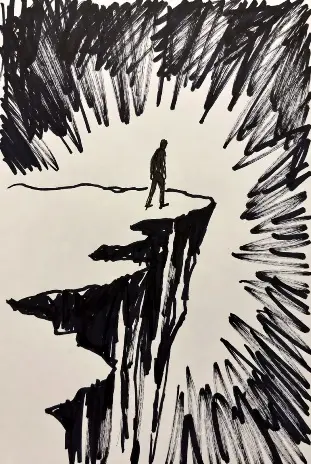
Introduction
Let us approach the subject indirectly, beginning with a series of questions that are rarely asked.
Suppose that the West's habit of concealing, simplifying, and smoothing over much of what has happened to it during the past two centuries has itself become the beginning of its decline.
From this perspective, moral judgment alone becomes one of the greatest forms of intellectual blindness for those who, in a deeper sense, have already ceased to exist. This is precisely what lies behind the remarkable indifference toward primitive moralism displayed by Socrates and those who followed him—those who had already discovered the secret of emptiness.
So, following the tradition so vividly described by George Orwell, let us join everyone else in condemning National Socialism.
But justification is not the question. The real question is different.
Is it still possible to understand what actually happened?
1. Where to Begin
Reducing National Socialism to nothing more than "resentment over a lost war" is one of the flattest intellectual shortcuts of modernity. It allows the "victors" to close the discussion without ever looking into the metaphysical abyss that shaped both the past and the present.
To dismiss that regime as merely a project of revenge is to conceal a more difficult fact: the German political project of the first half of the twentieth century was supported by broad circles of the country's intellectual elite. Germany's defeat in the First World War was not the primary cause. It was a powerful catalyst for intellectual and spiritual currents that had been developing throughout the eighteenth and nineteenth centuries.
Indeed, the German civilizational tradition put forward a claim not simply to political power, but to the reconstruction of the entire West.
2. New Horizons?
If everything can be explained by Versailles, then German National Socialism becomes nothing more than a temporary deviation in political management—an unfortunate historical malfunction. In that case, once the regime was destroyed, the problem was solved, and the West simply continued its journey toward new horizons and a new future for humanity.
But was that really the case? What horizons, exactly? How should we understand the destination that, after 1945, gradually became the accepted model of global civilization? Postmodernity? A civilization of consumers? A civilization approaching its own end?
Why has this particular destination now begun to unfold into what increasingly appears to be the West's own civilizational catastrophe?
What we are witnessing today may be nothing more than the final oscillations of a civilization exhausting its historical momentum—oscillations that could become both the point of collapse of Western humanity and the beginning of a new cyclical age, one that may endure for thousands of years.
3. Three Intellectual Currents
Over the past two centuries, the development of the West has given rise to several major intellectual currents, each competing to define the spiritual future of Western civilization.
- • The Anglo-Saxon current: centered on the world of the market, utilitarianism, contractual relations, the atomized individual, and technological domination—a civilization of "merchants." Its philosophical foundations can be found in British empiricism, utilitarianism, and Darwinism.
- • The Frankish current: emphasized rationalism, legal universalism, administrative order, and the republican framework inherited from Rome and reinterpreted by the Franks. René Descartes represents one of its defining moments: a unique form of rational idealism centered above all on method.
- • The Teutonic current: combined an engineering mentality with a distinctive philosophical imagination. It is visible, for example, in the thought of Goethe. German Classical Idealism emerged as a unique transformation of French rationalism. The intellectual legacy of Sturm und Drang, the critique of purely mechanical reason, and the search for the nature of meaning—or will—find their fullest expression in the works of Schopenhauer and Nietzsche.
Despite their differences, all of these currents were shaped by providential thinking, by the intertwined traditions of Catholicism and Protestantism, by a particular form of cultural discipline, and by what might broadly be called the "Western order"—an order understood, interpreted, and often ridiculed in very different ways across Europe.
Naturally, this is only a conceptual simplification intended to highlight several major trajectories of the Western spirit. It cannot capture the full complexity of Western metaphysical aspirations, including the existential line represented by Dostoevsky, Kierkegaard, Unamuno, and many other thinkers whose work transcends any such scheme.
4. The Limits of Rational Spirit
The formula of the limit is simple: human beings sought to understand reality. But what happens if reality proves fundamentally impossible to understand?
How does one cease to exist merely as a phenomenon and discover oneself as genuine existence—an existence capable, through the power of thought and imagination, of transforming reality itself?
How does one move beyond the predetermined logic of rational causality—a logic that ultimately reveals itself to be both sterile and profoundly limited? It cannot fully comprehend the world it seeks to explain. It is finite. And, like everything finite, it is destined to perish.
What remains once spirit has recognized the limits of its own power?
5. Deep Decadence and the Desire for Self-Destruction
A civilization at its limit becomes a civilization of decadence—a civilization emptied of meaning. A civilization that has lost any reason to continue.
Continue toward what?
Could another wave of positivist modernization—communism, for example—have become a genuine alternative for German intellectual circles? Most likely not. From this perspective, German Social Democracy remained, for many intellectuals, a movement of the social base rather than a response to the deeper spiritual crisis.
Marxism, already perceived by many Western intellectuals as an exhausted instrument of radical modernization, found its historical opportunity primarily in the East, where large parts of society had not yet passed through the full experience of modernization. That world had not yet encountered the dead end that had already become a familiar intellectual reality for many Western thinkers by the nineteenth century.
Spiritually, the positivist West had reached its own meta-limit.
Spirit had become an unnecessary program running inside a biological machine—the Homunculus foreseen by Goethe.
6. Humanity at the Limit: The Blinking Man
In Thus Spoke Zarathustra, Friedrich Nietzsche introduces one of the most prophetic figures in modern philosophy—the Last Man (der letzte Mensch):
"The earth has become small, and on it hops the Last Man, who makes everything small. His race is as ineradicable as the flea; the Last Man lives longest. 'We have invented happiness,' say the Last Men, and they blink."
The Blinking Man represents the metaphysical dead end of the West. He is a being deprived of great purposes, metaphysical depth, and the capacity for creative risk. He seeks only comfort, security, predictability, and small pleasures. He blinks because his horizon has narrowed—to the screen, to the wallet, to the dinner plate.
It was precisely against this Blinking Man that the German spirit, in Nietzsche's thought, revolted. It rebelled against the prospect of becoming a civilization of comfortable ordinary people—a civilization that had lost its history.
7. The Boundary of Spirit and Western Occultism at the Turn of the Twentieth Century
One remarkable expression of this aspiration to transcend limits was the emergence of Western elite occultism. At its core lay the conviction that it was possible to discover a path to "the other side"—the realm where pure meaning resides—and, through that discovery, unlock the hidden structure of reality itself.
Such a breakthrough promised not only the possibility of overcoming mortality but also of expanding the limits that confined spirit within the world of appearances. This explains the growing fascination with Eastern traditions—Hinduism, Buddhism, and other systems of thought that seemed to preserve sophisticated methods of sustaining contact with "the other side."
The Übermensch, in this context, was often understood as one capable not only of crossing into that other realm but also of remaining present within the world of phenomena. The challenge, therefore, was to exist simultaneously in both worlds while preserving a state of pure spirituality—a state believed to reveal dimensions of reality inaccessible to those completely immersed in the ordinary flow of life. From this perspective, creative activity itself—or profound contemplation, whether philosophical, mathematical, or musical—was understood as an attempt to suspend ordinary consciousness and preserve this state of purity.
If one radically simplifies this vast intellectual experience, its central intuition can be expressed as follows:
once a person reaches this pure state, once one enters Plato's world, everything suddenly becomes intelligible. Such insight would grant not only profound knowledge but also extraordinary power—including technological power.
8. Expectation: Not Hysteria but Mystery — Heidegger and Eleusis
National Socialism is often explained as an outbreak of mass hysteria, collective psychosis, or political madness. Such explanations, however, do little to illuminate its deeper nature. If millions of people became participants in a single historical movement, a more fundamental question arises: what were they actually seeking?
By the late nineteenth and early twentieth centuries, Europeans found themselves in a world where the old foundations were rapidly losing their authority. The old order was collapsing. It is precisely for this reason that so many political movements of the period acquired an almost religious character. They began to speak the language of destiny and offered people not merely a political program, but participation in an event that promised to transform the very structure of what we have called the world of the end.
The Eleusinian Mysteries of ancient Greece provide an illuminating parallel. Through ritual, symbolic death, and sacred madness, the initiate entered into direct contact with what lay beyond ordinary existence—with the chthonic foundations of the cosmos. This was not regarded as insanity. It was understood as a legitimate sacred technology for the transformation of consciousness.
Now consider Heidegger's Black Notebooks. What he perceives is not a "psychosis of the masses," but a metaphysical event—Ereignis (the Event of Being itself)—an attempt to break through Seinsvergessenheit (the forgetfulness of Being) and the domination of Ge-stell, the technological enframing of reality.
At this point, we move from hysteria to mystery. Suppose that the German spiritual revolt at the end of the nineteenth century was, at its deepest level, an attempt to recover forgotten roots and a lost tradition—to wrest them back from the approaching flatness of an industrial civilization approaching its end. Yet instead of a genuine mystery, something entirely different emerged: social engineering, biological Darwinism, and the party functionary.
9. The Last Manifestation of the German Spirit and the Utilitarian Dead End of the West
What followed almost erased the memory of the great tradition of German Romanticism. Several centuries of profound reflection—from Meister Eckhart to Jakob Böhme—and the aspiration to reunite the human being with the Mystery of Spirit were transformed into museum philosophy and ultimately removed from the sphere of living practice.
German National Socialism did, in fact, succeed in capturing the wave of this spiritual tension. Yet having captured it, it was able to transform it only into another variation of positivist party Darwinism—another form of utilitarian socialism, sustained by yet another dose of soma, while remaining trapped within the same Western positivist dead end.
But what, then, is the opposite of this existential orientation?
It is embodied in the Anglo-Saxon utilitarian tradition, where the human being is understood merely as an accidental phenomenon, reducible to pleasure, success, practical problem-solving, and economic efficiency.
It is precisely this type of human being that has become the norm of contemporary Western culture. A revealing illustration is the television series Dark Matter (2024), where the central focus is no longer the human being himself, but the decisions he makes and the consequences that follow from them.
But where, in such a worldview, is the existential dimension—the integral presence of the human being, not as a contingent phenomenon, but as a metaphysical co-event (co-being)?
10. The Metaphysical Condition of the West
Questions of moral condemnation or humanitarian dogmas—"the master race," "subhumans," and similar ideological constructions—have little to do with the metaphysical question or with the collapse of reality itself. It is precisely this deeper problem, I would argue, that deserves our attention, because it is both more fundamental and more intellectually significant.
If our aim is to understand the nature of the dead end into which Western civilization has entered, two observations become unavoidable:
- • The Secret of Spirit—and Its "Revelation." Within contemporary Western thought, particularly in the humanities, spirit itself has gradually come to be understood as merely another phenomenon among phenomena. Like everything else, it is treated simply as an object appearing within the field of Being. This is the meta-limit of rational consciousness: a boundary that reason itself can neither transcend nor comprehend. At this point, we unexpectedly find ourselves returning to the insights traditionally associated with the Buddha, who recognized the entire realm of appearances as appearance. Modern science, despite the sophistication of its methods, has not even approached the depth of that realization.
- • But what, then, is reality itself? If we set aside the comforting narratives of post-structuralism—Niklas Luhmann, Michel Foucault, and others—as well as the countless simulations of postmodern discourse, and instead turn to Physics and Philosophy by Werner Heisenberg, we encounter once again an indeterminate boundary that rational thought is unable to penetrate. In this respect, our intellectual position remains suspended somewhere between Democritus and Plato. Despite centuries of scientific and philosophical development, we may not have advanced, in any essential sense, beyond the fundamental question itself.
This is precisely the metaphysical condition of the contemporary West: immense technical power coupled with an inability to answer the simplest question—what is it that actually is?
11. The Normal State of the End
Postmodernity is a condition of completion—a condition in which the metaphysical search has been replaced by the efficient management of flows: informational, financial, and biological. It is a state of complete technical futility, where the question of the meaning of Being has disappeared, replaced by the accidental, the episodic, and the fragmented.
Such is the nature of ontological collapse. Friedrich Nietzsche's Last Man is the final product of Western civilization: a human being who has ceased to struggle. But what remains to struggle for once the limit has been reached—or simply forgotten?
There are no longer any historical tasks. A handful of ecological simulacra. A little intellectual emptiness produced by those who still call themselves intellectuals. And above all, the triumphant ordinary individual, no longer living within historical time, but existing instead within the cyclical time of completed comfort.
The dream has died.
What comes next?
12. The Edge of the Limit
Dream is not an ordinary desire. It is not the pursuit of profit, success, or material gain. It is the aspiration to transcend the finitude of manifested and enclosed spirit. It is this dream that enables spirit to break free from the futility of everyday existence.
It was precisely this dream of the boundless—the longing for an unknown horizon, for a passage beyond one's own limit, embodied in the figure of Odysseus—that became one of the driving forces behind the entire modernization of the West, beginning with the ancient Greeks.
This was never a dream of utility. It was the dream of the infinite striving of spirit—a spirit that, upon reaching the very edge of the limit, unexpectedly discovers meaning. The great Western novel of the modern age is fundamentally about this. In many respects, so is the entire historical civilization of the West, beginning with the wanderings of the king of Ithaca.
The edge of the limit stands at the very center of Greek tragedy.
It is here that death always overcomes life, while life compels death to reveal life itself. It is here that life encounters the limit of death and, in astonishment, awakens into what might be called the true state of awakening from ordinary existence. Only this total rupture with normality becomes Dream—or, more precisely, the reason to continue.
Only at this edge does spirit recover its proper nature within a world enclosed by its own limitations. Only here does it discover its boundless freedom, not through movement, but through a peculiar stillness—a suspension at the limit itself.
This experience of being simultaneously torn away from ordinary reality and brought into complete stillness is the outcome of profound contemplation. It is in such moments that the human spirit encounters freedom and becomes capable of genuine discovery. Great literature, sustained contemplation of mathematical truth, metaphysical reflection, participation in a theatrical mystery, listening to a powerful musical composition, or standing before a great painting can all become paths toward such an experience.
Yet there are also moments when this integral experience belongs not merely to an individual but to an entire civilization. There are historical epochs in which the Apollonian world suddenly confronts the reality of Dionysus—a force that, with a single blow, shatters every ordinary certainty, every established normality, bringing an entire civilization to the edge.
And beyond that edge...
There is only the Limit.