
Стратегический консалтинг. Видение «трех типов управления», через призму управления бизнесом (MBA)

https://rusnak.link

🌐 This article includes an English version at the end.

Rusnak, A. (2025). Strategic Consulting: A Vision of Three Types of Governance Through the Prism of Business (MBA). https://doi.org/10.5281/zenodo.17721459


  1. РАСПРЕДЕЛЕНИЕ КОМПЕТЕНЦИЙ

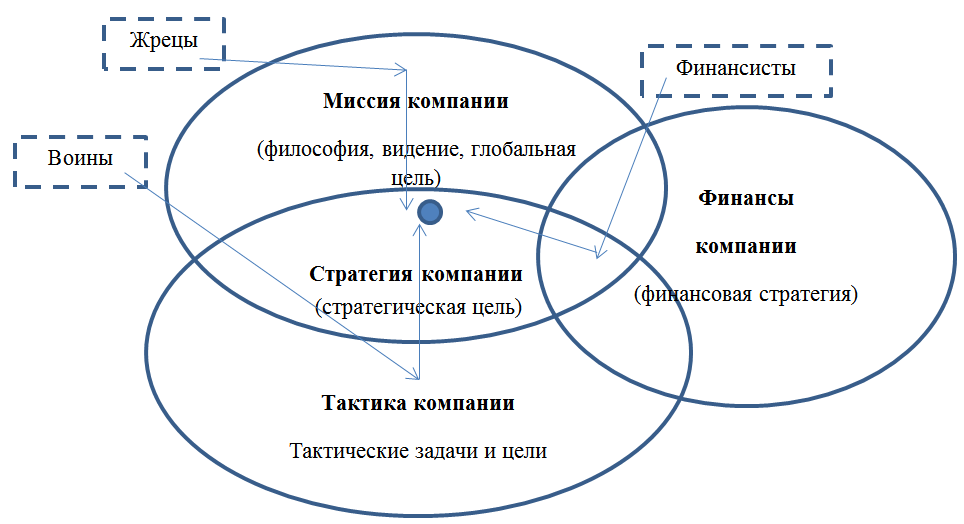
В схеме нет тех, кто «сверху», и тех, кто «снизу». Присутствуют только зоны ответственности, а далее происходит процесс организации положительного производства.
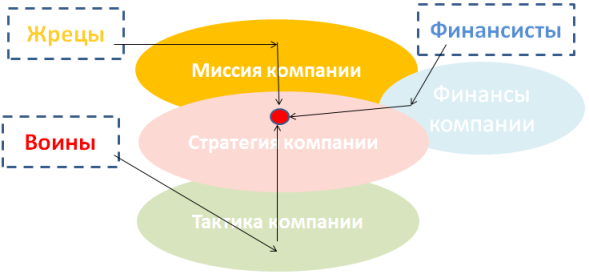

Но разве воины или финансисты могут заниматься «верхней частью» стратегического конструирования? Существует мнение, что разговоры про «миссию» — это благостная высокопарная говорильня, но так ли это на самом деле? Или в действительности вопросы, связанные с тем, чем должны заниматься «жрецы», вынесены в отдельно существующие от компании органы?

Оценивая «миссию компании» и связанные с ней аспекты стратегии, стоит предположить, что подобное — компетенция кого-то «кто вне управления», иногда владельцев, но не CEO. Причем CEO, преимущественно, обязаны быть воинами, немного жрецами и финансистами.

То есть «смысловое» находится в границах компетенции «жреческого сообщества», которое не мыслит сугубо категориями позитивного, командно-административного или финансового мышления.
Различие между жреческим сообществом и философским собранием можно посмотреть по ссылке [i].


2. ЗОНЫ КОМПЕТЕНЦИИ
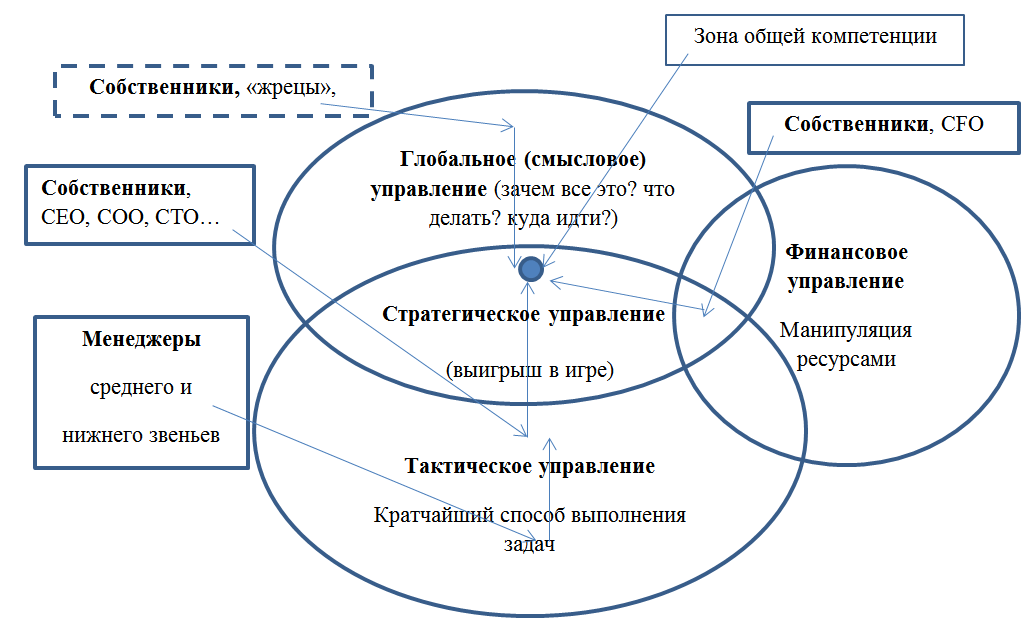
Стратегия компании — это эффективное участие в отрасли для достижения первого места: «остаться должен только один». И когда речь идет о более значительных субъектах, то «подобное целевое» может быть чем-то иным или значительно игровым.

Но в любом случае основной «характеристикой стратегии» остается мысль, которая будет связана с вопросом «первого места», победой в игре, достижением абсолютного превосходства над всеми остальными участниками.

При этом извлечение максимальной прибыли, маржа, положительный денежный поток, объем продаж, нарастающая рентабельность активов и другое — это всё сумма ключевых показателей «определяющих эффективность» сконструированного игрока. Но всё это на самом деле не является тем, для чего всё это существует на самом деле.

«Извлечение прибыли» и «денежный поток» — это только «пыль на сапогах идущего», но «куда идущего?» И если это «куда?» станет ложным, недействительным, ошибочным, то «идущего в никуда» ждет катастрофа, развал, разгром, поглощение. Поэтому «показатели» — это всегда что-то вторичное. То есть никакой пост-анализ, никакие аналитические выводы не позволяют воспроизвести на свет ответы-решения: «что делать?», «куда идти?», «зачем это всё?», «каковы его перспективы?», «что происходит?»

Стратегическое и тактическое управление. Основная задача менеджеров компании — это производство управленческой деятельности для достижения глобальной цели и стратегических преимуществ, а также это эффективное решение различных тактических задач.

И все вышеуказанное «управление» предполагает постоянный поиск оптимальных и технологических решений. Всё нацелено на максимальную эффективность и производительность.

Но эффективность на различных уровнях (тактика, стратегия и глобальное видение) — совершенно иная, что предполагает и несколько иное воплощение.

3. ОТСУТСТВИЕ «ЖРЕЦОВ» ИЛИ ЭКОНОМИЧЕСКАЯ ПЕРИФЕРИЯ
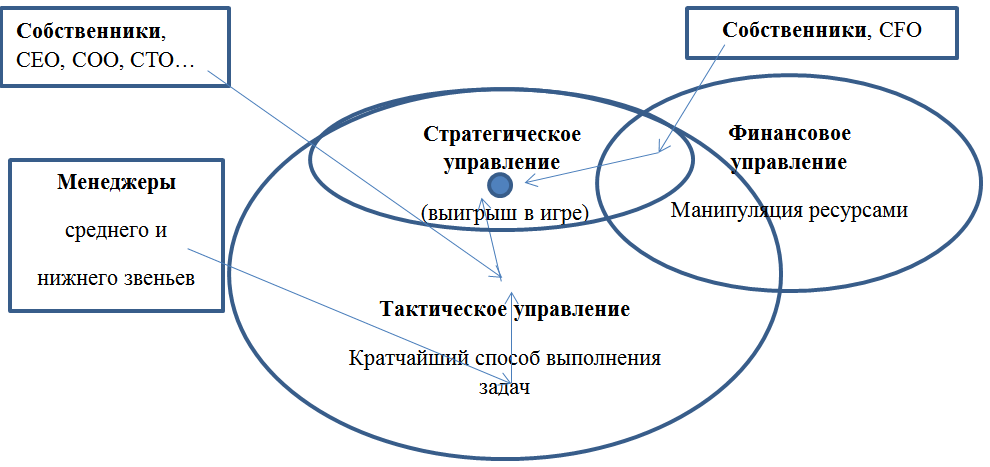
Усечённый вариант может не предполагать смыслового управления.

«Жрецы», в большинстве компаний, по разным причинам, отсутствуют. Предположим, что они наличествуют в глобальных корпорациях или, вообразим, что подобная функция обеспечивается внешними структурами.

Возможно, «функцию жреца» может выполнять основатель или собственник, но для этого он должен быть наделён способностью к особому целостному мышлению.

И в качестве начала подобного целевого, можно предположить обнаружение уникального технологического решения, нового продукта, глобальной услуги или чего-то подобного, вокруг чего и будет выстроен экономический целевой субъект.

Но сам по себе «продукт» — не позволит обратить происходящее в значительную практику, и тут всегда необходим эффективный менеджмент, маркетинг и другое сопутствующее и обеспечивающее.

ЗАМЕЧАНИЯ

Необходимо предположить, что сама среда, то, что в современности можно было бы обозначить словосочетанием «протестантское мировоззрение», уже в определённой мере руководит внутренним целеполаганием для всего собрания участников.

Ответами на глобальный вопрос «что делать? куда идти? зачем всё это?» могут быть «незачем, некуда, ни для чего». При этом подобное вопрошание — это обязательный постоянный труд, без которого всё это схваченное начинает терять смысл и «сходит с ума».


Strategic Consulting: A Vision of Three Types of Governance Through the Prism of Business (MBA)

Author: Alexey Rusnak; https://orcid.org/0009-0002-9021-5429

Abstract (short version)

This paper proposes a conceptual model of three fundamental types of governance in business: sacerdotal (strategic-vision), warrior (managerial/operational), and financial/resource governance. It argues that each type plays a distinct but complementary role — the sacerdotal layer provides long-term vision and existential meaning, warrior governance organizes processes and ensures performance, while financial governance manages resources and economic outcomes. Financial results (profit, cash flow, profitability) are considered secondary: they reflect the chosen path, but are not its goal. The model emphasizes distributed responsibility, purposeful goal-setting, and continuous reflection on purpose as essential for organizational sustainability — without them, a company may lose direction, collapse, or be absorbed.

This English version is a shortened and AI-translated adaptation of the author’s original Russian article.

Keywords: Strategic consulting; Corporate governance; Business management; Sacerdotal–warrior–financial governance; Strategic vision

Abstract (extended version)

This paper develops a conceptual model of three fundamental and complementary types of governance in business organizations: sacerdotal (strategic-vision), warrior (managerial/operational), and financial/resource governance. The model challenges the conventional hierarchical view of corporate structure and instead interprets the organization as a network of differentiated zones of responsibility, each grounded in distinct competencies and cognitive roles.

The sacerdotal governance layer formulates existential meaning, long-term orientation and the overarching purpose of corporate activity — the “why” and “where to”. The warrior level translates this direction into practical action, ensuring discipline, operational effectiveness and competitive advancement. The financial level secures and optimizes resources, evaluates performance and reflects the economic results of the chosen course.

Within this framework, financial outcomes such as profit, cash flow and profitability are not the objective of the organization, but rather indicators of whether the chosen strategic vision is being effectively realized. When meaning, direction and goal-setting are neglected, the organization risks losing its trajectory, becoming vulnerable to decline, market absorption or structural collapse. Therefore, continuous reflection on purpose, distributed responsibility and alignment across governance types are argued to be essential conditions of sustainable corporate development.

1. Distribution of Competencies

In this scheme, there is no “above” and “below”. There are only zones of responsibility, and then unfolds a process of organizing positive production.

In other words: first comes the production of something mental — vision, purpose — and only afterwards concrete management. Concrete, positive production at all levels — up to the last involved “production” link.

But can warriors or financiers engage in the “upper part” of strategic construction? There is a view that talk about a company’s “mission” is nothing but pious, lofty rhetoric — but is that really so? Or in reality the issues related to what the “priests” should do are entrusted to separate bodies, distinct from the company?

Evaluating a company’s “mission” and related strategic aspects, one should assume that this is the competence of someone “outside management”, sometimes the owners — but not the CEO. And the CEO must primarily be a warrior, slightly a priest, and a financier.

That is: the “meaningful” lies within the competence of the “priestly community”, which does not think purely in terms of production, command-administrative or financial thinking.

2. Zones of Competence

Corporate strategy — effective participation in an industry to achieve first place: “only one must remain”. And when it is about larger actors, that “target goal” may be something else, or significantly more game-like.

But in any case, the main characteristic of strategy remains the idea associated with the question of “first place”, victory in the game, achieving absolute superiority over all other participants.

At the same time, extracting maximum profit, margin, positive cash flow, sales volume growth, increasing return on assets and other key indicators of “effectiveness” of the constructed player — all this actually is not what everything exists for.

“Profit extraction” and “cash flow” — this is only “dust on the boot of a walking one” — but “where to walk?” And if this “where?” becomes false, invalid, mistaken, then the “walker into nowhere” faces catastrophe, collapse, defeat, absorption. Therefore metrics are always secondary. No post-hoc analysis or analytics can by themselves generate answers — “what to do?”, “where to go?”, “why all this?”, “what are its prospects?”, “what is happening?”

3. Absence of “Priests” or Economic Periphery

A truncated variant may not imply meaningful governance. In many companies “priests” are absent, for various reasons. Suppose they exist in global corporations, or imagine that this function is provided by external structures. Perhaps the “priestly function” may be performed by the founder or owner — but for that he/she must be endowed with special holistic thinking.

As a starting point of such a purposeful structure one can assume the discovery of a unique technological solution, a new product, a global service — something around which an economic target-subject will be built. But in itself a “product” will not allow turning this into significant practice; there always will be needed effective management, marketing and other accompanying ensuring functions.

But it is also necessary to assume that the environment — what today could be called a “Protestant worldview” — already to some extent guides internal goal-setting for the entire ensemble of participants.

Answers to the global questions “what to do? where to go? what for?” may be “nowhere, nowhere, for nothing.” Meanwhile such questioning is an obligatory constant work — without it everything captured loses meaning and “goes mad”.

REMARKS

It should be assumed that the environment itself — what in modern terms could be described as a “Protestant worldview” — already to some extent directs the internal goal-setting for the entire community of participants.

The answers to the global questions “what should be done? where should we go? what is all this for?” may turn out to be: “for nothing, nowhere, for no reason.”

Yet such questioning is a necessary and continuous effort, without which everything that has been grasped begins to lose its meaning and “go insane.”


Rusnak, A. (2025). Strategic Consulting: A Vision of Three Types of Governance Through the Prism of Business (MBA). https://doi.org/10.5281/zenodo.17721459

CC BY-NC 4.0 — Creative Commons Attribution–NonCommercial 4.0 International

© Rusnak Alexey, 2025 https://rusnak.link


На главную