Ontological Sleep
Ontological Fog and the Sleep of Constructionism
rusnak.link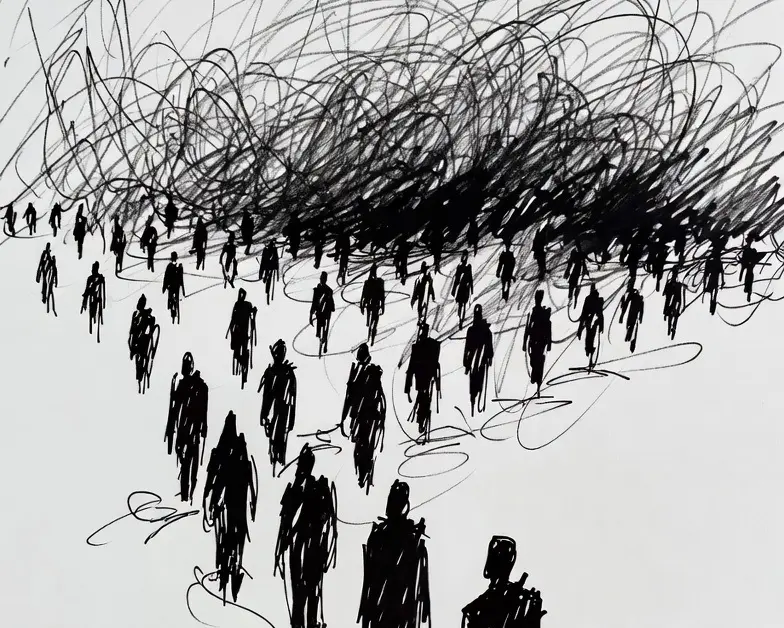
1. Concreteness, not abstraction
A collapsing world is a world in which the demographic core has been destroyed: there is no one left to continue, no one left to work, and no continuity of life as a social and material process.
For a human being, reality emerges only through actual presence. Without such presence, nothing is given at all.
Every instance of presence is singular. The sum of concrete presences does not form a repeatable pattern and cannot be reduced to a stable invariant or abstraction.
Claims that “all people are the same” can only be sustained within systems of averaging. This sameness exists only as an effect of abstraction, for example:
- equality before the law,
- equality in structural life conditions—birth, maturation, death,
- equality in the face of catastrophic events that unfold beyond control and destroy all human projects indiscriminately.
Thus, equality is not an ontological fact. It is a concept.
When we are dealing with concrete presences, we are dealing with one kind of reality. When we are dealing with generalized abstractions of people, we are dealing with another.
2. Words as constructions
Concepts such as atom, time, politics, society, economy, organization, and so on are not given directly in reality. They are constructed—assembled conceptual frameworks imposed on a more primary field of humanly encountered things and living persons.
There is, on the one hand, the world of differentiated objects as humans isolate and name them, within which living human beings also participate. On the other hand, there are conceptual structures that organize and interpret this field.
Those who are not familiar with ontological differentiation do not grasp how it works. They cannot distinguish between the way concepts exist as constructions and the way concrete reality unfolds. As a result, they remain within ordinary object-based thinking—effectively immersed in a kind of fog.
In practice, almost everyone is in this fog.
This is not a matter of secret knowledge, whether esoteric or exoteric. The issue is simpler: a lack of capacity to distinguish between constructions and what actually occurs.
And here it is important to emphasize: this is not merely “what happens” in the everyday sense, but occurrence itself at the level of reality.
3. Instrument of dispersion
The dispersion of ontological fog is, in its primary form, the task of philosophy—understood here as a practice that includes thinking about thinking itself.
The philosophy of the Greeks (and similar traditions in other civilizations) was never a mass discipline. It was not designed to be universally taught or widely distributed.
Its aim was not simply to help people “understand the world,” nor to establish ultimate foundations of knowledge, nor to serve as a precursor to modern science. These are secondary outcomes. They are only fragments of a deeper operation: a clarification of what is actually taking place.
At its core, philosophy functions as an initial dispersion of ontological fog.
This is not a matter of agnosticism or any other epistemological label commonly used in ordinary thinking. Nor is philosophy reducible to abstract or ornamental wisdom.
When its role as a practical instrument is understood in this way, it becomes clear why, in the modern period, philosophy was preserved and transformed within 19th-century university systems—particularly in German, French, and English intellectual traditions.
4. Degradation
As a result of the development of positive science and the simultaneous decline of philosophy as a practice—its reduction to ordinary knowledge among other forms of external information—philosophy ceased to be what it had been for practitioners of earlier epochs.
At the same time, the average participant in the era of mass production, industrialization, and the formation of standardized national structures governed by a new class of administrators and professionals—engineers, managers, and scientists—was no longer capable of engaging with this practice.
5. Positivism as a superstructure
Scientific thinking and other forms of positivism function as a superstructure built upon ordinary everyday cognition.
Positivism is unable to distinguish between constructions and what actually occurs. Within a positivist framework, constructions are treated as identical with reality.
However, once thought is reduced to operating only through constructions, it becomes possible to manipulate and mislead without limit. In such a condition, it is impossible to exit the state of fog from within the very structures that produce it.
This is not because of some exceptional difficulty, but because ordinary cognition, in its drive toward knowledge, typically captures only a fragment of scientific positivism and then assumes that this fragment represents the entirety of knowledge and the upper limit of human understanding.
As a reaction to this dead end, a form of weak esotericism emerges. It recognizes the limitations of positivism but continues to operate within its constructive methods, generating alternative entities and speculative systems, thereby offering a different version of “limit thinking” to a disappointed public.
Of course, a scientist operating within a positivist framework may understand how a nuclear reactor is structured, how a regional economy functions, or how a given mathematical domain is organized, but…
6. The sleep of constructionism
But the fact that all of this consists only of constructions remains hidden from an undifferentiated consciousness.
And the fact that everything exists “in some unknown way,” rather than as a construction, remains unresolved within the limits of ontological fog.
7. Onto-practice
For differentiation to occur, it is necessary to perform a set of practices that, taken as a whole, do not constitute “essential knowledge” in the usual sense.
Without such practices, one remains either an ordinary person or a positivist-ordinary person who assumes that what they know as a “teaching about something” is identical with what actually occurs.
Differentiation as practice is therefore not simply a matter of asserting that “this is not the case.” It involves maintaining a continuous sensitivity to the unstable character of presence itself.
The notion of undifferentiated consciousness (Ununterschiedenheit, Indifference), as well as the seriousness of thought, can be found in Hegel, Kojève, and other thinkers.
8. Always fog
The world of the ordinary person is ontological fog.
Ontological fog—and, beyond it, metaphysical sleep.
And yes, those who remain in ontological sleep can be misled indefinitely.
Recommended literature
- Hegel — Who Thinks Abstractly?
- Hegel — Phenomenology of Spirit
- Hegel — Science of Logic
- Heidegger — Being and Time
- Sartre — Being and Nothingness
- Kojève — Introduction to the Reading of Hegel
- Gilles Deleuze — Difference and Repetition
- Foucault — The Order of Things
- Husserl — The Crisis of European Sciences and Transcendental Phenomenology
Films
- The Leopard (Il Gattopardo), dir. Luchino Visconti, Italy–France, 1963