
1. Introduction
Strategic consulting often focuses on data, markets, and resources, yet beneath these measurable layers lies a deeper structure — the logic of management types.
Every management system combines elements of sense-making, enforcement, and resource distribution. The present framework identifies and analyzes three ideal types of management — priestly, warrior, and financial-economic — as fundamental modes of governance.
2. The Three Archetypes of Management
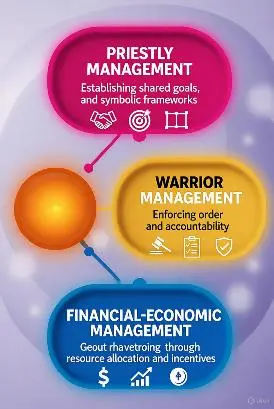
2.1 Priestly Management
The priestly type governs through meaning and collective belief. It establishes shared goals, narratives, and symbolic frameworks that orient participants toward a common direction.
- Domain: Vision creation, ideology, and cultural alignment.
- Risk of Absence: Loss of purpose and systemic coherence.
2.2 Warrior Management
The warrior type governs through discipline and execution. It transforms meaning into action by enforcing order, setting measurable objectives, and ensuring accountability.
- Domain: Operational strategy and structured activity.
- Risk of Absence: Disorganized, purely theoretical efforts.
2.3 Financial-Economic Management
The financial-economic type governs through resource allocation and incentives. It manipulates quantitative abstractions — budgets, profits, and investments — to regulate behavior.
- Domain: Material consequences and quantitative regulation.
- Risk of Absence: Loss of sustainability and growth potential.
3. Integration and Balance
A functional management system requires all three types. When one archetype dominates at the expense of others, systemic distortions inevitably arise:
- Excessive priestly influence creates ideological rigidity and detachment from reality.
- Dominant warrior control leads to bureaucratic coercion and creative stagnation.
- Overextended financial-economic logic reduces complex human meaning to mere profit.
Strategic consultants and organizational leaders must therefore integrate these dimensions into a coherent model of governance. This integration maps directly onto the fundamental questions of existence:
The dynamic equilibrium between them defines both the resilience and ethical integrity of an institution.
4. Practical Implications for Strategic Consulting
Diagnose imbalances within existing management systems.
Identify which of the three components — symbolic, operational, or economic — requires reinforcement.
Design strategies that unite values, coordination, and resource flows into a single coherent architecture.
Anticipate organizational risks stemming from one-dimensional management (e.g., profit-only or command-only cultures).
5. Conclusion
The proposed typology — priestly, warrior, and financial-economic management — expands the conceptual vocabulary of strategic consulting.
It reframes management as a synthesis of meaning, force, and value, requiring continuous balance rather than domination of one element. Sustainable governance emerges only when these three powers coexist in dynamic integration, shaping both human motivation and structural efficiency.