The Metaphysical Act of Overcoming and Unfolding
The metaphysical act of overcoming is a rupture of existing closure and the capacity of the spirit to exceed the givenness of a conditioned world, realizing what does not follow directly from its causality.
rusnak.link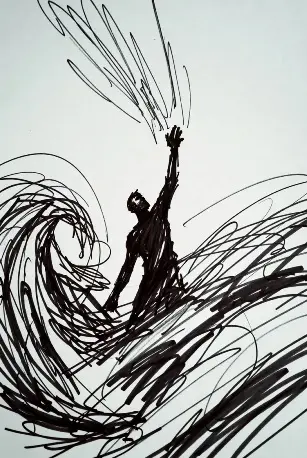
1. The Act of Overcoming and the Rupture of Closure
The act of overcoming is something that makes it possible to break through an existing closure. The act of overcoming is the possibility for the spirit to accomplish what was not originally intended for it.
An existing path may involve movement in the direction of overcoming difficulties. A path consists not of a single act, but of daily efforts — acts of will that sustain a constant movement “forward” toward final realization.
The act of overcoming is when 2 + 2 does not equal 4, but something that makes it possible to exceed a closed givenness or to break out here “from the other side” of that which contradicts closure. Only the spirit is capable of overcoming the so-called law of conservation of energy — of conditioned causality — which makes it possible to move in any direction, perform any actions, and realize itself in any manner, following an unknown command. And hence its metaphysical character, or the capacity to “exceed the arithmetic” of the world of non-thinking, while always remaining connected to that other side.
2. The Spirit and Its Unconditioned Unfolding
The act of overcoming is what happens to the human spirit when it suddenly becomes itself (a whatness-being, that is, an act with existence, whereas nothingness is existence without an act, yet still existence, and therefore nothingness as well can be noticed as some kind of realization).
The question remains a mystery: was there someone who was the first to carry out an act of overcoming?
And what is the very growth of the spirit, its development from an embryonic state, followed by its constant becoming? A process occurring together with the body? Closure upon society? But the spirit derives ethics from itself, not from society, not from the images shown to it, but through its own unfolding. As one matures, shame and understanding suddenly arise without any visible cause. And those who observed development noticed that practice for the developing being accounts for 0.1%, while its “unconditioned unfolding from the other side” accounts for 99.9% of its capacities. That is, society is secondary: it will be the outcome of the work of particular spirits — but without them, what kind of society would there be? Or would it simply be one corresponding to the whatness-beings that are present?
3. Mentality, Heredity, and Conditionedness
And yes, genes and blood do matter in the question of unfolding. It does not matter what universalists may claim, for whom mentality is a sum of formally logical operations that are universal and supposedly reveal the spirit. The abstract operations of the mind revealed through any addition and subtraction (any schematism, Boolean algebra, constructionism, including IQ testing) are only the upper layer of operational capacities (the analytical mind), essentially useless in ordinary life and hardly characterizing the strength of intelligence.
In fact, every mentality is unique and hereditary, just as every part of our body and all the diseases inherited from our ancestors are. Hence, the question of inheritance becomes less universal than those who claim that “every atom in the Universe is not unique” would have us believe. This is merely a weak ideology. In reality, everything is unique and hereditary, as are the properties of the unfolding of that which we can define by the word “mentality” (something about the importance of heredity can be found in C. G. Jung’s Memories, Dreams, Reflections).
Therefore, the unfolding of mentality, its particular properties, the understanding of shame, pride, honor, and honesty, the strength of spirituality, vitality, as well as many specific characteristics of intelligence — all of this is unique, but also conditioned. If a person with one mentality is placed in a society with an entirely different one, the difference will become obvious to the practitioner. And the matter here is not upbringing or culture...
And conditionedness is what will arise afterward; it will be determined by interaction with the environment, with another mental being. Yet in any case, the basic characteristics are something that arises as a fact of origin.
4. Potential and the Realization of the Spirit
And the act of overcoming, as unfolding, is always some kind of potential. But will this potential be realized? How is it to be realized? How is it to be unfolded?
How can one avoid the traumas and attacks of those who will attempt to alter the path or suppress a significant capacity for the unfolding of whatness-being, which, through the power of intelligence (light), illuminates significant spaces of meaninglessness?
At the same time, without forgetting the connectedness to nothingness, being this nothingness which, like a wave of serenity spread out everywhere, extinguishes all shocks and blows, returning us after sleep to a new beginning of the path. And what does it mean to know how to use one’s nothingness-being?
5. Whatness, Nothingness, and Immersion
And the question always remains open: how is the act of overcoming connected with the world of whatness? How does constant immersion in nothingness exist? What comes from there; is nothingness the same for everyone, is it universal (common to all), or not? And what is this immersion? And what lies beyond nothingness? What is immersion in a field of meaning, or not only meaning? And why can something different come from there, and why can different things be discovered there?
What do animus and anima mean in this context in C. G. Jung? In the context of whatness and nothingness, one can consider Heidegger’s Being and Time and Sartre’s Being and Nothingness.
Recommended Reading
1. Jung, C. G. Memories, Dreams, Reflections.
2. Jung, C. G. The Development of Personality.
3. Sartre, J.-P. Being and Nothingness: An Essay on Phenomenological Ontology [L’Être et le Néant: Essai d’ontologie phénoménologique].
4. Heidegger, M. Being and Time [Sein und Zeit].
5. Heidegger, M. What Is Metaphysics?.
6. Zhuangzi. The Butterfly Dream. In: Zhuangzi: Philosophical Treatises. Vostlit. [The Butterfly Dream]