
Rusnak, A. (2025). Strategic Consulting: A Vision of Three Types of Governance Through the Prism of Business (MBA). Zenodo.
 0009-0002-9021-5429
Abstract (extended version)
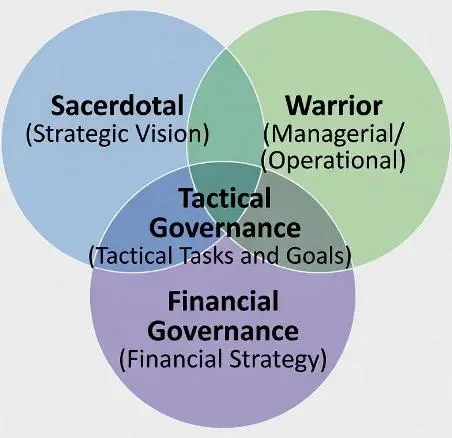
This paper develops a conceptual model of three fundamental and complementary types of governance in business organizations: sacerdotal (strategic-vision), warrior (managerial/operational), and financial/resource governance. The model challenges the conventional hierarchical view of corporate structure and instead interprets the organization as a network of differentiated zones of responsibility, each grounded in distinct competencies and cognitive roles.
The sacerdotal governance layer formulates existential meaning, long-term orientation and the overarching purpose of corporate activity — the “why” and “where to”. The warrior level translates this direction into practical action, ensuring discipline, operational effectiveness and competitive advancement. The financial level secures and optimizes resources, evaluates performance and reflects the economic results of the chosen course.
Within this framework, financial outcomes such as profit, cash flow and profitability are not the objective of the organization, but rather indicators of whether the chosen strategic vision is being effectively realized. When meaning, direction and goal-setting are neglected, the organization risks losing its trajectory, becoming vulnerable to decline, market absorption or structural collapse.
Keywords: Strategic consulting; Corporate governance; Business management; Sacerdotal–warrior–financial governance; Strategic vision
1. Distribution of Competencies
In this scheme, there is no “above” and “below”. There are only zones of responsibility, and then unfolds a process of organizing positive production.
In other words: first comes the production of something mental — vision, purpose — and only afterwards concrete management. Concrete, positive production at all levels — up to the last involved “production” link.
But can warriors or financiers engage in the “upper part” of strategic construction? There is a view that talk about a company’s “mission” is nothing but pious, lofty rhetoric — but is that really so? Or in reality the issues related to what the “priests” should do are entrusted to separate bodies, distinct from the company?
Evaluating a company’s “mission” and related strategic aspects, one should assume that this is the competence of someone “outside management”, sometimes the owners — but not the CEO. And the CEO must primarily be a warrior, slightly a priest, and a financier.
That is: the “meaningful” lies within the competence of the “priestly community”, which does not think purely in terms of production, command-administrative or financial thinking.
2. Zones of Competence
Corporate strategy — effective participation in an industry to achieve first place: “only one must remain”. And when it is about larger actors, that “target goal” may be something else, or significantly more game-like.
But in any case, the main characteristic of strategy remains the idea associated with the question of “first place”, victory in the game, achieving absolute superiority over all other participants.
At the same time, extracting maximum profit, margin, positive cash flow, sales volume growth, increasing return on assets and other key indicators of “effectiveness” of the constructed player — all this actually is not what everything exists for.
“Profit extraction” and “cash flow” — this is only “dust on the boot of a walking one” — but “where to walk?” And if this “where?” becomes false, invalid, mistaken, then the “walker into nowhere” faces catastrophe, collapse, defeat, absorption.
Therefore metrics are always secondary. No post-hoc analysis or analytics can by themselves generate answers — “what to do?”, “where to go?”, “why all this?”, “what are its prospects?”, “what is happening?”
3. Absence of “Priests” or Economic Periphery
A truncated variant may not imply meaningful governance. In many companies “priests” are absent, for various reasons. Suppose they exist in global corporations, or imagine that this function is provided by external structures.
Perhaps the “priestly function” may be performed by the founder or owner — but for that he/she must be endowed with special holistic thinking.
As a starting point of such a purposeful structure one can assume the discovery of a unique technological solution, a new product, a global service — something around which an economic target-subject will be built. But in itself a “product” will not allow turning this into significant practice; there always will be needed effective management, marketing and other accompanying ensuring functions.
But it is also necessary to assume that the environment — what today could be called a “Protestant worldview” — already to some extent guides internal goal-setting for the entire ensemble of participants.
Answers to the global questions “what to do? where to go? what for?” may be “nowhere, nowhere, for nothing.” Meanwhile such questioning is an obligatory constant work — without it everything captured loses meaning and “goes mad”.
REMARKS
It should be assumed that the environment itself — what in modern terms could be described as a “Protestant worldview” — already to some extent directs the internal goal-setting for the entire community of participants.
The answers to the global questions “what should be done? where should we go? what is all this for?” may turn out to be: “for nothing, nowhere, for no reason.”
Yet such questioning is a necessary and continuous effort, without which everything that has been grasped begins to lose its meaning and “go insane.”
Conceptual Analysis Nodes
The KPI Trap
Focusing exclusively on financial metrics is equivalent to managing the 'dust on the boots.' Without the strategic question 'Why?', any profitable system moves toward absorption or decay.
Externalization of Meaning
Modern companies often bracket out the 'sacerdotal' function, delegating it to external structures or relying on the inertia of a global worldview (e.g., Protestant ethic), which diminishes their institutional subjectivity.
CEO as a Universal Soldier
The effective leader in the MBA system is a synthetic subject: 70% warrior, 20% financier, and only 10% priest, which limits the capacity for radical strategic maneuver.
FAQ: Vision and Competencies
Can a financier become a strategist?
Only on the condition of moving beyond quantitative thinking. Strategy is a qualitative thought regarding superiority, which cannot be calculated by mere post-analysis of figures.
What is the difference between tactics and global vision?
Tactics solve the question of operational efficiency (how to do it better); global vision solves the question of existential presence (why we are even here).
What is 'economic periphery' in the context of sacerdotal roles?
It is a state of the system where management is reduced to servicing external meanings and technologies. True sacerdotal leadership is having a unique product or idea that changes the rules of the game.