The Problem of Truth and Postmodernity: Questions of Foundations
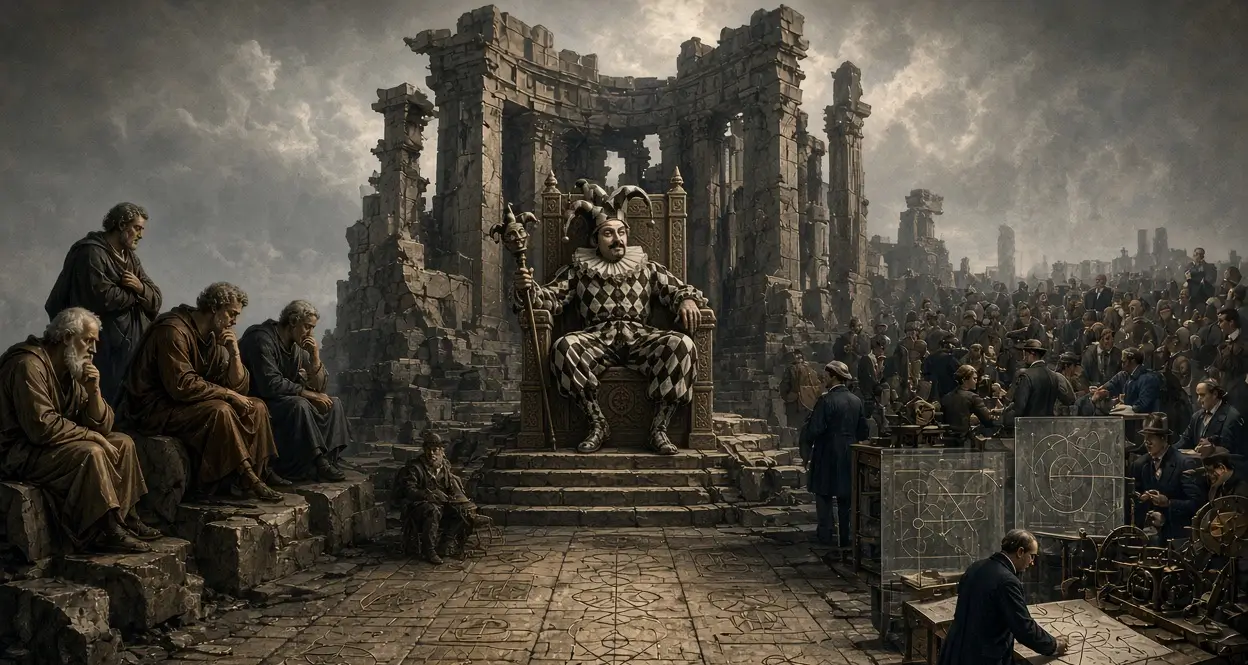
And if There Is No Universal Truth, Who Is Sitting on the Throne?
Introduction
This article examines the problem of Truth and the crisis of universal foundations in postmodernity. It explores the relationship between universal thinking, the foundations of political and social order, and the legitimacy of power. Moving from Plato and the philosophical traditions of the West to modern positivism and postmodern thought, it examines how conceptions of universal Truth shape our understanding of reality and the organization of civilization.
Rather than offering a survey of philosophical positions, the article pursues the problem of foundations itself: what underlies what happens, and what follows when the possibility of universal Truth is rejected? It argues that the rejection of universal foundations raises a fundamental question concerning political legitimacy: on what grounds can any existing order claim the right to rule, and what can replace those foundations once they have been abandoned?
1. Universals
The problem of truth — ἀλήθεια (aletheia), as distinct from δόξα (doxa), meaning opinion or representation — is not a matter of distinguishing truth from opinion, but of identifying the foundations: the universals.
Let us elaborate.
The multiplicity of what happens does not, in itself, imply the existence of something universal underlying it, but neither does it rule out such a possibility. The very idea of “discovering universality behind everything contingent” is what Plato proposed in the form of the Ideas, understood as archetypes underlying a multiplicity of otherwise unrelated phenomena. This idea can also be linked to the secret teachings of Pythagoras concerning the mathematical entities underlying what happens.
Of course, such universality may also be found in the apeiron or in atoms. In any case, the aim is to address a fundamental question — “What is happening?” — by seeking to discover the Truth. Once we have understood the Truth, we can act correctly in the world, develop plans and strategies, and then test our Truth through its implementation.
2. Overcoming Truth
But if universal thinking is branded as fundamentalism, and the systems of Plato, Hegel, and other thinkers are treated as forms of totalitarianism — as Karl Popper does to a significant extent in The Open Society and Its Enemies — this raises questions about the entire positivist foundation of modern Western civilization. In the nineteenth century, this foundation largely displaced Christian thinking about the First Principle underlying what happens, replacing it with evolutionism and other theories of foundations.
So, if Hegel’s dialectical laws, for example, or any other theory, fail to reveal the foundations of what happens — the Truth — then what is actually happening? If what happens has no universal truth underlying it, what are we left with: a jumble of disconnected absurdities? And who, then, are we within such a process?
Therefore, if there is no Truth:
- We do not understand what is happening.
- But how are we to act in the world if we understand nothing?
- Why, in such a world, are those who do not possess the Truth the ones in power? What strategies can they offer if they do not understand what is happening?
- What, then, is this entire civilization without foundations about? Where is it ultimately heading?
Brushing aside any of these questions may bring about the collapse of a particular civilization. This has happened more than once, including in the relatively recent past. Moreover, those who claim that these questions are irrelevant can observe how DeepSeek, like ChatGPT, suddenly freezes when confronted with questions about the foundations of particular civilizations.
3. Truth and the Question of Power
One could say that none of this matters, that what happens is entirely devoid of universal meaning. But what follows from such a claim? What remains after abandoning the search for foundations — a dislocation of thought in which it is no longer possible to connect an understanding of reality with meaningful action?
Postmodernity, as it were, is not interested in questions of foundations: what underlies what happens, and what are we supposed to do within it? This refusal gives rise to more than mere uncertainty. It produces an intellectual condition in which it becomes difficult to distinguish understanding from misunderstanding, a well-grounded strategy from arbitrary action, and meaningful movement from Brownian motion.
This is the crisis not only of modern science but of Western civilization as a whole: a civilization that has discovered the limits of rationalism but has failed to offer a way beyond this crisis.
But if the old foundations have been overcome and no new ones have been discovered, what are we to base our understanding of what happens on? What should guide the development of strategies, and what future are those strategies directed toward? And how, under such conditions, are we to settle the question of the right to rule?
And if there is no universal Truth, who is it sitting on the throne?
4. A Model for Constructing a Universal Political Order
The political system of the United States was founded on universal knowledge — natural, true, correct, and precise knowledge of how the human being is constituted. On the basis of such knowledge, the aim was to establish a true and just sociopolitical order and then determine a strategy for further development in accordance with a discovered universal principle: all people are created equal and possess inalienable rights…
The Founding Fathers proceeded from the existence of natural and true rights inherent in human beings by virtue of their very nature — rights grounded in the universal and true essence of the human being, as discovered by the progressive philosophers of the Modern Age. Consequently, the founders of the United States were not simply constructing a political system arbitrarily; their project rested on a foundation of firmly established universal truths.
In other words, they were not usurpers and conquerors who had seized power from an anointed ruler governing as the representative of the Almighty, but representatives of the Universal, establishing a true order on earth.
Thus, foundations mean the right to rule. In other words, denying universality calls into question the legitimacy of a particular authority and, in a stronger sense, the necessity of the entire existing political order. Conversely, proposing new foundations is always a question of a new authority.
5. The Sect of Philosophers
A contemporary of Socrates living in Athens would hardly have known much about philosophers. In other words, philosophy was the pursuit of a narrow circle, and it was probably not until the end of the nineteenth century, with the development of mass education in the modern age, that philosophers became widely known.
Suppose that when Carneades arrived in Rome, the event mattered only to a very small segment of the Roman elite. The closure of the philosophical schools by a Christian emperor probably went unnoticed by most of his contemporaries. And yet Cicero, Seneca, and the emperor Marcus Aurelius all belonged to the philosophical sect.
Here, then, we have a phenomenon that was practically invisible to its contemporaries yet exerted a fundamental influence on Western civilization. There can be little doubt that the disputes among the Church Fathers were likewise confined to narrow circles. Yet when the results of this thinking entered the wider public sphere, they became a matter of concrete political order and the right to rule.
The new order that replaced the old world can be traced to Bacon’s Novum Organum. The method of the bee and rationalism, too, were probably intellectual developments of which few contemporaries were aware. In time, however, these ideas became foundations for a new organization of life: the economy, the political sphere, structures of power, and the prevailing order.
Locke, Hobbes, Grotius, Jean-Jacques Rousseau, and other philosophers proposed a new universal mode of thought, which in turn became the foundation of a new society and political order. The thought of Kant, Fichte, Hegel, and other representatives of German Idealism — a new critical and objective-dialectical mode of thought — became an instrument for overcoming primitive rationalism and a foundation for the next world. Finally, positivism and Marxism emerged as an ultimate simplification of thinking about foundations, taking up and deploying this now-established mode of thought about foundations.
Within this context, we must recognize the revolutionary significance of thinking about foundations: a mode of thought accessible to an insignificant sect of philosophers can exert an enormous influence on the future organization of civilization.
And to return to the beginning of this article:
- Denying the possibility of discovering universality calls into question the foundations of the existing order.
- The discovery of a foundation, in turn, becomes the beginning of a new order.
6. The Practice of “Non-Stoppage”
“Pure philosophical thinking as practice” is itself a state opposed to the positive thinking of the “supposedly knowing majority,” which always remains within the boundaries of a truth brought to a halt.
Genuine philosophy makes it possible to move beyond any form of “positive thinking,” becoming a mode of thought in which life unfolds “outside stoppage.” And this is always a practice, not ready-made knowledge about…
7. Forms of Ersatz
In place of the thinking of the philosophers’ sect, the skilful operators of the modern world offer the philistine an ersatz product whose essence is primitive positivism. The main forms of modern ersatz are as follows:
1. “Ten Rules for Achieving Success.” The crudest form. Here, philosophy is replaced by a form of everyday management that presents itself as “wisdom.” Instead of thinking about foundations, one is offered a set of practical recipes promising success.
2. “How to Find the Meaning of Life in 30 Days.” A subtler form. Here, philosophy is replaced by psychotherapy: thinking about foundations gives way to the question, “How can I feel better?” Everyday “therapy” is offered as a “philosophy of life,” while the problem of Truth is reduced to the problem of subjective well-being.
3. “A Coach Who Will Help You Find Yourself.” A still subtler form. Here, philosophy is replaced by purported mentorship. Everyday self-help training is presented as a special path to oneself, yet instead of the “practice of non-stoppage,” one is offered instruction in supposedly “effective” attitudes and techniques.
4. “The Book That Will Change Your Life.” Here, the practice of strong thinking is replaced by an empty narrative that presents itself as a “revelation.” Instead of strong thinking, the reader is offered a ready-made “story” designed to create the impression of a discovery and the illusion of having attained understanding.
5. “The Philosophy of Success,” “The Philosophy of Business,” “The Philosophy of Leadership.” Here, what occurs is no longer merely the substitution of philosophy with something else, but the appropriation of philosophy’s very name. Arbitrary, invented rules and a conventional, everyday ideology present themselves as philosophy, and the word “philosophy” becomes a label for anything whatsoever except thinking about foundations.