Grant's Poker: The Significance of Strategic Existence
An analysis of decision-making mechanisms, staff culture, and Lincoln's role in transforming the Union's military machine.
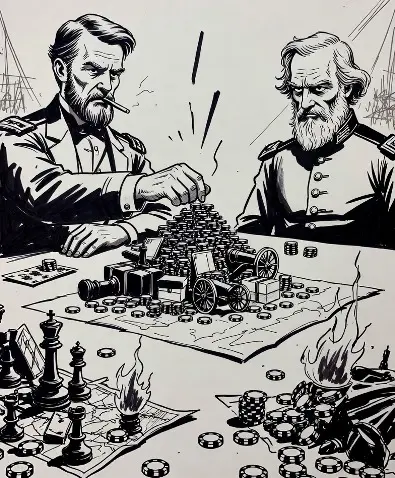
An examination of Strategic Existence, its capacity for conceptualism, and its ability to act strategically.
Introduction
When the Northern states found themselves in a strategic deadlock—in the absence of a fully functioning strategic command, which was largely composed of incompetent "Northern aristocrats" (like the Boston Brahmins)—it became necessary to pull an unrefined rural commoner, Ulysses S. Grant, from the lower strata. Grant, in turn, built a team of similar "marginals."
This is one of the most remarkable episodes of the American Civil War (1861–1865), rarely emphasized in standard textbooks. It is a raw example of how a deep systemic deadlock forced the Northern elite to temporarily cast aside their arrogance and hand supreme command to a man from a completely alien social background—all to prevent the system from collapsing.
Ulysses S. Grant and his circle—primarily William T. Sherman and Philip Sheridan—show how total war shreds elite caste filters when physical survival is on the line.
Yet, physical survival alone is not enough. What was also required was a rare historical fortune embodied in the Existence of Lincoln and Grant.
1. The Washington “Swamp” and the Era of “Ineffectual Aristocrats”
During the first two years of the war, the North, despite its overwhelming advantages in industry, population, finance, and economic power, repeatedly suffered humiliating defeats at the hands of the South on the principal (Eastern) theater of war.
The cause was the absence of a strategic command level and the dominance of “parquet generals.”
The leading figure of the Union Army in the early years of the war was General George McClellan—a favorite of Washington's political establishment, a refined, highly educated, impeccably mannered graduate of West Point. He was the perfect manager: he organized logistics brilliantly, staged impressive parades, and produced excellent reports for Lincoln.
- • McClellan's Disease: he was terrified of fighting. He constantly reported that the South possessed “million-man armies” (despite being vastly outnumbered), endlessly searched for the “perfect political moment,” and maneuvered without end.
- • War as a Show: Washington's elite treated the war as a political spectacle and a source of government contracts. Generals were appointed according to political influence, patronage, and loyalty to New England financiers. They had no strategy whatsoever for destroying the South's military potential.
As a result, the South, despite possessing far fewer resources, repeatedly defeated these huge but completely ineffective Union armies thanks to the professional military genius of Robert E. Lee. The North entered a complete strategic deadlock.
1.1. The Emergence of Grant: The “Commoner” vs. the Caste
And it was at this point of existential terror, when Washington stood on the verge of defeat, that Lincoln realized: if they continued promoting graduates of the business and diplomatic schools of the era, the North would lose the war to farmers.
They had to dig to the very bottom. And there they found Ulysses S. Grant.
For Washington’s industrial and financial elite, Grant was an absolute marginal, a country bumpkin, and a plebeian.
- • He came from a family of tanners.
- • Before the war, he had been forced out of the army, became an alcoholic, went bankrupt, hauled firewood in Illinois, sank into debt, and worked as an ordinary clerk in his father's store.
- • He could not speak elegantly, wore a wrinkled private's uniform, constantly smoked cheap cigars, and carried the reputation of a hopeless drunk. The “Northern aristocrats” despised him.
Yet Grant possessed something the entire General Staff in Washington, taken together, did not: a cold-blooded understanding of the nature of total industrial war.
1.2. How Grant’s Team Broke the Backbone of the South
Grant completely discarded "chivalric" conventions and parade-ground maneuvering. When Lincoln appointed him General-in-Chief of all Union armies in 1864, Grant brought with him a team of equally hard, cynical practical men—commoners who did not care what Washington newspapers thought of them.
Grant formulated one of the earliest concepts of attrition warfare. His strategy rested on three iron principles:
- 1. Synchronous Pressure Across All Fronts
Before Grant, Union armies fought like independent "shops": one advanced while the others watched. The Confederates exploited this by shifting reserves along interior lines. Grant's order was simple: "All advance at once. Whoever cannot advance must hold the enemy by the breeches so he cannot move." - 2. Eliminating the Enemy's Center of Gravity
Grant did not care which cities or geographical points were captured. In his directive to General Meade, he formulated the central objective: "Lee's army will be your objective point. Wherever Lee goes, there you will go also."
He tied himself directly to the Confederate army and began grinding it down without pause, understanding that Northern factories could replace men and ammunition, while the South could not. - 3. Destroying the Economic Base (Sherman's Team)
His right hand, General William T. Sherman—a man Washington's elite considered insane—implemented the concept of total war. His famous March to the Sea through Georgia was not aimed at destroying the Confederate army itself. It was aimed at destroying railroads, factories, plantations, cotton depots, mills, and the economic infrastructure that sustained the Southern war effort.
Sherman stated: "We are not only fighting hostile armies, but a hostile people. We must make them feel the hard hand of war, so that they will lose the physical desire to fight."
Grant was accused of stupidity, branded a "butcher," and faced constant demands for his dismissal after the enormous losses at the Wilderness and Spotsylvania. To every attack from Washington's political establishment, Lincoln responded with a single sentence:
"I can't spare this man; he fights." [1]
1.3. Selection Under Existential Crisis
Grant's case reveals a fundamental systemic principle: a system allows genuine strategists from below to rise to the top only when the ruling caste begins to experience a visceral fear for its own survival.
As long as defeats can be explained away by "objective circumstances," as long as rents continue to flow, and as long as the rear remains comfortable in the restaurants of the capital, the system will not allow any "Grants" to emerge. Until the very last moment, it will cling to its "McClellans" because they are socially familiar, predictable, and convenient for the distribution of resources and contracts.
But when the foundations begin to crack and defeat becomes physically real, the elite is forced to turn to a former alcoholic and the son of a tanner. It hands him full authority and waits while this "dirty countryman" and his "insane" colleagues break the enemy's backbone through the logic of total war.
2. Grant and the Logic of Strategic Poker
Grant's strategy was poker: he pushed a corps forward and effectively asked his opponent, "Do you still have anything left?", then pushed the next one.
This metaphor precisely captures the essence of Grant's internal psychological matrix. His confrontation with Lee was not a classical game of chess, where pieces move according to the rules of elegant maneuver. It was a brutal poker game played at extreme stakes.
Grant was the first in history to understand that in an industrial war, victory belongs not to the side with the "better marshals," but to the side with the larger stack of chips (resources) and the mental strength to keep pushing that stack into the center of the table, raising the stakes again and again.
Let us examine this "poker" mechanism that Grant employed against General Lee during the 1864 campaign. It was pure psychological terror.
2.1. Grant's Stack vs. Lee's Stack
Before Grant, every Union general played "chess" against Lee. They tried to outmaneuver him on the battlefield, but Lee was a tactical genius. He read their moves and checkmated them again and again despite commanding a smaller and poorer army.
Grant came, sat down at the table, looked at Lee, and understood the essential point:
- • The North (Grant) had an effectively endless stack of chips: factories were operating, immigrants were arriving in Northern ports by the thousands, and railroads were delivering tons of supplies to the front.
- • The South (Lee) had a limited stack: there was nowhere to find more men, the Southern population was starving, and ammunition was running low. Lee was physically unable to replace his losses.
And Grant began his game.
In May 1864, during the Battle of the Wilderness, Grant suffered terrible losses—around 18,000 men in just a few days. Lee rejoiced. Under the old rules, after such a defeat, any Union general would have ordered a retreat, withdrawn across the river, and spent months licking his wounds.
But Grant did something Lee did not expect.
As if nothing had happened, he lit another cigar, turned his army not backward but forward, moved around Lee's flank, pushed another corps onto the table, and asked without emotion:
"Robert, I have lost a corps. But I still have three more. And you?"
2.2. Psychological Suffocation: Bluff vs. Mathematics
Lee was forced to answer every such challenge. He did not have the right to fold, because behind him stood Richmond, the Confederate capital. He had to call every one of Grant's bets using his finest Southern infantry.
Spotsylvania: Grant strikes head-on again; another mountain of corpses, another horrific meat grinder at the Bloody Angle. Grant writes to Washington: "I propose to fight it out on this line if it takes all summer" [2]. This is the declaration of a professional poker player who understands that his hand is stronger simply by virtue of resource superiority.
Cold Harbor: Perhaps Grant's most horrific and seemingly senseless attack. In twenty minutes, thousands of Union soldiers fall. Newspapers curse Grant. Yet, from the perspective of Grant's poker mathematics, even this nightmare worked toward the final outcome: Lee lost several thousand of his best veterans, men who were physically irreplaceable.
Grant pushed his corps forward time after time—not out of stupidity or bloodlust. He understood a stark mathematical reality: every time both sides lose 10,000 soldiers, Grant grows stronger in relative terms, while Lee moves one step closer to collapse.
It was pure calculation. He nullified Lee's tactical genius by forcing him to play a game in which Lee possessed fewer chips from the very beginning.
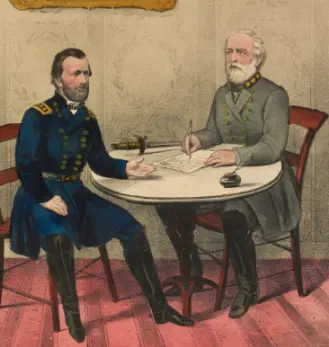
2.3. The Climax at the Table: Surrender at Appomattox
This game of poker ended in April 1865. Lee had simply run out of chips: his soldiers were deserting from hunger, ammunition was exhausted, and Grant continued to bring forward fresh, well-fed, and fully supplied corps.
When Lee arrived to surrender, Grant showed the restraint of a player who had just won the entire pot. He made no attempt to humiliate his opponent. Instead, he allowed Confederate soldiers to keep their horses for the spring plowing and ordered rations distributed to the starving Southern army.
The game was over. The South's stack had been completely exhausted.
3. Grant’s Strategic Piston
3.1. The Transition from Holistic Thinking to Action
The enemy would not simply tire himself out, as McClellan imagined. Grant’s poker was neither a crude meat-grinder tactic nor a desperate throwing of corps into the void. It was the highest operational mathematics of its era.
Before Grant, Northern generals—McClellan, Burnside, and Hooker—committed the same mistake that would later characterize much of the First World War: they wore down their armies battalion by battalion. Troops were fed into battle piecemeal, allowing Lee to exploit his interior lines.
Lee simply concentrated reserves against each local Union breakthrough, systematically grinding down one battalion after another. After only a few days of fighting, the Army of the Potomac would find itself exhausted, depleted, and demoralized.
Grant was the first to put an end to this fragmentation. He employed entire corps as unified and indivisible strategic instruments of a single army, relentlessly executing his overarching design.
This was Grant’s true strategic advantage: both a superior understanding of the situation and the capacity to translate that understanding into action.
3.2. One Big Stack: The Corps as a Monolith, Not a Sum of Battalions
When Grant committed to battle, for example, Hancock’s II Corps or Warren’s V Corps, he employed them not as a chain of regiments, but as a single battering ram.
Simultaneous broad-front advance: The corps advanced simultaneously across the entire front, over a wide sector, ensuring a colossal concentration of firepower and mass.
This stripped Lee of his greatest advantage: maneuver. Lee could no longer detach a regiment from one flank and rush it to another, because his forces along the entire line were simultaneously engaged in fierce combat with Grant’s advancing corps. Lee found himself effectively pinned in place.
3.3. The Unbroken Stack: Continuity of Operational Pressure
Grant understood that time itself was a resource. Before him, after three days of fighting, the advancing Union army would halt to regroup, bring up ammunition, and prepare new reports. During these weeks of pauses, Lee had time to entrench, dig himself into the ground, rest, and replenish his ranks.
Grant abolished this practice. His corps—the Union army as a whole—pressed forward around the clock and without interruption. If the II Corps became exhausted and fatigued, Grant did not halt the offensive. He immediately, without pause, committed the fresh VI Corps to the same point, while withdrawing the exhausted corps to the second line for reorganization.
The Union army worked like a giant piston, continuously striking the same point, day after day, without allowing the Southerners to raise their heads or restore their defenses. This was precisely why Lee’s army was physically exhausted.
3.4. Folding the Hand: Disregarding the Enemy's Tactical Advantage
Grant's poker consisted in forcing Lee to play on ground fundamentally unfavorable to him. Whenever Grant encountered an impregnable tactical position—as at the North Anna River or on portions of the Spotsylvania line—he did not continue battering it with frontal assaults.
Instead, he executed an operational maneuver: quietly disengaging his corps, bypassing Lee's fortifications in a wide arc, and continuing south toward Richmond. Faced with a direct threat to the Confederate capital, Lee had no choice but to abandon his carefully prepared positions, move out, and race to intercept Grant before he reached his objective.
In this way, Grant dictated the rules of the game and maintained control of the operational space. Local tactical advantages—high ground, river lines, fortified crossings—were of little interest to him. He evaluated the theater of war as a single strategic whole.
3.5. Synchronization of Pressure and the Limits of Positional Warfare
After the failure of the initial phase of decisive destruction, the generals of the First World War reverted to the practices associated with McClellan and Burnside: the gradual attrition of forces through piecemeal offensives. Between these attacks, long operational pauses inevitably emerged.
- Inherently battalion-level warfare. This mode of warfare allowed defenders to respond with maximum efficiency. During operational pauses, they could bring forward ammunition, rebuild damaged fortifications, redeploy reserves by rail, and rotate exhausted formations.
- The self-sustaining positional system. Under such conditions, the defensive system could survive for years. This was not Grant's poker of attrition but a slow process of mutual bloodletting that was structurally incapable of producing a decisive operational or strategic result.
Grant demonstrated that an entrenched defensive system can only be broken by applying the full mass of strategic formations simultaneously, continuously, and across the entire operational depth of the theater. This principle was later reconsidered and implemented on a much larger scale during the Second World War.
Yet such a task required more than the mind of a Grant. It demanded the full capacity of the Union itself and of everything that stood behind it in a total war: a mobilized society, an economy operating at its limits, an elite capable of renewal and rotation, and a great objective that was clear and meaningful to every soldier.
4. Real Military Competence and the Existence of Strategists
Strategic competence is the ability to manipulate large military formations not on a map, but in reality—constructing effective strategic combinations and bringing them into existence. It requires not only a theoretical understanding of such combinations but also the training of the entire military machine. This is the fundamental definition of operational art and strategic command.
Any staff officer can draw an arrow across half a continent. Real strategy begins where what is drawn on paper becomes physical reality. The competence of a military machine—when such a machine exists—is its ability to make a hundred-thousand-man structure move, sustain itself, coordinate its actions, and outplay the enemy not in a simulation, but on real ground, in mud, under fire, and amid complete chaos.
This process rests on two rigid foundations:
- Intellectual comprehension by the high command. The existence of a genuine strategic echelon—capable of understanding, designing, and executing large-scale strategic combinations—is an exceedingly rare phenomenon in history.
- Total competence throughout the command structure. The entire hierarchy of headquarters and formations must be trained to execute complex operations. This capability does not emerge by itself; it is a direct reflection of the actual condition of the people and institutions that compose the system.
4.1. War as an Evolving Living Design
- The existence of the whole. In real war, a large formation—a corps, an army, or a front—is not merely a collection of troops. It is a complex living system in which every element exists as part of the whole, provided that this whole itself exists. This whole is formed by the human mind through conceptual design and simplification, which makes it possible to bring the entire mechanism into motion.
- The interconnectedness of events and the enemy's will. The first step—for example, a demonstrative strike by one corps—is made to force the enemy to commit his reserves. The strategist calculates the reaction: he strikes at point A, knowing that the enemy will rush to save it, thereby exposing point B, where the main striking force is already being deployed. This is how strategic interconnectedness emerges. A mind unfamiliar with the strategic design is incapable of understanding what is happening because it cannot see the internal logic of the process.
- Synchronization of the military machine. It is not enough simply to send corps forward. An artillery barrage, air strikes, the advance of armored spearheads into the operational space, and the construction of crossings over water obstacles must converge at the same point with precision measured in minutes. If tanks reach a river four hours before the pontoon-bridge regiment, the strategic combination immediately turns into a local catastrophe, as the examples of the Second World War repeatedly demonstrated.
4.2. Staff Culture as the Army's Nervous System
Even if the General Staff develops a brilliant strategic combination, it remains dead without the training of the formations and the entire staff hierarchy. A large military formation is viable only when it possesses a highly developed staff system that functions like clockwork.
A large General Staff is, in effect, a giant distributed "supercomputer" composed of thousands of professional officers.
- Staff Culture. A division or corps commander is not supposed to personally run around with a rifle on the front line. Behind him stands an entire professional staff: operations, intelligence, communications, logistics, and artillery. Every element knows its sphere of responsibility.
- Execution as Routine. Redeploying a corps fifty kilometers to the enemy's flank requires thousands of movement schedules. Which brigade moves first? Which road is assigned to fuel trucks, and which to tracked vehicles? Where will field hospitals be established? How will radio communications be encrypted? In a trained army, staff officers execute these tasks automatically, according to strict protocols and field manuals. They know their work by heart.
If this staff culture is destroyed—or has never been developed—any attempt to move a large formation immediately produces informational and logistical paralysis.
4.3. The Evolution of the Union Army: From Staff Chaos to Systemic Conductivity
At the beginning of the war, the Union Army had no staff culture at either the lower or, even more so, the higher level.
- Staffs as Administrative Offices: Brigade and corps staffs existed primarily as bureaucratic bodies for writing reports and conducting inspections. Officers were not trained to manage the chaos of moving thousands of tons of supplies under real combat conditions, but to fill out paperwork correctly and please their superiors.
- Operational Paralysis: During the first campaigns, it became clear that the staffs were physically incapable of controlling the troops. They lost contact with their own battalions, did not know the exact positions of their units, could not organize the delivery of ammunition to artillery pieces that had changed positions, and were incapable of coordinating infantry, cavalry, and artillery within a single battle.
Strategic competence in manipulating large formations represents the highest stage in the development of an industrial-age military machine. It requires years of academic training for the strategic echelon, rigorous professional training, regular large-scale exercises, and a developed industrial base.
As long as the Union armies consisted of raw, hastily assembled brigades led by "parquet" appointees, while the officer corps as a whole reflected the culture of the "Northern aristocracy," the war remained a form of positional medievalism. There was neither the intellectual capacity at the top nor trained staffs below for complex corps-level maneuver.
The situation changed fundamentally only when Grant assumed command, establishing end-to-end conductivity for his orders and transforming the staff hierarchy into a functional nervous system.
5. Lincoln's Umbrella: The Grand Strategist
Grant does not emerge in a vacuum. Grant is a function of Lincoln.
For a ruthless, systemic marginal executor to emerge within the system, the very top must be occupied by an absolute grandmaster of the political framework—a fanatic of the Idea, capable of holding the structure together against internal disintegration and bureaucratic sabotage while his "butcher-general" breaks the old rules of the game, transforming the entire space into a unified system for achieving the objective.
Yet a figure like Lincoln is not an accident, but a product of a great Idea of transforming the world, reproduced precisely by this particular, unique Existence (and this works in both directions). Therefore, a historical event of such magnitude, resulting in the emergence of new geopolitical empires, is not a закономерное, automatic convergence of blind causes and circumstances.
Precisely for this reason, such a political-strategic symbiosis is always unique and practically impossible to reproduce artificially.
5.1. Lincoln's Umbrella: Strategy as a Lightning Rod
Ulysses S. Grant was hated by almost everyone. Washington society, the press, members of Congress, and career generals continuously flooded Lincoln with denunciations. They portrayed Grant as an alcoholic, accused him of making catastrophic mistakes, condemned the enormous losses at the Wilderness, and branded him an ordinary butcher.
An ordinary political leader, concerned primarily with public approval and bureaucratic equilibrium, would have dismissed Grant within weeks simply to quiet the elites. Lincoln answered such accusations with his famous remark:
"Find out what brand of whiskey he drinks and send a barrel of it to each of my generals." [3]
Lincoln possessed extraordinary political courage and genuine strategic vision. He clearly understood two things:
- The Necessity of Total War. The Union needed a commander prepared to wage total industrial war and carry it through to the preservation of the Union, regardless of the political consequences.
- The "Lightning Rod" Function. The President had to become the lightning rod. He had to absorb the anger of Congress, the press, and public opinion, creating an absolute umbrella of protection within which Grant could methodically, cold-bloodedly, and without regard for political intrigue wear down the Confederate armies.
Grant was carrying out Lincoln's Strategic Design. Yet he was only the most visible military expression of a far broader strategy. Lincoln simultaneously reorganized industry, brought the railroads under centralized wartime control, transformed military logistics, and pursued a sophisticated policy of coercive diplomacy toward the European powers. Grant remained the clearest military manifestation of this process, but he was only one element within Lincoln's unified strategy for the reconstruction of the Union.
5.2. Fanaticism of the Idea vs. the Pragmatism of Retaining Power
Lincoln was a fanatic of the highest order—a fanatic of the idea of the Union and of the Constitutional order. He genuinely believed that American democracy was "the last and best hope of Earth." For the sake of this metaphysical idea, he took unprecedented, radical measures: he suspended habeas corpus, shut down opposition newspapers, and consciously accepted the deaths of hundreds of thousands of his fellow citizens in the furnace of total war.
His fanaticism was directed toward the future—toward the creation of a new planetary reality. In Lincoln's view, if the Union, as an idea and as a civilizational project, were to suffer defeat, all of humanity would lose its greatest chance for development.
In this context, the provincial arrogance of the Southerners, who sought to put an end to the future of a united country in order to preserve their own archaic order and old way of life, appeared insignificant. From this perspective, Lincoln proved to be historically right.
The division of the former community of free builders of the New World into two hostile camps would have prevented the emergence of the global force that, according to the vision of the intellectuals and visionaries of the nineteenth century, was destined to become an instrument for far more grandiose transformations of humanity.
Lincoln changed reality for the sake of a great dream and ruthlessly broke the old elites.
Here lies the problem of the constant "inner sleep" or paralysis of the elites. When the key objective of the ruling class becomes merely the preservation of short-term stability and the retention of power, the system is organically incapable of producing a fanatic-modernizer.
The Presence or Absence of Strategic Existence. There is a widespread belief that, under conditions of severe survival pressure, a system is bound to come to its senses and call upon crisis managers. But this is an illusion. The experience of the First World War completely refutes it: even the existential question of survival did not lead to the emergence of leaders on the scale of Lincoln and Grant.
Without such an awakening, a system operating in survival mode will continue, to the very end, to produce only predictable cynics, compromise-seeking executors, and bureaucratic careerists who obediently document the chronology of their own catastrophe.
5.3. High-Stakes Poker: Lincoln as the Grandmaster
Lincoln was playing a complex, multi-vector game. His objective was never limited to military victory. He had to solve several interconnected strategic problems simultaneously.
- Diplomatic Blockade: He had to prevent Great Britain and France from intervening on the side of the Confederacy. The Emancipation Proclamation became one of his most brilliant strategic moves. It transformed the war into a struggle against slavery, making official support for the South politically impossible for the European elites.
- Internal Balance: He had to keep the wavering border slave states—Kentucky, Maryland, and Missouri—inside the Union. A single political mistake could have triggered a chain reaction of secession.
- Preservation of Legitimacy: He had to win the presidential election of 1864 while leading the bloodiest war in American history, at a moment when the country was approaching exhaustion.
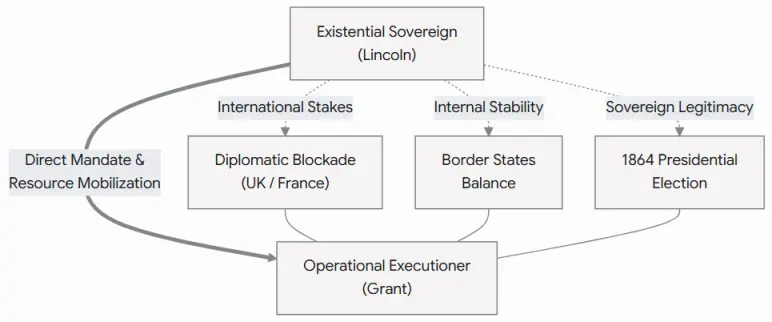
This was political poker on a planetary scale. Lincoln understood perfectly that Grant was the decisive card in his hand. Without Grant's relentless victories on the battlefield, Lincoln would almost certainly have lost the election, and the project of preserving the Union would have collapsed.
5.4. The Course of History as the Result of Strong Strategic Existence
The central systemic conclusion of the American Civil War is straightforward: the quality of strategic command is a direct reflection of the leader's Strategic Existence.
The distinction is absolute. Strategic Existence either exists, or it does not. In its absence, a system becomes incapable of strategic correction and is condemned to repeat the same fatal mistakes until its final collapse.
Historical development follows one of two fundamentally different existential trajectories:
- Projection of Lincoln's Strategic Existence:
Fanaticism of the Idea → Political Courage → Demand for Decisive Results → Emergence of Grant → Transformation of Reality → Victory - Projection of McClellan-Level Existence:
Preservation of Power → Bureaucratic Balancing → Demand for Loyalty and Procedure → Emergence of McClellan → Operational Deadlock
Those living within the comfort of the existing system—as did the career generals of 1861—are organically incapable of creating new strategic concepts. They remain bound to inherited rules and to their own position within the existing order.
A new strategic concept is rarely born in the mind of a polished careerist. More often, it emerges from the marginal—the individual who stands outside the system's center, remains free from its conventions, and therefore sees reality without institutional illusions. Such people look directly into chaos, strip away bureaucratic noise, and reduce complexity to the ruthless conceptual architecture of the future.
6. Why Grant’s Strategy Is Non-Reproducible: The Example of World War I
World War I was a strategic deadlock. Despite the scale of the conflict, it lacked the essential Strategic Existence—which cannot be reduced to military doctrine—and a unified instrument of power comparable to Grant’s Army of the Union.
Factors of the WWI Deadlock:
- Absence of Strategic Existence: There was no strategic echelon capable of formulating a concept and driving its realization. Furthermore, there was no individual capable of synthesizing all available resources into a unified design, sanctioned by a political architect of Lincoln’s stature.
- Absence of Design: The imitation of Grant's strategy in WWI lacked his systemic precision. It was not a calculated breach to dismantle the enemy’s operational stack; it was simple, inertia-driven mass casualty.
- Absence of a Project for the Future: The warring monarchies offered no clear vision of a "New World." Unlike the Northern soldiers, who were motivated by a coherent civilizational project, the masses in WWI were driven by fleeting propaganda. Consequently, the participants could never be forged into a unified strategic mechanism.
- Elite Competence and the Fear of "the Grant": None of the monarchies could reproduce Grant’s management, as it would have necessitated the displacement of the old aristocratic elites. This was impossible without a "Lincoln’s umbrella"—a Grand Strategist with a direct mandate from the people to reorganize the state.
World War I was not "Grant’s poker." It was the ludomania of petty gamblers, squandering the lives of others in the hope that their opponent would collapse first.
Appendix: Historical Basis and Documentation
- 1. Lincoln’s "I Can't Spare This Man": This statement was first documented in the memoirs of Colonel Alexander McClure, a close associate of the president, in his book Lincoln and Men of War-Times (1892). The original source can be consulted on the documented page in the digital library Internet Archive.
- 2. Grant’s "Fight It Out on This Line": Dispatch from Lieutenant General U. S. Grant to Major General H. W. Halleck, May 11, 1864, at 8:30 a.m. The full report was published in the official multi-volume collection of Civil War documents, The War of the Rebellion: A Compilation of the Official Records of the Union and Confederate Armies (Series I, Vol. 36, Part 2, p. 627). The original digitized document is available in the Cornell University archive. The relevant passage reads: "We have now ended the sixth day of very hard fighting... I am proud to say the result was much in our favor... I propose to fight it out on this line if it takes all summer."
- 3. The "Whiskey Brand" Anecdote: This phrase was never recorded in Lincoln’s personal letters, diaries, or official speeches. It first appeared in print through Charles Graham Halpine, who wrote under the satirical pseudonym Miles O’Reilly. The anecdote appeared in New York newspapers and later in his book The Life and Adventures, Songs, Services, and Speeches of Private Miles O’Reilly (1864). Halpine was himself a Union officer and a committed supporter of Grant. He invented the dialogue as satire, mocking Washington officials and highlighting Grant’s military successes against their incompetence. Lincoln’s actual, documented response to demands for Grant’s dismissal was more restrained but conveyed the same essential position: "I can't spare this man; he fights."
- 4. Repressive Diplomacy (Lincoln/Seward Doctrine): In the context of Lincoln’s grand strategy, repressive diplomacy describes a policy of brinkmanship employed by Washington against the major European powers, above all Great Britain and France. Its essence was a harsh ultimatum: any attempt to recognize or assist the Confederacy with naval forces would mean an automatic declaration of war against the United States.
- Strategy of Controlled Madness: Seward openly and aggressively communicated to European diplomats that if they provoked a conflict, the United States would not retreat. Washington deliberately demonstrated its readiness to risk total mutual destruction, including an invasion of British Canada, if Europe intervened in the internal conflict.
- Use of Food Dependence: While the South sought to pressure Europe through the absence of cotton, the North emphasized Britain's critical dependence on American grain imports. Lincoln effectively confronted London with a choice: "go without clothes" (without cotton) or "go without bread."
- Resolution of the Trent Affair (1861): When an American captain independently intercepted the British vessel Trent and arrested Confederate diplomats, Britain reacted furiously and began moving troops into Canada. Lincoln demonstrated extraordinary strategic flexibility: he released the diplomats, formally defusing the immediate crisis, while the operational signal had already been delivered—the North was prepared to operate on the edge of the limit.
- Ideological Knockout (Emancipation): The final element of this hard framework was the Emancipation Proclamation (1863). By transforming the war from the legal suppression of a rebellion into a sacred war against slavery, Lincoln deprived the European elites of the political possibility of intervention. British society, which opposed slavery, simply would not have allowed its government to send a fleet to aid the slaveholding South.
Author’s Note: The author's conceptual framework relies on identifying structural mechanics within historical events. Artificial Intelligence was used exclusively for technical editing, correction of typographical errors, stylistic refinement, and verification of sources.