A Correctly Operating Command Mechanism and Its Degradation
A Cybernetic Model of Systemic Transitions, Epistemic Degradation, and Governance Dynamics
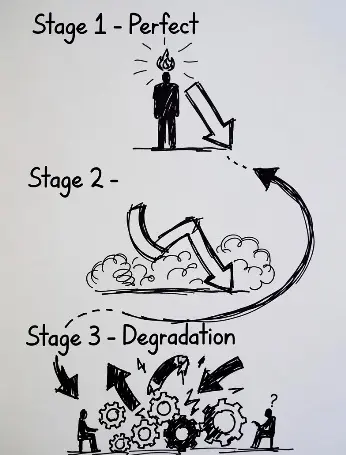
Dynamics of Command Mechanisms and Stages of Systemic Crisis
1. Properly Operating Mechanism (Stage 1)
A properly operating mechanism is a high-enforcement system characterized by zero tolerance for persistent execution failure. The command node issues an order that cascades through the entire hierarchy to the front line, where it is executed with precision. Upon detecting non-compliance, the system triggers immediate deactivation or restructuring of the failing execution chain.
2. Moderately Operating Mechanism (Stage 2)
A moderately operating mechanism represents a metastable regime in which orders are issued but executed only partially — approximately 50%. Significant informational losses occur during transmission. Gradually emerging nepotism and corruption introduce “windows of opacity” into what was once a transparent chain of command. Lower levels absorb the costs of failure, while upper layers remain insulated despite growing incompetence. Stage 2 is characterized by stabilized informational distortion: degradation is present but has not yet become self-reinforcing.
3. Malfunctioning Mechanism (Stage 3)
A malfunctioning mechanism is one in which orders are issued but actively subverted by the system itself. Feedback prompts weak restructuring attempts and new orders, locking the system into a self-reinforcing failure loop. Execution falls to near-zero, rendering the system largely ceremonial. The outcome is an accumulation of unresolved systemic distortions that lead to localized collapse or total failure under competitive or external pressure.
Transitions
Governance systems tend to cycle from Stage 1 through metastable Stage 2 into Stage 3. If the system survives the crisis, a return to Stage 1 remains possible, though often at high cost.
Stage 3 systems in conditions of intense competition — whether in ancient steppe corridors, emerging Greek poleis, river crossings on the Tigris, or Bronze Age resource concentrations — are systematically defeated and subordinated by Stage 1 systems.
Resistance to transitioning from Stage 3 to Stage 1 arises from deep structural inertia: the refusal to purge non-functional nodes, dismantle entrenched interest networks, and reconfigure the governance vertical. Most systems prefer gradual entropic decline over the painful shock of renewal.
History demonstrates that the forced transition from Stage 3 to Stage 1 has frequently proven fatal for heavily degraded entities.
At any stage, “black swan” events — natural disasters, technological disruptions, invasions, misjudgments, or weak leadership — can convert slow decay into rapid collapse.
Stage 1 is the hunter. Stage 3 is the prey.
Systemic Reset (The End of Stage 3)
Any mechanical restructuring or declarative announcement of transition from Stage 3 to Stage 1 typically marks the closing of a historical phase rather than true renewal. Reviving a degraded system requires foundational reinvention — new products, technologies, and capital structures — rather than superficial reform. Absent this, the process remains ceremonial and concludes in failure.
Idea and Command Mechanism
Every viable system exists in service of a founding idea or mission. The slide from Stage 1 to Stage 3 is accompanied by the gradual erosion of this mission. Those who once actively built the system eventually lose the will to confront collective irresponsibility. At that threshold, the system has already entered Stage 2 or 3.
The specific content of the idea matters less than its vitality: whether it concerns logistics, energy, transportation, or large-scale resource control, the founding mission ultimately shapes the command mechanism — never the reverse.
Systemic Crisis
Systemic crisis originates in the epistemic degradation of governing elites: the progressive loss of capacity to accurately perceive reality (“what is happening?”) and to formulate coherent, effective responses (“what should be done?”).
Entire civilizations have persisted in a state of managed catastrophe for centuries, as evidenced by the trajectories of Ancient Rome and the Early Middle Ages.
Ultra-Rigid Stage 1 Systems
Highly rigid Stage 1 systems possess a critical vulnerability: when the command node itself operates on distorted information or flawed judgment, the system will execute catastrophic directives with high fidelity.
Mitigation demands institutionalized mechanisms for dissent and alternative cognition — historically manifested through court jesters, opposition voices, independent analytical centers, and systems of checks and balances.
Autonomy and Command
All viable systems require autonomous units capable of context-sensitive decision-making. Competitive advantage emerges from the optimal calibration between execution fidelity (Stage 1 logic) and local autonomy.
In Stage 3, this distinction erodes critically: autonomy is routinely conflated with sabotage. True autonomy adapts orders to ground reality, including selective refusal. Sabotage consists of formal compliance that masks actual non-execution, sustained by falsified reporting and bureaucratic theater.
Final Remarks
The historical record — from Rome to the East India Company and beyond — reveals recurrent 1→2→3→1 cycles. Each stage possesses functional advantages under specific environmental conditions.
The highest expression of a command system is the collective, disciplined realization of a shared mission. The lowest is widespread systemic detachment, in which both command and execution lose meaningful connection to reality.