Extended Abstract: Groundlessness: The Experience of Strange Thinking (Part I)
Extended Annotation
The book Groundlessness: The Experience of Strange Thinking. Part 1 presents a comprehensive philosophical investigation into the nature of thinking, human existence, and the ultimate foundations of reality, structured around the central concept of “strange thinking”—a specific mode of intellectual experience that emerges under conditions of radical uncertainty and the absence of stable foundations.
At the core of the work lies a fundamental distinction between thinking as an act—fluid, unfinished, processual, and elusive—and thinking as a construct—a fixed result expressed in concepts, theories, and systems.
The author consistently demonstrates that any attempt to definitively fix thinking inevitably leads to its reduction: a living process turns into a frozen scheme, and philosophy becomes scholasticism. From this follows the thesis of the principled impossibility of reaching a “final foundation” or ultimate truth.
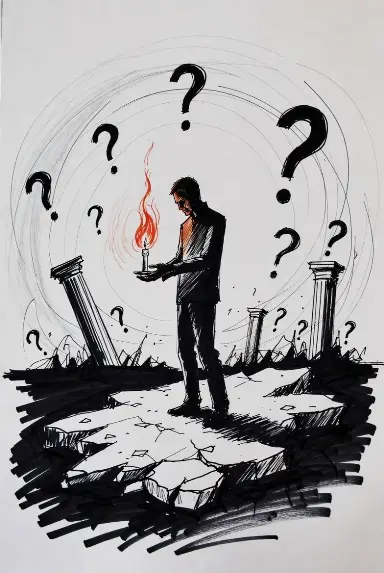
A key ontological assumption of the text is the idea of fundamental groundlessness. Groundlessness is interpreted not as a deficiency but as a condition for the possibility of thinking. Thought arises not on solid ground but within a space of uncertainty, where any foundation proves to be a temporary and destructible construction.
In this context, classical philosophical positions—from the Socratic recognition of ignorance to Kant’s “thing-in-itself”—are interpreted as intermediate forms of stabilizing experience that do not eliminate, but merely mask, the radical uncertainty of being.
A substantial part of the book is devoted to a critique of various forms of the reduction of thinking:
- ● everyday thinking oriented toward utility and creating the illusion of a “comprehensible reality”;
- ● scientific and positivist approaches that reduce the complexity of being to abstract models;
- ● ideological and religious systems that replace fundamental questions with ready-made answers;
- ● philosophical traditions that degenerate into formal constructions or rhetorical practices.
In contrast, the author introduces the concept of the “state of involved thinking”—a special experience in which the subject becomes aware of their involvement in the process of thinking, the impossibility of stepping outside it, and the absence of ultimate foundations.
This state is associated with the experience of a “pause” in the habitual flow of life and a confrontation with ultimate uncertainty.
The central category becomes strangeness—the experience of the abnormality of being and the mismatch between the apparent self-evidence of the world and its incomprehensibility. This state is not accessible to everyone and requires a specific intellectual sensitivity.
Attempts to systematize or conceptualize this strangeness inevitably lead to its loss, transforming it into an object deprived of its original intensity.
Particular significance in the text is given to the idea of inadequacy: human thinking is viewed as a limited system that forms only a “phenomenal reality,” while what actually happens constantly escapes into the past.
Time functions as a fundamental destabilizing factor: it makes the fixation of reality impossible, turning any description into a delayed and partial construction.
Thinking is described as an endless process of questioning, in which the so-called “useless questions” (about the meaning of life, reality, the self, time, and death) appear not as deviations but as expressions of the true nature of thinking.
Their principled irresolvability testifies not to the weakness of reason but to its ultimate structure. Attempts to complete or systematize this process are regarded as illusions.
Radicalizing this position, the author introduces the metaphor of thinking as wandering or even a delirium-like state—a state in which stable criteria of adequacy are absent. Any “theories of adequacy” (scientific, philosophical, religious) are interpreted as temporary mechanisms of stabilization that inevitably collapse in the course of further reflection.
In this context, the figures of the so-called “priests of adequacy” denote those capable of temporarily structuring the chaos of experience without eliminating its fundamental instability.
The existential dimension of the work unfolds through the analysis of human existence as a state of being on the boundary between being and non-being. The human being is presented as simultaneously present and already doomed to absence, forming a fundamental duality of experience.
Life unfolds under the horizon of death, which retrospectively devalues all achievements and calls into question the very possibility of meaning.
An important element is the analysis of contradiction as a basic structure of being. Contradictions—between the rational and the irrational, the necessary and the desired, life and death, order and chaos—are treated not as problems to be resolved but as inescapable conditions of existence.
Thinking does not eliminate contradictions; it reproduces and sustains them.
A separate layer of the study is devoted to the philosophy of history and culture. History is interpreted not as a collection of facts but as a form of presence—an “echo” of events and states that continues to operate in contemporary thinking.
Cultural works function as partial fixations of this “hymn of what has happened,” yet never exhaust its content. Understanding history thus acquires the character of interpreting a transcendent presence that resists final verification.
Taken together, the book advances a radical philosophical position:
- — thinking has no ultimate foundation;
- — reality cannot be fully and adequately represented;
- — philosophy is not a system of knowledge but a state, a process, and a risky intellectual experience;
- — human beings exist under conditions of fundamental uncertainty, contradiction, and incompleteness;
- — meaning is not given but may only be hypothesized (up to the idea of a “super-meaning” or “super-being”).
Thus, in the author’s interpretation, philosophy appears as a continuous movement at the boundary between meaning and its absence—a practice of sustaining uncertainty rather than overcoming it, and a form of intellectual experience in which the absence of foundations becomes not an obstacle but the initial condition of thinking.