Strategic Integrity and Durability: Governing the Future
Mechanisms of forming and sustaining strategic reality
Citation: Rusnak, A. (2026). Strategic integrity and durability [Preprint]. Zenodo. https://doi.org/10.5281/zenodo.18325845
Governance of Non-Materiality
Strategy is the capacity to govern diverse non-material phenomena across extended temporal horizons.
Strategy is the aspiration to exert control over a distant future.
Strategy is the sustained effort to keep future spatial and temporal domains within the sphere of governance.
Strategy emerges as the intention to manage in pursuit of an “invisible” outcome composed of “invisible” constituents.
Strategy: Beyond the Visible
Strategy arises either as a distinctive response to current events or as an ambition for proactive-reactive governance of unfolding processes.
Governance in conditions of direct presence can be exercised through immediate, hands-on control.
However, anything lying beyond the horizon of direct visibility requires either a meaningful conceptual framework for its definition or a sustained form of strategic conceptual duration.
Duration: Conception and Realization
The governance of the invisible in order to secure future results is intrinsically linked to the concept of duration.
The essential feature of such duration is the capacity for its ongoing maintenance.
Strategic conceptualisation constitutes the initiation of duration-holding.
Strategic realization represents the enactment of conceptualisation as duration.
Sustaining Strategic Duration
- Strategising — recognition of a potential future threat (e.g., enemy invasion).
- Concept formation — elaboration of an intention: “the wall.”
- Strategic planning (the “wall” project) — development of detailed calculations and blueprints for construction.
- General strategic decision — formal adoption by strategic leadership, accompanied by the allocation of communal resources.
- Strategic realization — execution of the project, mobilising large-scale forces to generate a new reality.
- Strategic outcome (strategic instrument) — the emergent entity: an education system, foundational technology, industrial cluster, navy, academy of sciences, spaceport, oil-and-gas or semiconductor industry, major infrastructure facility, etc.
- Evaluation of the strategic outcome — has the intended result been achieved, or has catastrophe occurred? If unsuccessful, reversion to strategising is required.
- Strategic maintenance — the phase in which the created instrument must be continuously reproduced, necessitating a bureaucratic apparatus and ongoing resource commitment.
When an actor initiates the construction of a strategic instrument (e.g., “the wall”) to preserve duration in anticipation of a future threat, it accepts significant upfront costs and perpetual maintenance obligations.
Strategic Reactions: Instruments
Reactions to anticipated challenges — whether triggered by current events or by the ambition to reshape reality — serve as the foundation for creating instruments that define and sustain strategic duration:
- aggression against a neighbour (army);
- initiation of unequal international trade (military and merchant fleets);
- extraction of resources from the existing production system (fiscal apparatus);
- transformation of the current state of a strategic resource (education system);
- and so forth.
Strategic Conceptualisation and Instruments
Strategic conceptualisation may entail:
- a scientific paradigm that subordinates and structures space, ultimately enabling its transformation into, for example, a nuclear-energy complex;
- a commercial-economic vision that, through institutionalisation, crystallises as a transnational corporation (e.g., Glencore-type entity);
- the concept of an academy of sciences or analogous knowledge-production institution that ceases merely to describe reality and begins to actively produce it;
- the creation, within a coherent strategic political doctrine, of a novel political institution or institutional system that, by enacting its own vision and evolving into operational instruments, reconfigures reality.
Thus, the primary level is strategic conceptualisation, followed by strategic apprehension and the subsequent conversion of reality into strategically efficacious instruments.
Global Strategy as the Cohesive Framework for Conceptualisation
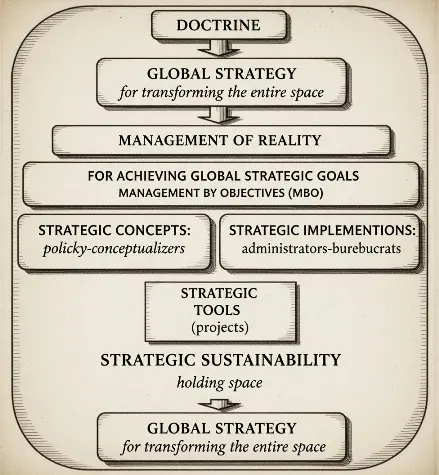
The only underlying element behind all this conceptual apparatus is a significant doctrine that articulates the strategic adequacy of existing reality and whose visible manifestation can be designated by the term “global strategy”.
In other words, any final form of “management by objectives” rests, at its foundation, upon a certain holistic mode of thinking — upon a particular vision or dream of the future held by a definite subject. This subject, in order to realise that vision (whether explicitly formulated or tacit), is capable of generating a master conception (a grand design) from which — or toward which — all subsequent management by objectives is coherently aligned and rhythmically organised.
Strategic Duration as Activity
Strategic realization demands strategic activity, which presupposes the continuous production of instruments for duration maintenance.
Loss of capacity for such activity in the reproduction of strategic instruments leads to atrophy of the strategic governance mechanism.
This atrophy — “administrative slumber” — manifests first as the inability to generate strategic conceptualisation, then as the loss of other strategic responses, or ultimately as the incapacity to produce new strategic realities.
Conceptualisation and Duration Maintenance
The reproduction of a strategic bureaucratic apparatus capable of sustaining strategic duration becomes imperative.
Absence of strategic bureaucracy equates to absence of a mechanism for duration maintenance.
A strategic instrument that escapes political control becomes difficult to govern.
Officials are not strategists. Administrators can sustain an existing mechanism but are incapable of generating novel thinking or actively repurposing the instrument toward new objectives.
Agency Costs and Degradation
Strategic bureaucracy is not the conceptual node that generates political strategy, giving rise to inherent conflict:
- the bureaucratic operator, by consolidating executive power, seeks to eliminate the strategic node;
- conversely, the conceptual-political node prioritises ideation, thereby losing operational control over implementation.
The core problem is the loss of capacity for policy production. Realization divorced from conceptualisation constitutes strategic impotence.
The production of strategic duration begins with strategising and continues thereafter; once the originating conceptual moment is lost, realization ceases to be strategic.
The Politician and the Administrator
The politician is capable of generating concepts and leveraging existing mechanisms to forge new strategic realities.
Administrators are primarily focused on preserving an already-established strategic realization.
Strategic Closure
The mechanism of strategic governance in the context of duration production operates between two poles: conception on one side, produced instrument on the other.
- On one side: conceptualisation (politician, entrepreneur, composer, inventor, ideologue); the outcome of strategy is the result-instrument: national governance, enterprise, fleet, bridge, factory, etc.
- On the side of maintenance: administrator-director, military official, etc.
Strategic Madness
Technocratic idiocy
Conceptual inadequacy
Technocratic idiocy manifests in structures such as Easter Island monuments, pyramids, purposeless fleets and armies — situations in which understanding of the original rationale has been lost, leading to meaningless overproduction of strategic instruments. The system replicates “new patterns on old templates” until crisis and collapse ensue.
Conceptual inadequacy is exemplified by medieval scholastic philosophy or scientific materialism.
Conceptual inadequacy and technocratic idiocy converge at the point of foundational loss. Scientific materialism may detach from empirical validation, positivism from correspondence between theory and outcome, rationalism from logical verifiability. All represent futile attempts to establish that reason possesses no external ground. Reason left to itself cannot discover its own foundation.
It sometimes occurs that no external authority exists to assess the adequacy of emerging strategic conceptualisations. This gives rise to the madness of strategic conceptualisers who nonetheless retain control over administrators.
One may hypothesise that Easter Island lacked external adversaries capable of exploiting the loss of conceptual adequacy and thereby arresting its descent into technocratic madness.
The outcome of such madness is either self-destruction from internal causes or vulnerability to external conquest.
Causes of Madness
Strategic thinking is the aspiration to govern what lies beyond ordinary conscious visibility.
“Visibility beyond the visible” constitutes one proposed dimension of invisibility. Engagement with such invisibility — the governance of the non-apparent — is the domain of philosophy, specific scientific theories, and all thought that seeks to penetrate what lies outside everyday perception. This form of visibility invariably poses a profound challenge.
Strategic thinking is thus a mode of managing “invisibility”; when connection to reality is lost during the execution of a destructive project across the entire strategic apparatus, catastrophe ensues.
Concluding Remarks
Over prolonged existence, strategic duration tends to shift power from conceptualisers toward administrators.
If the administrative system fails to renew or integrate conceptualisers capable of revitalising strategic duration, collapse is inevitable.
The ideal figure is the politician-administrator who can both generate concepts and maintain effective control over implementation.
Every emergent strategic element becomes the foundation for subsequent strategic layers.
Any particular strategic initiative must necessarily form part of the overarching strategy currently being pursued.
The visible presence of sustained strategic thinking — evidenced through strategic realization — indicates the existence of strategic leadership capable of actively producing strategic reality.
Inability to hold strategic duration (or any of its phases) within consciousness signals professional inadequacy at the strategic level.