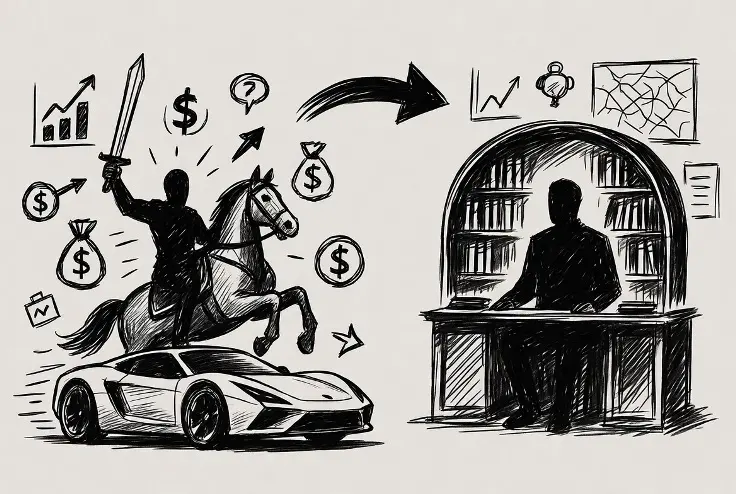
Let us advance several hypotheses — and allow ourselves a degree of speculation — about how the difference in thinking emerges between those who create products and those who manage capital at a global scale.
1. The Financier and the Managing Partner
Someone accumulates a modest — or sometimes substantial — body of industry knowledge, solves a specific problem, assembles a team, and tries something. If capital appears — if someone provides resources — the roles almost inevitably settle into a familiar pattern.
- The previously unknown financier becomes the equity owner.
- The entrepreneur becomes the junior partner — the managing partner — and, more often than not, in spirit an enterprising warrior.
Another Christopher Columbus. Successful, perhaps. Celebrated, even. Yet always a viceroy — destined, in time, to be removed, and replaced by a Grandee from an old family, institutionally ordained to take his place.
Call this the recurring encounter of the engineer and the dynasty — of the builder and the lineage of capital. Whether this resembles the partnership of engineers and industrial dynasties or some entirely different pairing is secondary. The pattern itself repeats too often to ignore.
To make sense of it, we must assume the coexistence of two distinct modes of cognition: young thinking and old thinking.
This distinction is, of course, a deliberate simplification. “Young” does not mean biologically young, energetic, or modern. “Old” does not mean tired, conservative, or elderly. These are not age categories. They are cognitive architectures.
2. Young Thinking
The formation of young thinking tends to follow a familiar arc.
Someone has a dream — but also energy, health, talent, luck. Perhaps supportive relatives who financed a carefree beginning, an education, a few mistakes. Then chance intervenes. Someone offers a push. Someone opens a door.
Eventually, a person spends enough time obsessing over a specific problem — sometimes one that began as a personal dream — to assemble a small team. Small experiments follow. Modest ventures.
And if these early efforts are noticed, funding appears.
After that — fortune decides.
Characteristics of Young Thinking
Brevity. Young thinking is fast, energetic — and short-range.
Low stability. It is short-grasping and mildly aggressive, optimized for movement rather than endurance.
Surface orientation. It instinctively avoids problems that demand long immersion or deep structural work.
Aversion to depth. It has little patience for prolonged study, for wrestling with dense “tomes” and inherited bodies of knowledge.
Lack of tradition. It rarely feels compelled to understand deep culture, ancient intellectual movements — or even the long history of failed ideas.
Limited refinement. It often has little exposure to traditions of intellectual sophistication, to the habits and quiet disciplines of older thinking.
Cult of luck. It glorifies boldness, speed, and lucky breaks. You can watch this mindset play out endlessly on YouTube.
Short-term validation. Success is measured by rapid wins, quick results, loud praise, public recognition — and the inevitable self-display that follows.
3. Old Thinking
Old thinking is fundamentally different from young thinking. Those who possess it think unlike the restless riders. The crowd constantly sees the first group, yet rarely notices the second — hidden deep within old estates or in the library halls and archives of the Vatican.
Let us assume that these hidden actors possess a refined mode of thought that seeks to descend to the foundations of what is happening. A person formed in the old mode might ask:
- "How can one manage a process without possessing knowledge of the whole?"
- "How can anything significant be created without understanding the problem in its entirety?"
- "How can one act without a view of the entire picture? And if one does not grasp the large-scale dynamics, how can one act at all?"
Then follows the Augustan reflection on the “golden hook” — the loss that cannot be compensated once it disappears.
This first layer of reasoning does not negate the second, which assumes an awareness of the metaphysical dimension of events — the possibility that the teleology we perceive is not the teleology that actually governs reality. Such awareness makes it possible to recognize the many false constructions that must be overcome through accumulated experience.
This way of thinking enables a simple but difficult distinction: the difference between what is desired and what is real — and the recognition that subjectivity profoundly shapes decision-making. We want our thoughts to be both a description of reality and a tool for controlling it.
Yet reality resists this wish. The depth of such meta-strategic thinking is the product of ancient experience — something unlikely to be acquired within a single lifetime.
Thus, any problem worthy of solution divides into two layers:
- • Deep knowledge of the domain (industry knowledge).
- • Knowledge of the metaphysical dimension of the problem (philosophical knowledge).
And the scheme, strictly speaking, does not describe what actually happens.
It is not an exercise in grandiosity or esoteric obscurity. Metaphysics, in this context, is not sentimental mysticism. Philosophical knowledge — metaphysical understanding — is not about how to bake bread, command armies, or trade stocks. A person with strong professional expertise can function perfectly well without metaphysics.
But the moment one begins to suspect that reality is more complex than it appears — that the teleology we perceive, and even our deepest industry knowledge, may still be incomplete — philosophy begins. This supposedly “impractical” knowledge becomes necessary for those who are willing to look up from the mud beneath their feet.
Industry knowledge, of course, does not include knowledge of the Game. The Game is something else entirely. Universities do not teach it. Yet how can one participate in what is happening without understanding a game that has been unfolding for centuries? Without this knowledge, participation remains a form of permanent childhood — or simply the ordinary life of someone living inside someone else’s enterprise.
And here we must recall the Whole. How can one play without seeing the entire board?
Holistic knowledge — the significance of moves and exits, the full space of possible victories and defeats — demands immersion, long study, and time. Yet life is short. Time is scarce. One must earn a living and still hopes to do everything at once.
The Nietzschean Tension
In simplified form, it resembles a recurring cycle: the devoted followers of Apollo build their rational structures, their fleets and trading ventures — until a storm reduces everything to nothing. After the catastrophe of visible reason, the defeated turn to the temple of Dionysus to avoid madness by embracing it.
Faith in cheerful logos.
Then the encounter with Reality.
Each encounter can yield experience. But one may also attempt to understand something more fundamental about the pattern itself. Powerful thinking can lead to contemplative life — or to something greater: a deep investigation of reality through the only true measuring instrument available, one’s own existence.
But that is not the subject of this essay.
Notes on Old Thinking
Intellectual continuity. The accumulation of substantial knowledge — crucial in the so-called Dark Ages (and even in prehistory) — was only possible in environments and among groups capable of sustained, long-horizon cognition. This required the capacity to think slowly, to study tradition as a whole, and to observe the entire board at once. Here one might recall the priestly “universities” of Mesopotamia, the curates of ancient orders, and, later, financial dynasties that also trace their origins to priestly structures — as well as certain old families, both historical and modern, that have long ceased to be merely military in nature.
Strategic temperament. Such thinking is characterized by deep composure, interrupted by rare but extremely intense eruptions of anger — in the sense described by Clausewitz in On War, where he analyzes the highest form of strategic intelligence.
Temporal horizon of affect. Old thinking may sustain emotions across centuries — including long-duration hostility and inherited patterns of revenge.
Biological capital. In its implicit form, old thinking presupposes talent, ability, and sometimes what appears as innate genius. It includes the idea of hereditary predisposition, which can be reinforced through structured lineage strategies, including marriage alliances. In this sense, one may recall the logic described in Ender’s Game, where strategic capability is cultivated across generations.
Historical selectivity. Old thinking can emerge anywhere — even at the social bottom. However, its consolidation into a true strategic resource requires historical conditions that are rare: moments of systemic upheaval that demand highly capable “helmsmen” able to stabilize a ship falling off the crest of a historical wave.
Environment of formation. Under ordinary conditions — periods of stability or decline — only established families and structured environments allow such cognitive capacity not only to emerge, but to become operational as a tool of large-scale practice.
Social deviation. From the perspective of mass society, this form of cognition often appears abnormal — a deviation from the dominant “grasping” logic of young thinking. In some environments, even the act of sustained thinking itself becomes socially non-functional, producing irritation rather than recognition.
Hidden aggression. Representatives of old thinking often regard the overtly combative nature of young thinking with a certain contempt. Their own aggression is rarely expressed in visible form, yet structurally it is deeper and more durable — and, in strategic terms, significantly more powerful than the aggression of younger modes of thought.
4. Business Strategy of Old Thinking
Let us imagine a particular kind of business strategy — one that is not played by young entrepreneurial warriors, but by priests and capital. It is worth remembering that financiers historically emerged from temple priesthoods. And that old military dynasties — such as the Argeads — represent, through maternal lines, a synthesis with ancient priestly structures (with Alexander the Great as a culminating outcome). In this sense, we are dealing with a fusion of old cognitive traditions — something that can be imagined as a peak form of strategic intelligence.
Detection Mechanism
Assume that financial actors have developed a system for identifying young projects that might “break out.” The mechanism is simple in structure but brutal in statistics: Every year, approximately 100 early-stage projects are selected and launched.
In most cases, new ventures are created by actors with “young thinking.” This is the general rule, though not an absolute one. One might say that figures such as Ford in the past, or Elon Musk in the present, occupy the position of managing partners in exactly such a system — representing one of the rare breakout trajectories among hundreds of attempts, financed by capital accumulated elsewhere over long time horizons.
Youngness initially has advantages. But over time, it becomes a constraint for projects that evolve into large-scale industrial or financial empires — systems capable of controlling entire sectors for decades or even centuries.
And the world is large. Financiers operate across multiple levels and regions, allocating capital to different kinds of ventures and structures. Their role is not limited to funding creation — it also includes acquisition, consolidation, and resale of existing projects, as part of a continuous reconfiguration of ownership and control across the system.
A Structural View of the Global Economy
If we follow this logic, the global economy begins to look less like a smooth system and more like a layered ecology of competition, consolidation, and decay.
Old Industries
Typically only a handful of dominant players (~50 industries globally). Structure is stable, innovation is internal, and innovation is absorbed or neutralized by existing giants. The structure is resistant.
Medium Industries
Landscape is fragmented with 20–30 significant players (~100 industries). Competition is active but not explosive; around 50 experiments per year.
Young Industries
Radical fragmentation with 40–60 emerging major players (~250 industries). Experimentation is maximal with ~100 new projects annually. Fluid, unstable, and highly generative.
Structural Transition
Industries do not remain fixed. Young industries gradually transition into medium ones. Medium industries consolidate into old ones. Some disappear entirely, exiting all categories. It resembles a continuous “Highlander”-like struggle for singularity within a field.
Systemic Complexity
• Inter-industry dynamics
• State-level influence
• Education, trade, medicine
• Syndicates and cartels
• Informal networks & illegal flows
• Simple error and incompetence
Political and Civilizational Layer
When we move from industries to nations, governance systems, empires, and political projects, the structure remains broadly similar. Capital does not simply fund “companies.” It participates in the structuring of entire systems — across economic, political, and civilizational scales.
Holistic Knowledge and Business Empires
Where does “old thinking” appear in world history?
In ancient civilizations, priests functioned as early systems of accumulation. They stored not only goods — vessels, grain, precious objects — but also knowledge itself. Knowledge of games, territories, families, households, and the full structure of lived reality: causes and effects, recurring patterns, even the movement of the sun across time.
In this sense, knowledge was not abstract. It was storage — of reality itself. One is naturally reminded here of the Vatican Library — alongside various archival systems: dynastic records, inquisitorial archives, and similar repositories.
Speculation (from Latin specio) — not conjecture, but seeing: the act of intellectual vision and structured interpretation of data. These accumulated “treasures” became the foundation of early financial operations.
Resources accumulated in such systems could be allocated to governors, administrators, or military actors. But this was never purely material — it was always about composite power: a combined resource of knowledge, authority, and structure. Think of the Bank of England or less visible, less formally financial systems operating on similar principles.
If we trace the origins of “old thinking,” we might even speculate about its modern institutional descendants: bodies such as the Council on Foreign Relations or the Royal Institute of International Affairs. The mapping is uncertain, but the structural analogy is suggestive.
The Upward Flow of "New Blood"
Old structures decay. They exit the system of relevance. Meanwhile, fragments of the old merge with actors emerging from below or outside the established order.
Civilizational winds, historical waves, political moods, technological breakthroughs — ships and icebergs, islands and reefs, blind passages and unexpected crossings.
Everything is in motion. Everything collides.
Some structures collapse. Others emerge and stabilize — but only temporarily.
5. Old and Young Thinking: Remarks
It is possible to assume that carriers of “old thinking” are structurally prepared to lose nine battles, and still win the war in the tenth encounter (a logic associated with Svechin and Clausewitz). Old systems carry strategic reserves and depth that allow them to retreat for nine moves, only to deliver a decisive strike in the final act — defeating an opponent who, until that moment, believed the outcome was already settled.
By contrast, representatives of “young thinking” are often simply unaware that such a layer of thinking exists at all. They tend to interpret reality through what is immediately visible, operational, and legible — without the need to engage with long traditions of texts, accumulated experience, or structural memory.
This is not so much “hidden knowledge” on the part of the old, as it is a lack of connection to it — an absence of access, or even interest, in entering that longer horizon of knowledge.
Parallel Coexistence
Old and young thinking always coexist. They operate in parallel, intertwined, mutually constraining and enabling each other. Each carries its own strengths and its own structural blind spots.
Surface vs. Depth
What is visible is almost always the young layer — surface dynamics and immediate motion. The old layer remains beneath the surface, largely invisible, but structurally more persistent.
This distinction can also be interpreted not only as a cognitive model, but as an analogue of capital structure itself — financial, commercial, industrial capital. Each sector has its own internal logic, corresponding both to the scale of operations and to its specific form of uniqueness.
One may even suggest that “young thinking” is closer to industrial capital, while “old thinking” is closer to financial capital — although this remains an oversimplification.
In certain historical configurations, industrial capital can acquire autonomy and begin reproducing financial institutions internally. Yet ancient pools of financial power — and the corresponding mode of “old thinking,” which interprets economic activity through a different structural lens — tend to wait. Not disappear, but remain latent, until conditions make them operative again.
Lack of Wholeness and the Superficiality of the “Young”
Business trainings, success seminars, and the broader industry of “how to become successful” or “how to launch a startup” are, in essence, designed to stimulate a form of young thinking — or more precisely, to accelerate entry into the ranks of the “runners,” those who act quickly, move fast, and constantly jump from one opportunity to another.
One could object that real business thinking — especially in its more pragmatic, often described “American” form — is nothing more than direct action: simple execution, strong operational drive, and a rejection of unnecessary theorizing. Only clear schemes, only decisive movement, only a kind of repeated “pirate raid” on the nearest coastal city — again and again.
But is that really the full picture?
Or is it possible that those who truly structure the process operate elsewhere — beneath the visible surface? One is reminded here of Drake and those who actually benefited from the system behind him: the ones who approved expeditions, financed fleets, and validated entire operational structures.
Modern business schools often produce operational agents — financial “automata” capable of executing tasks within predefined schemas, without ever being required to understand the structure of the Whole itself. This implies the absence of any real philosophy of finance, replaced instead by schematic abstractions and auxiliary rhetoric about “success.”
Attempts to grasp wholeness tend to dissolve into collections of mathematical transformations and partial models — systems of representation that never reconstruct the full canvas.
All the major professionals, each embedded deeply within their specialized “tile of the mosaic,” often appear to operate without any active awareness that a concept such as WHOLENESS even exists. Yes, partial knowledge is useful — it reveals connections, dependencies, local structures. But the question remains: what about the Whole?
How can one design financial, economic, or commercial strategies without a concept of the Whole? Without it, all action becomes tactical by default — sequences of moves that often end in structural failure or collapse into irrelevance.
The one who understands the Whole is capable of inventing any scheme. For such a thinker, “schemes” are merely a surface expression of a deeper cognitive architecture.
By contrast, the “automaton,” operating within a constrained schematic framework, produces only reduced and partial solutions, without ever being able to ask the fundamental question: what is primary? And when the system inevitably shifts again, this same “automaton” once more finds itself expertly describing what has already become obsolete.
Several Important Questions About “What Is Actually Going On”
To meaningfully participate in any system, one needs a certain form of holistic knowledge about what is actually happening. Yet this very question — “what is going on?” — may conceal a structure that is both highly complex and, at the same time, reducible to simplicity.
Historical Configurations of Control
Throughout history, we can observe different configurations of control over global finance, trade routes, and cognition itself. From the Chaldeans, Phoenicians, Sogdians, Venetians, and Genoese to the Colonna, Medici, Fugger, and Welser families.
And, possibly, analogous structures continue to operate in some form today.
It may also be suggested that what is called “discounted cash flow” is only a derivative of earlier monetary distortions — not the foundational principle of financial theory itself. A truly holistic understanding would mean a form of financial cognition grounded in the management of total resources as a system.
- ? What does it mean to “know total resources”?
- ? What does it mean to possess the instruments for governing them?
- ? What is governance ultimately for?
Mainstream financial theory does not truly answer this. Reducing the purpose of planetary-scale resource coordination to “profit extraction” or “surplus generation” is a substantial simplification of the actual structure of reality. One must not confuse instruments with goals.
Toward what end are global investment institutions ultimately oriented? Toward “efficiency”? Toward something prior to efficiency? Or something beyond it entirely?
The distinction between “types of thinking” introduced in this text is itself only an analytical simplification — a way of making a complex structure legible. In reality, things may be organized in a fundamentally different way.
***