Aristocracy of the Spirit: The Red and the Black
Management Mechanics, Social Layers, and the "Sorel" Energy
rusnak.link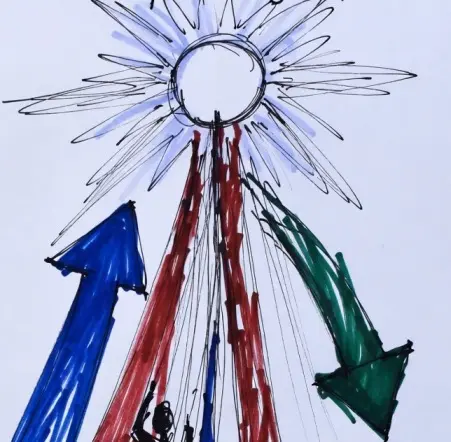
For an analysis of a particular process of spiritual becoming, one may turn to the events described in Stendhal's The Red and the Black,[i] as well as to Jack London's The Sea-Wolf.[iii] The same underlying outlook that animates The Red and the Black can also be found in the modernist novel A Waif of the Plains, as well as in Scaramouche.
Preliminary Remarks
The notion of Khlev employed throughout this work is not intended as something insulting or derogatory. What is presented here serves merely as a means of establishing a contrast: between that which strives toward the world of dreams and those aspirations that are directed toward what is earthly and grounded.
One may perhaps suspect a certain radicalism in such a distinction. Yet no such radicalism is, in fact, intended.
Likewise, the opposition of different "strata" represents nothing more than a speculative device, a means of rendering visible something elusive and difficult to grasp. It should not be understood as a description of actually existing civic structures, concrete rights of the individual, the affirmation of civil liberties, or anything of that sort.
In other words, the reflections presented here are no more than synthetic meditations inspired by Stendhal's novel, meditations which themselves imply reflections upon the romantic world.
And if certain Gnostic overtones are hastily attributed to what follows, such readings would be mistaken. For that is not what is at stake here. The matter concerns something altogether different. More precisely, it concerns the curious fact that contemporary "philosophy" appears, for some reason, to deny the reality of the meta-occurring itself, proposing in its place either a mere reflection of materiality or some false superstructure erected upon the material.
Yet what, precisely, is materiality?
What is it?
A weak concept?
For perhaps what is commonly called "matter" is itself something secondary. Something already determined. Something already cooled. Only the residue of something stronger.
And perhaps the reality of what is occurring cannot be reduced either to matter or to ideas, but belongs to something prior to both. Something that manifests itself through both, while remaining reducible to neither.
A Note on Khlev
The notion of Khlev employed throughout this work does not refer to poverty, nor to any particular social class, profession, or mode of life. Nor is it intended as a term of abuse.
Rather, Khlev designates a certain mode of existence: a condition of spiritual closure, attachment to what is merely earthly, and immersion in what has already become determined and cooled. In this sense, Khlev stands in opposition to the world of dreams and to those higher aspirations through which man seeks to transcend the immediacy of ordinary existence. What is presented here, therefore, serves only as a means of distinguishing between these two orientations of being.
But what, after all, is materiality?
What is it?
And is such a weak concept truly sufficient to explain the world?
1. Those Led by Spirit and the "Ordinary"
A being endowed with spirit is led by something spiritual. It is led by particular thoughts and by genuine dreams (Julien Sorel).
Let us suppose that there are those who aspire toward something spiritually elevated, those who wish to know something and to understand what is happening, those who experience the uselessness of what surrounds them and its melancholy absence of meaning (Humphrey Van Weyden). But there are also those to whom all of this higher realm remains entirely uninteresting.
Let us further suppose that among those "to whom it matters" there occasionally appear individuals capable of catching glimpses of eternity itself, capable of bringing the fire of Olympus down into this world of perpetual cooling. And not merely of catching such glimpses. But afterward, of creating here something genuinely great. Something grand. Something capable of exceeding the uselessness that surrounds them.
And the division between those "to whom it matters" and those "who have no need of it" may very well arise for reasons unknown. Perhaps it is connected with something that precedes education. Something deep. Something not entirely accessible to explanation. Let us therefore assume that the source of such predispositions lies in something hidden from any simple account of causes.
For the moment, let us simply acknowledge that this mysterious—and highly provisional—division between those to whom such things matter and those to whom they do not (the latter not even being bored, but merely bent over their plates) does, in fact, exist.
Yet one should not confuse those who are merely bored—the possessed, those who seek to destroy themselves in one way or another—with genuine idealists, with those who wish to hear something and to understand something. For what is being spoken of here is something altogether different.
2. Severed from the Higher Spiritual
Let us suppose that there are those who, spiritually, live in Khlev, for whom the higher life holds no interest. Or perhaps their ideas revolve merely around eating—around "piglets and molasses."[ii] And when abundance is provided in great quantity, it turns out, once again, that creativity and spirituality do not emerge from such plenty. Quite the opposite. What emerges is swelling.
And such a stratum is rather broad. It ranges from those who are almost entirely cut off from spiritual aspirations to those who are still capable of hearing something. Yet profound interest nevertheless fails to arise. And the matter here is not one of some supposed "physical limitation." It is more complicated than that. Nor is this a matter of Gnosticism. The diversity of such spiritual dispositions is powerfully portrayed in Jack London's The Sea-Wolf.[iii]
The governance of such a condition may be exercised through direct command—by methods familiar from The Sea-Wolf—but also through mental manipulation: by constantly placing before the guided various fleeting objects, pulling them first one way and then another, while concealing from them the fact that they are guided at all. Not because someone has necessarily imposed this condition upon them. But simply because they have become disconnected from the world of dreams.
Yet this considerable guided stratum may itself be guided by something significant. By significant dreams. And dreams may concern something lofty. Or perhaps only some form of bestiality. Thus there may exist different thoughts and different "historical" "regularities."
One may suppose that the ruling stratum can deliberately offer something capable of pulling people out of Khlev and directing them toward the world of dreams. But it may also happen that the weary rulers neither wish, nor are capable, of drawing the gathering toward anything truly significant. And this ultimately becomes the cause of decline and of the eventual exhaustion of the entire process, as everything begins to move downward.
For a community that has become the final Khlev ceases to exist as a gathering capable of living under common laws and occupying significant spaces. The maintenance of what has been socially achieved requires civilizational constants. And when those constants are denied, what comes afterward? A new barbarism? Wild tribes?
And, naturally, those who are always inclined toward Khlev never suspect that the noise inside their heads is neither self-generated nor truly their own. Someone has made that noise. Someone has already filled the silence.
And, as always, the hero of The Red and the Black lacks the ability to interact naturally with those who wish to remain in Khlev. Yet neither is he capable of becoming a foreman of men (Wolf Larsen). He belongs to something else. And if no way out is found, then he will either be crippled or, embittered and having broken himself, become part of this world without dreams. A world that demands the constant demonstration of loyalty to the habits of Khlev—as in the interactions between Humphrey Van Weyden and the ship's cook at the beginning of The Sea-Wolf, or between Sorel and his father and brothers at the mill.
And the process of deactivating the Sorels within a declining community may assume catastrophic proportions. For such Sorels are those who tomorrow, by means of strong and fresh blood, revitalize the entire gathering, creating an ascending current. Yet these young commoners are always a threat to the fossilized ruling stratum—a stratum that has grown weary and no longer desires anything.
And when the opposite process begins, something entirely different starts to rise upward. Khlev itself. And this is precisely the sign that the whole order has been turned upside down.
3. The Intermediate Layer: Between Dream and Khlev
The organization of the relationship between the ruling stratum and those who, lacking any dream, nevertheless gravitate toward Khlev, almost always requires the presence of people capable of directing the mass through forms of rough compulsion toward positive aspirations (Wolf Larsen in Jack London's The Sea-Wolf).[iii]
For spirit itself, by virtue of its constitution, its character, and even its habits, is not suited to direct coercion. One need only recall Humphrey Van Weyden at the beginning of his stay aboard the Ghost in The Sea-Wolf.[iii]
Spirit is not naturally inclined toward command. Spirit does not compel. Left entirely to itself, it would simply be ignored. And therefore there almost always emerges an intermediate layer, something standing between, something that makes possible the proper and positive movement of the whole.
Thus, the boatswain, the sergeant, the shift supervisor on the factory floor, the foreman of a brigade or collective enterprise—these are indispensable elements in the organization of every process of positive production.
For the world of dreams, by reason of its very constitution, is incapable of organizing rough compulsion. It is not made for such a task. And therefore, between those who lead through dreams and those who, having no dream, seek only Khlev, there invariably appears something intermediary. A particular estate. A certain roughness. Something harder. Something more practical. Something capable of translating aspiration into discipline, meaning into order, and order into habit.
For no enduring structure is possible without those who are capable not merely of understanding, but also of compelling, coordinating, preserving, and maintaining movement. Such people rarely produce dreams. Still more rarely do they produce meanings. Yet without them, meanings themselves often remain powerless. For meaning does not become reality by itself. Dreams do not organize themselves. And spirit, left entirely to itself, is often incapable of defending its own creations.
Thus, this intermediate layer is neither the source of the ascending movement nor its ultimate purpose. Yet it frequently becomes the bridge without which that movement itself cannot endure. For between the dream and Khlev there almost always emerges something intermediate—something stronger, something rougher, something capable of transforming aspiration into daily practice.
And if one day Sorel or Humphrey Van Weyden should be regarded as equals within such a layer—expect disaster. For neither Sorel nor Humphrey Van Weyden was made for that role. Spirit is capable of something else. The man of dreams is incapable of becoming a boatswain, just as the boatswain is incapable of becoming the source of dreams.
Every attempt to force spirit into a role alien to its nature ultimately turns against what is highest. Just as every attempt to entrust the world of dreams to those who know only coercion inevitably ends in vulgarity.
For dreams without strength become powerless. But strength without dreams becomes Khlev. And perhaps every healthy order exists only because these three—the dreamers, the intermediaries, and the multitude—never fully coincide, and yet are compelled to live together.
4. Horizontal and Vertical Structures of Governance: The "Service Collars"
Considering both the composition of a community and its horizontal and vertical structures, one may assume the existence of various branch, departmental, and other forms of organization. And with them appear different kinds of intelligentsia—not only governing, but serving as well. Administrators and custodians of differing degree and significance.
These are qualified strata which, by their spiritual disposition, dwell within the world of dreams, yet nevertheless remain a serving substance.
The engineering and scientific-technical intelligentsia, whose task is the organization of large-scale productive mechanisms.
The administrative intelligentsia, itself divided according to sphere of activity and according to its particular "collar": education, upbringing, sport, medicine, trade, production, science, law enforcement, and other domains.
The warrior estate, destined to guide the great military mechanism. The special services, whose task is to preserve the integrity of the mechanisms. The diplomatic corps. The scientific intelligentsia as a whole. And the higher stratum occupied with art.
All of these belong to the world of qualified service. For although such strata may spiritually inhabit the world of dreams, they nevertheless remain an auxiliary substance. They serve. They organize. They maintain. They administer. But they are not necessarily the source of meaning itself.
Movement from Below Upward
And if the system remains healthy, entry from below remains open and accessible to those who are capable of demonstrating thought. Or the educational system permits upward movement to all those who possess the will and the ability to make the effort. Thus, during periods of modernization, at the beginning of formation, within the first generation of ascent, men without established estate—raznochintsy—penetrate into the technical and service strata, gradually filling the lower levels of governance.
For every ascending order requires an influx of fresh blood. It requires those who come from below. Those who still possess hunger. Those who still possess dreams. Those who are not yet tired. And therefore the movement from below upward is one of the signs of a healthy and living order.
For the technical and service strata constitute the first steps of ascent. The first schools. The first proving grounds. And through them, those capable of greater things may gradually move higher. Toward larger responsibilities. Toward broader horizons. Toward the upper levels of administration. And perhaps, eventually, toward something beyond administration itself.
For not every engineer remains merely an engineer. Not every officer remains merely an officer. Not every administrator remains merely an administrator. And sometimes, from among these serving strata, there emerge those who are capable of something greater. Something independent. Something spiritual. Something that no longer merely serves the world of dreams, but begins, in turn, to participate in its production.
For healthy systems are distinguished not only by the presence of hierarchy, but by the presence of movement. By permeability. By ascent. By the possibility that those who demonstrate thought may rise. And when such movement ceases, when the upper levels become closed, when inheritance replaces merit and fatigue replaces aspiration, then the entire mechanism begins gradually to cool. And what once constituted an ascending order slowly becomes something else.
5. A Higher Layer, Yet Still Guided
Let us suppose that those who live in Khlev are, as is usually the case, led by those who live differently—by those who are capable of something more significant, of that wonder which arises before the grandeur of the mountains.[v] That is to say, by those in whom somewhat different aspirations may arise, making possible the organization of positive reproduction.
And these very people—those who are drawn toward the light of knowledge—may themselves also be distinguished according to the nature of their aspirations.
In The Red and the Black, the lower governing layer is represented by the provincial nobility, complete with the entire obligatory circle of provincial narrowness. And one may suppose that this lower level of governance has not separated itself very far from those who live in Khlev. It merely possesses upbringing and education, which, as it were, constitute the primary qualities by which distinctions first become possible.
Yet one should also assume that boundaries exist among the governing strata themselves. And the principal distinction lies in the understanding of what knowledge actually is. Or rather, in understanding that knowledge is always bound up with the capacity for independent thought, and not with the mere possession of dates and formulas. For one may possess erudition. One may possess encyclopedic learning. One may know definitions. And yet simultaneously remain incapable of understanding the meaning that unites all these disconnected fragments. To know the "schemes" produced by others is emptiness. It is not genuine work with meaning. For the memorization of conclusions produced by someone else is not thinking. And the possession of accumulated knowledge is not yet wisdom.
At the beginning of The Red and the Black, Sorel astonishes the local provincial society by displaying his memory, demonstrating his ability to memorize and recite things by heart. But the knowledge that this is not knowledge at all, but merely a useless skill, remains inaccessible to the provincials. For them, memory itself appears as wisdom. Quotation appears as understanding. And the ability to reproduce becomes confused with the ability to think.
Thus, even among those who are drawn toward the light of knowledge, there are boundaries. And even among those who govern, there exist different degrees of freedom. For one may rise above the ordinary inhabitant of Khlev and still remain guided. Guided not by crude appetites, but by authorities. Not by bodily habits, but by inherited formulas. Not by objects, but by schemes devised by others.
And therefore a man may belong to the educated estate, occupy a position within the structures of governance, possess refinement and considerable learning, and yet never step beyond the boundaries of borrowed determinations. He may stand above the ordinary man and still remain guided. For the true distinction lies not between education and ignorance. Nor between culture and the absence of culture. But between the capacity for independent thought and the inability to think independently.
It is for this reason that a gulf separates Julien Sorel from the provincial society of Monsieur de Rênal. And the matter lies neither in origin, nor in wealth, nor even in the degree of education. It lies in the difference of aspirations themselves. Some seek possession of ready-made knowledge. Others seek understanding. Some strive to know what has already been determined. Others strive to understand what is happening. And it is this distinction, rather than estates or formal hierarchies, that ultimately determines both the fate of men and the fate of entire gatherings. For one may belong to a higher layer—and still remain guided.
6. The Upper Layer: Producers of Meaning
The novel also presents a higher layer—one capable of independent thought. A layer that despises the display of quotations and the vanity of encyclopedic learning.
The higher layer, owing both to good education and to something else, knows the true value of "static" knowledge. Such a self-sufficient participant is capable of independent and autonomous thought, and it is precisely this capacity that confirms his belonging to the higher layer—at times, to the upper layer of governance itself.
Such a higher layer is spiritually self-sufficient. It is capable of producing independent thought and, therefore, reality itself. For everything visible and produced by man is only what remains after thought. Only the residue of thinking. Only the residue of the work of spirit. Only the residue of the production of meaning. And all strategic, administrative, political, economic, scientific, and every other construction are, in the end, nothing but thought. Nothing but acts of thinking which afterward may become something else.
What becomes externally visible is merely an indirect consequence of the presence of producers of meaning. Tastes. Fashion. Preferences. Habits. Or the totality of a certain "cultural reality" which tomorrow descends downward—toward the periphery, toward the provinces, toward those who receive what has already cooled.
The existence of a higher class of producers constitutes the possibility of independence itself. The possibility of subjecthood. The possibility of one's own thought. And therefore the possibility of designs. The possibility of purposes. And afterward—the possibility of History itself. For History begins only where there exists the capacity to produce meaning. Where there are none capable of producing meaning, there may still exist events. There may still exist administration. There may still exist prosperity. But there is no History. There is only movement within determinations established by others.
Yet even the higher layer may itself remain guided. For refinement does not necessarily imply sovereignty. And intellectual superiority does not necessarily imply the ability to produce those particular civilizational constants upon which entire worlds are founded. One may possess brilliance. One may possess cultivation. One may even possess the ability to govern. And yet remain incapable of generating those meanings around which generations subsequently organize themselves.
Which is why one must assume the existence of those who are capable of such work. Those capable of producing the enduring constants of civilization. One example might be found in the Jesuit colleges. For every order, every gathering, and every civilization ultimately rests not upon institutions, but upon those who are capable of producing the meanings through which institutions themselves are able to endure.
And when such producers disappear, what remains continues to exist for some time by inertia. For institutions outlive spirit. Forms outlive meanings. And mechanisms continue to function long after the dream that animated them has already grown cold. But only for a time. For what has ceased to produce meaning has already entered the path of cooling. And everything that cools eventually descends. Toward the periphery. Toward the provinces. Toward imitation. And afterward—History begins elsewhere.
7. The Guided and Those Who Lead
Yet the guided—and even the upper layer itself—cannot replace those who work in an altogether different manner. For in the absence of this peculiar, almost "deranged" element, any territory eventually becomes merely incorporated into the world. And the world, often without even realizing it, begins to speak the language of the center, to adopt the customs and the mode of life that proceed from the source of civilization itself.
And indeed, the Western core, if one considers its broadly ethnic composition, has for several centuries been represented by three major substances. Certainly, other elements and inclusions have always existed. Yet it happened in such a way that precisely these components became something exceptionally significant, and what they produced eventually became the inheritance of the entire civilizational community.
And yes, before the emergence of diverging national languages, Latin had served as the instrument of intellectual production. Through it, a common process was maintained. The Reformation interrupted this unified movement, but at the same time it drew vast popular strata from below into the process itself.
Nor does this negate the fact that alongside the Protestant movement there appeared, as it were, Milanese humanism, and later the movement of the Enlighteners, which eventually became the foundation for the emergence of special colleges.
For the guided—even the highest among them—remain incapable of replacing those who operate differently. One may possess refinement, education, administrative talent, and considerable influence, and yet continue to live within meanings produced elsewhere. One may occupy the highest offices and still remain guided.
For the distinction lies neither between rulers and the ruled, nor between wealth and poverty, nor even between education and ignorance. The true distinction lies elsewhere. It lies between those who inherit meanings and those who produce them. Between those who dwell within ready-made definitions and those who are capable of confronting the undetermined itself. Between those who receive and those who lead.
And every civilization, every historical subject, every ascending community ultimately depends upon the existence of a very small number of such peculiar beings. Beings who are often excessive. Inconvenient. Misunderstood. And sometimes regarded as slightly mad. Yet it is precisely through them that a center becomes possible.
Without them, territories merely become provinces of someone else's world. Without them, administration remains, but not creation. Power remains, but not direction. Education remains, but not meaning. And there may exist guided strata of extraordinary brilliance, wealth, and sophistication. But where there are only the guided, there is no source. And where there is no source, there is, sooner or later, no center.
For history is not sustained by institutions alone. Nor by wealth. Nor by armies. But by those strange few who work somewhat differently. Those through whom meanings appear. Those through whom civilizations acquire their particular language. Those through whom the world unexpectedly begins to speak in the voice of the center. And everything else, perhaps, is only the subsequent dissemination of what was once produced there.
8. Those Who Lead
The upper layer consists of those who are capable of the priestly function—of grasping and producing meaning. For the transmission of meaning is precisely that which makes it possible to apprehend the world of dreams and, afterward, to bring the "world of dreams here" into being.
It was precisely such a layer that stood behind the Greek miracle of antiquity. Those who were citizens of Athens and of the other Hellenic poleis. This particularly free stratum, capable of agonistic interaction with other free men, proved capable of reproducing its own world of dreams. And not merely of dreaming of something lofty, but of bringing it into reality. Of transforming dream into practice.
And those who later sought to join this process—the Macedonians—became merely a continuation of the realization of the Hellenic world of dreams, whose origins may already be discerned in Homer. And the subsequent rise of Rome itself represented the emergence of a cultural bilingualism. It was the absorption by the Roman patriciate of Greek Stoicism and of the other powerful spiritual traditions. And this, very possibly, became one of the foundations of that future imperial civilization.
And the next world of dreams likewise rested, in its foundations, upon the whole of the classical tradition, while simultaneously drawing a second center into the process. And afterward came the known and unknown fathers of the Enlightenment, the humanists of Milan, and those associated with the Academy at Careggi.
But there were also those who organized a protest against a center that had already grown considerably cooled—a center that had ceased to produce the world of dreams. And this cessation became one of the causes of profound decay and of the gradual descent toward Khlev. For a center that no longer produces meaning inevitably begins to live off the inheritance of yesterday. And inheritance, however great, cannot replace creation.
This upper layer is always exceedingly narrow. And there may arise periods when such a layer is absent altogether, or when it is represented by a single person. There may also be times when those who officially constitute the layer no longer fulfill its function. And then, somewhere nearby—or parallel to it—there exist others who carry out this higher spiritual work.
For the upper layer is determined neither by titles, nor by offices, nor by recognition. And still less by the institutions of the age. Its distinguishing feature lies elsewhere. It lies in the capacity for the priestly. In the ability to confront the indeterminate. To grasp meaning. And afterward to produce meaning. For those who lead are not necessarily those who rule. And those who rule are not necessarily those who lead. Because true leadership belongs to those who are capable of bringing forth worlds. Those who, having touched the world of dreams, are able to return and produce that world here.
And from this, afterward, there emerge customs. Forms. Institutions. States. Civilizations. And eventually—History itself. For what later appears as reality is often nothing more than the cooled residue of yesterday's acts of spirit. And because of this, every ascending civilization ultimately depends upon a handful of such peculiar and often incomprehensible people. People who are frequently regarded as excessive. Or strange. Or even slightly mad. Yet without them there remains only administration. Only inheritance. Only repetition. And what once constituted a center gradually becomes a province.
For when the source disappears, what remains may continue to exist for some time. But no longer as a source. Only as memory. Only as inheritance. And afterward—inevitably—as a province.
9. The Mechanism, the Subsequent Absence of True Priests, and the Dead Teaching
Such a higher priesthood was always embodied in the college. And the governance of the process beyond the center was organized in the following manner.
The Highest Administrator
The first representative of the college within the "republic." This first representative of the college—the administrator—having completed a specialized faculty, possessed the professional education necessary for governance within a particular sphere: military, agricultural, mechanical engineering, chemical, or some other domain. At the same time, such a person was required to master the higher school as well, in order to remain connected with the highest priestly governance of the process. And this higher school itself presupposed two branches: the ideological branch—the realm of purpose; and the administrative branch—the realm of management. That is to say, the one entrusted with directing a particular sphere was required not only to know how, but also for what purpose. For management without purpose eventually degenerates into administration. And administration without purpose becomes mere maintenance.
The Priest
The deputy responsible for ideological work. Alongside the administrator there was always present a professional priest—a deputy representing the priestly estate itself. Formed through philosophical or theological faculties, he embodied the professional priesthood. And this, of course, is not Abbé Pirard. For the priest does not merely preserve doctrine. Nor does he merely quote authorities. He serves the dream. He guards the purpose. He preserves the connection with what is higher. And where purpose disappears, administration itself eventually loses direction.
The college as a whole was formed around a dream—royalist, republican, social-democratic—a dream which itself had originally emerged from a movement born in the preceding century. And the entire construction remained governed by that dream. For institutions were only secondary. The primary thing was always the dream. But once the dream cooled, the entire edifice began to crumble. And this collapse coincided with another process. The higher college gradually became filled with those incapable of working with the dream. Then came the prohibition against work with what is higher. And in the final stages—subversion. For one may prohibit many things. But perhaps the most fatal prohibition is the prohibition against the production of meaning itself.
Wherever a new Enlightenment has passed through a people, colleges of priests invariably emerge. And from these colleges proceeds a carefully constructed mechanism of transmission, extending all the way down to the very last participant of the gathering. For meanings do not reproduce themselves. Dreams do not preserve themselves. And teachings do not perpetuate themselves automatically. They require those capable of serving something higher. From the college there descends an entire chain of transmission. From the producers of meaning—to the interpreters. From the interpreters—to the administrators. From the administrators—to the executors. And finally—to the last participant in the gathering itself. For civilization is not held together by coercion alone. Nor by laws. Nor by institutions. But by the continuity of meaning.
And where such colleges are absent, something else inevitably appears. And where even that is absent—then... For a time, institutions may continue to exist. Offices may remain. Titles may survive. Ceremonies may still be performed. And the language of the old dream may continue to be repeated. But repetition is not transmission. And preservation is not production. For when true priests disappear, teachings do not perish immediately. They continue to live for a while through inertia. But gradually the living dream becomes doctrine. Doctrine becomes formula. Formula becomes ritual. Ritual becomes habit. And habit eventually becomes something that no longer understands what it serves. At that moment, the teaching is already dead—though its temples may still stand. And its servants may still speak in its name.
For the death of a teaching does not begin with persecution. Nor with external defeat. It begins with the disappearance of those capable of producing meaning. With the disappearance of those capable of renewing the dream. With the disappearance of those capable of serving what is higher. And where there are no longer any true priests, there remain only the servants of a cooled cult. Only guardians of forms whose purposes have already been forgotten. Only custodians of yesterday's inheritance. And afterward—as always—History begins elsewhere.
10. Movement Upward, but Also Downward
Whenever there is aspiration, whenever positive production unfolds, whenever a community expands, pressure inevitably arises from below. Those who are capable of participating in the movement forward begin to penetrate upward. They require personal freedom in order to realize themselves, and self-realization itself is necessary for the exercise of creative freedom. Everything that obstructs this freedom for realization will, sooner or later, be swept aside.
And when the system functions properly, such upward pressure and penetration presuppose the existence of certain limitations and filters, which make it possible to arrange those who rise according to their inner content and spiritual disposition. For someone may indeed demonstrate exceptional gifts for mathematical transformations, yet his other qualities may render him incapable of integration into the unfolding world of dreams. Or an inclination toward khlevhood itself—the orientation toward the khlev—may negate the possibility of further advancement within the emerging subjecthood.
For the issue lies not merely in talent, nor in knowledge, nor even in brilliance, but in the direction of aspiration itself. Thus, every healthy ascending movement presupposes not only openness, but selection; not only freedom, but hierarchy. It requires the ability to distinguish between those who seek participation in the world of dreams and those who merely desire a more comfortable place within the khlev.
And when the system remains healthy, those capable of participating in what is higher gradually rise upward, while those incapable of such participation remain where they are. But if the movement reverses—if the process begins to descend rather than ascend—then everything changes.
For then those who are incapable of building the khlev, or those who continue to strive toward the dream, find themselves expelled from the process. What had once been regarded as a promise becomes a defect. What had once been considered strength becomes an inconvenience. What had once been necessary becomes dangerous. And gradually another kind of pressure begins to emerge. No longer pressure from below exerted by those seeking participation in what is higher, but pressure exerted by the khlev itself.
Then those incapable of serving the downward movement are pushed aside, while those possessing an aptitude for decline begin their ascent. And this inversion—the ascent of the khlev and the expulsion of those who continue to dream—is itself one of the signs that a subjecthood has entered the path of exhaustion.
For every ascending gathering elevates those capable of serving the dream. And every declining gathering elevates something else. And it is by this movement—perhaps even more than by laws, institutions, or constitutions—that one may discern whether History is still being made, or whether there remains only the final cooling of what was once alive.
11. The Degeneration of the System
When the dream dies, when the ruling layer itself undergoes degeneration, there follows the degeneration not only of those capable of working with the dream, but also of those capable of positive production in every sense. And simultaneously with this process, the system begins to fill with those who desire only one thing—to build the Khlev. The process gathers momentum. And afterward comes an avalanche-like collapse. Unless, of course, a Luther is discovered—someone capable of refreshing the process. But if no such figure appears, and no new foundation is found, then the system begins its descent. And tomorrow it may become someone else's prize. Or something else altogether.
For it may happen that the lower strata within such a process still remain comparatively healthy. While that which has climbed to the very summit of the movement toward the Khlev turns out to be something incapable of work and devoid of effectiveness—something unable to engage in positive production. For ascent toward the Khlev does not necessarily elevate the strongest. Nor the most capable. Nor those who are able to create. Quite the contrary. The downward movement often raises upward those who are incapable of positive production altogether. Those who know only how to consume what has already been created. Those who have inherited, but are unable to renew.
And thus the healthy and productive lower strata, themselves the result of an earlier period of positive development, continue for some time to sustain the process. That is to say, they continue to sustain the process of being governed by those who build the Khlev. For the habits, skills, and forms acquired during the previous ascending cycle do not disappear immediately. They continue to function through inertia. And therefore it may happen that the lower strata of such a declining order remain considerably healthier than those who have ascended to its summit.
Indeed, it may turn out that the strongest, the most capable, and the most productive are still located below. While above them there stands something exhausted. Something ineffective. Something incapable of positive production. Something that has risen upward precisely because the system itself has already turned upside down. And the healthy and productive lower strata, formed during the previous era of growth, are able for some time to compensate for this inversion. They continue to sustain the process—the process of being ruled by those who build the Khlev. But only for a time.
For no amount of labor from below is capable of indefinitely compensating for the absence of meaning above. No degree of discipline can replace a dead dream. No amount of inherited wealth can replace creation. No mechanism is capable of functioning forever without renewal. At first, individual failures appear. Then contradictions begin to multiply. Then what had long been concealed gradually reveals itself. For what had once been living becomes mechanical. What had once been creative becomes administrative. And what once had been animated by spirit becomes dependent upon inertia alone. The mechanisms continue to operate. Institutions remain standing. Production still persists. And the ordinary participant may not even notice that anything essential has changed. Yet the process of cooling has already begun. And what remains alive increasingly serves something that is already dead.
Eventually, however, the burden becomes unbearable. The mechanisms begin to fail. Positive production declines. The capacity for self-government weakens. And the entire structure, deprived of a renewed foundation, begins its movement downward. Not because of external enemies alone. Nor because of accidental circumstances. But because the dream itself has already perished. And where the dream has died, the Khlev inevitably advances. For no vacuum remains empty. And what ceases to be governed by the world of dreams inevitably becomes governed by something else. And thus what had once been a civilization may, after some time, become merely the inheritance of others—or the prize of those who still possess the capacity to dream.
12. Strong Energy from Below
"Sorel" is the energy of youth. The energy of impulse. The energy of genuine freedom. A freedom that presupposes lofty spiritual aspirations, rather than some impoverished caricature of freedom mistaken for liberation.
"Sorel" represents those who are capable of breaking through the ever-forming cooled shells, interrupting the completion that constantly seeks to establish itself. "Sorel" belongs neither to the lower nor to the middle estates, with which he is not spiritually equal. Yet the upper layer, too, accepts him only reluctantly, for his estate-less condition constitutes a threat to the peculiar and already satiated mentality of those who have long since become free.
For the freedom of the higher stratum may itself drift toward detachment from ordinary reality, or even toward decadence. And this, paradoxical though it may seem, eventually becomes a source of intellectual limitation. Abundance itself may become exhaustion. And freedom, deprived of inner tension, may become sterile.
Thus, "Sorel" occupies an ambiguous position. He is alien below. And he is disturbing above. For he carries within himself not merely dissatisfaction, but an excess of energy. Not resentment, but aspiration. Not rebellion for its own sake, but the desire to break through what has already cooled. And because of this, every exhausted order instinctively fears him. For "Sorel" is always a threat to completion. He is the reminder that what appears final is, in fact, only another shell. And that what has become established may once again be overcome.
To harness and direct the energy of "Sorel" is always, in the end, the discovery of a possibility for reorganizing an existing state of cooling. Though, admittedly, only for a time. For every renewal eventually cools. Every victory becomes habit. And every form, once established, begins its slow movement toward exhaustion. Yet so long as the fresh current continues to flow, the process remains alive. And as long as new Sorels continue to appear, there remains the possibility of overcoming completion once again.
But should the fresh stream one day dry up, or should profound conservation take hold, then this becomes the beginning of the end for everyone. For the exhaustion of the stream signifies the exhaustion of renewal itself. And when there are no longer those capable of breaking the shells, there remain only the shells. When there are no longer those capable of disturbing completion, completion triumphs. And when there are no longer those capable of producing new beginnings, the old world continues to exist only by inertia—until, eventually, it ceases to exist altogether.
For every ascending civilization is sustained by this powerful energy from below—by those strange and restless beings who refuse to accept the world as something completed. And perhaps this is why the young Sorels of every age are always inconvenient. Always misunderstood. And frequently unwelcome. Yet tomorrow it is precisely through their fresh blood that exhausted gatherings are revived, ascending currents are created, and History itself begins anew. For where there are no more Sorels, there is no longer renewal. And where there is no renewal, there remains only the final cooling.
13. Collective Sorel and the Conflict with the Weary Upper Layer
Something active, gradually assuming a collective form, may arise for several reasons. First, it may emerge from the necessity of incorporating the lower strata—or even from the self-awakening of those lower strata themselves—a necessity brought about by previous growth and by competition with neighboring powers, followed by the inability of the raznochintsy to advance any further.
Such a process may be observed, for example, in the centuries-long development of the Kingdom of France, culminating in 1789 and in the emergence of the Third Estate as a fully constituted historical force. At the same time, this process is accompanied by the exclusion of certain elements from the upper layers themselves—those who, for various reasons, are deprived of the possibility of realizing what is, above all, their spiritual right.
Not everyone is as fortunate as Pierre Bezukhov. Nor as fortunate as Vasily Andreyevich Zhukovsky. Nor as many others, real or fictional. And thus, the exclusion of illegitimate sons, younger sons, and gifted men rising from below gradually becomes the basis for the accumulation of a certain opposition toward the upper class. For what, in essence, distinguished the raznochintsy of New England from the governors sent by the Sovereign to administer them? Or the lawyers of the Third Estate gathered at the Café Amory from the highest nobility of Paris? Or the raznochintsy walking along Nevsky Prospect from the upper aristocracy? Nothing. And afterward—conflict. (Scaramouche, the novel of Rafael Sabatini.)
Yet collective Sorel may emerge for another reason as well. It may arise from the powerful resistance of those above who themselves have long ceased moving anywhere. Having ceased to move, they have nothing left to offer collective Sorel. Their dream has cooled. Their horizon has narrowed. Their freedom has turned into satiety. And their wisdom has become habit. Under such circumstances, the energy accumulating below inevitably begins to seek another path. And what can liberal doctrine say about such stagnation? Or the clubs of free men? And afterward—a new ordering of the world. For revolutions are not always born of poverty. Nor merely of oppression. At times, they arise because the upper layer itself has grown weary. Because those who stand above no longer possess the capacity to lead. Because the world of dreams has ceased to renew itself. And because those who carry fresh blood within themselves encounter only closed doors.
Thus, collective Sorel is born not merely from deprivation. It is born from blocked ascent. From the inability of the capable to realize themselves. From the inability of the old order to make room for what is becoming. From the refusal of the exhausted upper layer to recognize those who are spiritually its equals. And because of this, yesterday's excluded become tomorrow's founders. Yesterday's outsiders become tomorrow's elite. And yesterday's weary aristocracy discovers—too late—that what it regarded as a threat was, in reality, the source of its possible renewal.
For every ascending civilization requires fresh blood. And every upper layer that loses the capacity to incorporate it gradually condemns itself. Until the conflict between collective Sorel and the weary upper layer becomes the means through which History itself once again clears a path forward. And afterward—as always—a new dream begins.
14. The Demons
Yet Collective Sorel and the demons are not one and the same. In the former case, what is present is an attempt to discover a path toward the world of dreams, toward the realization of the free spirit, toward movement forward and the opening of new horizons. In the latter, what emerges is the conjunction of spiritual deficiency with a simultaneous experience of one's own useless and unfulfilled existence, whose cause lies not in oppression, but in oneself alone. And this becomes the foundation of the deepest nihilism—a denial of every positive movement and a desire for self-destruction through the destruction of all.
For the demons do not seek the world of dreams. They seek the abolition of every world. They do not aspire to what is higher. They aspire to negation. And if Collective Sorel is born from an excess of living energy, then the demons arise from spiritual exhaustion.
This spiritual deformity of the demons emerges most readily within the environment of petty-bourgeois satiety. Within a milieu detached from genuine life, a milieu that prevents one from seeing that the world beyond the enclosed and isolated bourgeois universe is not quite what it appears from within. And thus, lofty spiritual aspirations and higher longings remain inaccessible to these outwardly educated, yet inwardly corrupted and limited bourgeois beings, who possess nothing except their pretensions.
For they are separated from necessity. Separated from greatness. Separated from tragedy. And therefore separated from life itself. They have read much, yet understood little. They have inherited comfort, but not spirit. They possess criticism, but not vision. Pretensions, but not vocation. Resentment, but not greatness.
Precisely because they are incapable of creating, they become obsessed with negation. Because they cannot ascend, they seek to drag everything downward. Because they are unable to produce meaning, they strive to dissolve every meaning. Because they are incapable of loving what is higher, they gradually come to hate everything that rises above themselves. Thus, nihilism becomes not merely a doctrine. It becomes a spiritual condition. A condition that denies every hierarchy, every authority, every dream, every greatness, and ultimately every possibility of positive becoming.
And what, after all, have the demons ever proposed? Who has seen any genuine proposal coming from them? Have they offered a dream? Have they founded a world? Have they transmitted anything worthy of inheritance? Have they opened a new horizon? Nothing. Except destruction. Except mockery. Except the endless exposure and denigration of others. Except the desire to pull everything down to their own level. And, ultimately—self-destruction. For the demon, incapable of discovering meaning within himself, eventually seeks salvation through annihilation. Not only his own, but everyone's.
And therefore the demons and Collective Sorel belong to entirely different spiritual worlds. For Collective Sorel seeks renewal. The demons seek the impossibility of renewal itself. One strives toward the future. The other desires that there should be no future at all. One seeks a new world of dreams. The other, having lost the very capacity to dream, can offer only the temptation of the abyss. For Collective Sorel is born from the excess of life. The demons are born from the exhaustion of life. And this is why, despite all superficial similarities, they are opposites. For one seeks ascent. And the other—having renounced every height—seeks only the universalization of the fall.
15. A Society of Equal Possibilities
The essence of a society of equal possibilities lies in the recognition that whoever demonstrates the capacity for intellectual exertion, for profound inner tension, and who is capable of apprehending the higher spirituality of the world of dreams, ought to stand in the foremost ranks. This, perhaps, is what Nietzsche had in mind when speaking of an aristocracy of the spirit.
- When a gathering is directed toward the dream, those who are capable of moving toward it naturally occupy the leading positions.
- But when the gathering grows weary, the upper layers gradually become filled with something intermediate, something average, which may eventually become either the source of a new ascent or, on the contrary, the beginning of the descent toward the final khlev.
- And when the gathering itself begins to move toward the khlev, then the last become the first—and afterward comes decline.
Every form of labor possesses dignity. There is no dishonor in necessary work. The distinction lies elsewhere. A system oriented toward the world of dreams places dreamers at the point of the spear. Those capable of hearing something higher, of enduring spiritual tension, and of drawing meaning out of what is becoming, inevitably become the leading force of the whole.
But within a system that has entered the path of degeneration, everything is reversed. The spearhead itself turns downward. The aspiration that once pointed upward begins to point toward the ground. What once served the dream becomes subordinated to comfort. What once sought meaning begins to seek convenience. And those who are incapable of bearing the burden of higher striving gradually come to occupy the highest positions.
Thus, the question of equality is not a question of the equal distribution of places. Nor is it primarily a question of formal rights. It is, above all, a question of whether the path upward remains open to those who are capable of serving the dream. For where such a path remains open, the gathering preserves the possibility of renewal. And where it becomes closed—where everything grows fixed and exhausted, and where the highest places come to be occupied by those who desire only the construction of the khlev—decline becomes merely a matter of time. For every civilization is ultimately governed by that toward which its highest aspiration is directed. And when the direction of aspiration itself turns downward, sunset inevitably follows.
Perhaps this is precisely what a true society of equal possibilities signifies. Not the equalization of all. Not the abolition of distinctions. But the preservation of an open ascent, whereby those capable of serving the world of dreams may rise to where they are most needed. For equality of possibilities does not mean that everyone possesses the same vocation. It means that no artificial barrier prevents those capable of higher service from answering their calling.
And therefore, a healthy order is not one in which all stand at the same level. It is one in which everyone occupies his proper place, while the highest places remain open to those who are capable of the greatest spiritual tension. For the aristocracy of the spirit is not a privilege. It is a responsibility. And perhaps every ascending civilization is nothing other than an attempt to ensure that those who are capable of hearing the call of the world of dreams stand, once again, at the point of the spear.
Recommended Reading
Leo Strauss. "Xenophon's Anabasis" // Vox. Journal of Philosophy. — 2021. — No. 32. — pp. 51–82.
[i] The Red and the Black.
[ii] The expression "piglets and molasses" is borrowed from the work The Luck of Roaring Camp and Other Sketches by Bret Harte, specifically from the story The Waif of the Plains.
[iii] The Sea-Wolf.
[iv] Scaramouche.
[v] Letter to Posterity by Francesco Petrarch.
Hierarchy of the Spirit: From 'Khlev' to the Production of Reality
The dynamics of a community are determined by the capacity of its strata to grasp the dream and produce meaning.
Producers of Meaning
The priestly layer, capable of independent thought. They create the "world of dreams," which later transforms into civilizational constants and administrative structures.
Inhabitants of Khlev
A stratum devoid of spiritual aspirations. When this layer becomes dominant, the system loses its capacity for development and descends toward degradation and collapse.
Key Transformation Mechanisms: