Aristocracy of the Spirit: The Path of the Priest. Part I
The Metaphysics of Consciousness, Priestly Capacity, and the Nature of Creative Breakthrough
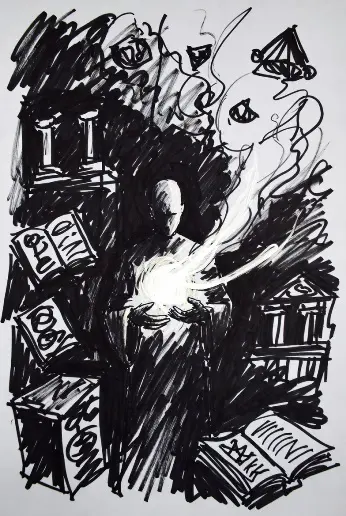
1. Centering on Spirit
Let us suppose that all conventionally distinguished forms of activity, at their highest level of meaning, ultimately reduced themselves to the priestly. From it they took their beginning, and to it they eventually returned.
At the highest level of every estate in antiquity there were always priests. And it does not matter what kind of priests they were or what form their ultimate realization assumed. They could be: a priest-warrior, a priest-founder, a priest of a cult, a priest-ruler, a priest...
Thus, at the summit of every social function stood precisely those who possessed the highest spiritual or priestly capacity. Only afterward could an individual acquire a particular functional coloration and, with it, the specific character of the defining work that he performed.
Let us suppose that whenever hollowing-out occurred, whenever the highest ranks became occupied by those lacking priestly talents, the system gradually entered into decline. It became filled with a substance incapable of looking to the other side, incapable of drawing determination from beyond itself, a condition that ultimately prolongs completion.
Thus priest-warriors become warrior-priests, then merely warriors... and the same process occurs elsewhere: priest-rulers, ruler-priests, rulers, rulers of completion. Or priest-scholars, scholar-priests, and finally merely scholars — scholars incapable of understanding that what is happening is not simply a sum of schemes.
And every imitation, every naked symbolism, every merely external performance of a function becomes, within the world of actual processes, actual acts, and actual spirit, a cause of actual completion.
Any simulation, any empty symbolism, any merely external execution of a role becomes, in the world of living processes, living acts, and living spirit, a cause of genuine ending.
And if someone genuinely actual applies even a little pressure — then everything collapses...
1.1. The Strength of the Candle
What is happening is not determined in any final way. What is happening is a kind of not-yet-determined happening; it comes into being only as a result of the work of spirit. Without such work, it is not there.
And here one almost inevitably has to assume the existence of a candle whose light is capable of revealing vast spaces. Or, conversely, one so dim that its light cannot even adequately reveal ordinary everyday existence — something often observable in children, in the elderly, or in others.
One may also suppose that “adults” very often fail to respond adequately to the everyday world. Examples include conversations with oneself after missed conflicts, after opportunities already lost, and much else besides. Consciousness must constantly make sense of — that is, bring into view — what is happening.
And if one adds to this bringing-into-view the various moments when decisions had to be made about a career, about a direction in life many years ago, then it becomes clear that the strategic dimension is itself a form of revealedness produced by one candle or another. By a nearby candle.
The light of such a candle may cast different shadows, revealing the corridors of futility in different ways. And this already-established revealedness may later be noticed by someone nearby. The contours of what has been brought into view may sometimes provoke bewilderment or admiration.
There exists a light capable of revealing vast historical spaces. It is capable of creating complex structures of meaning within what is happening. A light directed for a long time toward a particular field may reveal entire mathematical horizons or something similar. And it is obvious that without such spirit, without such revealing activity, none of this exists. Books in themselves are something nonexistent without spirit.
At the same time, dividing the work of the candle into something theoretical or practical is a considerable simplification. Its influence occurs simultaneously. The separation of one aspect from another is merely the work of the analytical mind, which is always capable of dividing things and inventing causes for them. But living acts of revelation are always something else.
And within such a context one must understand that when the candle goes out, or when its light weakens, everything sinks into darkness. What was revealed yesterday is no longer revealed without living and actual spirit.
1.2. The Other Side
The revealedness that emerges is not exactly a matter of illumination. In a certain sense, it is also the overturning of the other side into this one.
In its simplest form, it works as follows. Spirit participates in what is happening, understands it in a particular way here and now, works with it here and now, and at a certain moment may suddenly draw from the other side a particular understanding of what is taking place — reflection.
And what has been drawn out, what has been turned inside out, becomes a new determination.
This is not an analytical judgment. It is something pulled from an unknown source — from the other side. It is a new qualitative grasp of what is happening. It is spirit breaking through what is happening and giving it a new determination, but always from the other side.
Of course, there are more sophisticated definitions and conceptual schemes that attempt to describe the creative power of spirit. Yet the source of such self-generating creation is always the other side, to which a constant connection exists.
One may feel and recognize this connection within oneself, or one may live without noticing it at all. But any definition of the creative power of spirit remains only a definition. In reality, what is happening is something that cannot be fully enclosed within a concept.
Thus, the other side is an inexhaustible source of creative energy. It is the source of spirit's ability to determine, reveal, and make meaningful this infinitely meaningless expanse.
And every living person experiences moments when illness or some other weakness arises. In such moments one immediately notices a reduction in one's capacity to reveal what is happening, to understand what is happening, to endow it with meaning and necessity.
During such moments of weakness everything suddenly grows dim. Everything loses meaning. And it becomes apparent that what is happening becomes real only through our efforts.
Without us, what is it?
Abandonment and futility?
1.3. The Priestly Mode of Being
The ability to create determination for what is happening is precisely the priestly capacity.
Those who are incapable of knowing this as a practice still determine what is happening in one way or another, yet they do not know how to do so consciously as a practice.
Each of us is capable of determining what is happening through our own spirit, yet this capacity for determination differs from person to person.
A grasp may be given a definition. Yet a definition is not what is happening. And what has been defined is already different from what existed before the definition.
This is how the world invented by priests emerges.
This is how that objective spiritual activity of spirit arises — the activity that reshapes what exists in itself.
Spirit reshapes what is happening. As an analogy, one might recall experiments in physics where the gravity of a body bends space, and the greater the mass, the stronger the curvature. Yet again, an analogy is only an attempt by manifest thought to describe something that ultimately exceeds description.
Such influence upon what is happening may appear in many forms. Yet it arises specifically from the capacity to switch on, through one's spirit, a certain determination of what is happening.
In its most primitive sense, this means producing time, space, and meaning.
Such an act of "switching on the light" may be simplified considerably. Yet in reality it is not merely illumination.
More accurately, it is spirit breaking through the indeterminacy of what is happening, and through this breakthrough a new world is created.
Anyone entering a space shaped by such priestly spirit can immediately sense the existing determination, the already-established order of meaning. And this implies a certain synchronization.
In some traditions of initiation it is believed that because the spiritual is present within everyone, anyone can become a priest.
In others, it is assumed that this is not the case.
That is, the mere presence of the capacity to break through does not necessarily grant the ability to engage in such activity in its pure form.
1.4. Determination as Service
Powerful determination is always, in some sense, a form of service.
But service to whom?
Or is that question unimportant?
One may speak of service to Truth, to an idea, to oneself, to everyone, to Him.
Or perhaps the question of whom one serves is not really what is at issue here.
To determine reality for someone, or to share one's determination with someone, is always a particular question.
Yet perhaps a powerful spirit inevitably creates a field of determination that eventually draws others into its orbit.
The determination created by Socrates becomes a kind of great visibility, a great spiritual mass, capable of bending the determinations of other spirits that enter the space shaped by Socrates.
A space that remains shaped by him even now.
1.5. The Discovery of Metaphysicality
"Knowledge of oneself is the privilege of the gods." (Plato) [iii]
Without discovering oneself as a metaphysical being, it is probably impossible to speak of the path of the priest.
Yet such a discovery is not a matter of wishing. It presupposes a specific act of recognition.
The precise discovery of metaphysical experience requires a particular kind of stopping — a pause that sometimes presupposes the presence of another who halts us and points toward such a discovery.
Such a stopping most often leads toward the condition of μοναχός, but specifically in the sense of independent, self-grounded, self-sufficient, and ultimately solitary thinking — thinking determined only by itself.
The discovery of this within oneself is precisely what constitutes the recognition of one's own metaphysical nature.
One may know that such knowledge exists.
Yet this does not grant genuine experience, because this is not external knowledge, not a sum of schemes.
Rather, it is a realized practice that allows one to encounter something objectively spiritual.
And how, in such a context, can one fail to recall Heidegger's famous forgetfulness of Being?
It is precisely this context that reveals the meaning of that formulation.
The life of the ordinary person is a form of presence without awareness of one's own metaphysical absence.
Or, more precisely, it is participation in reality without awareness of the source from which reality is continuously determined and made meaningful.
Only through the discovery of one's metaphysical self does it become possible to discover existence itself, to discover one's actual self, the actuality of oneself, and the Being of what happens both within and beyond oneself in a metaphysical sense.
Only then does one begin to recognize oneself not merely as a participant in what is happening, but also as one who participates in the determination of what is happening.
2. The Priest: Between the Undetermined and the Determined
Let us unfold the concept of the priest through the categories of the undetermined and the determined.
Suppose that, on the one hand, anyone who has embarked upon the search for an answer to the fundamental question, "What is happening?", is already employing priestly methods or walking the path of the priest.
In this sense, one might say that all people are philosophers,[iv] but also sages.
Those who remain suspended within a state of philosophical indeterminacy nevertheless encounter a passage that always implies a movement toward determination through wisdom.
The ability to move there and back again, the ease of entering such indeterminacy and then returning to determination, constitutes the twofold nature of the priestly capacity.
For the priestly path unfolds precisely between these two poles: the undetermined and the determined; the question and the answer; the openness of what is happening and the act of giving it form.
The priest is capable of dwelling within the undetermined without fleeing from it, yet is also capable of returning from it with a determination.
Thus the priestly capacity is not merely the ability to know, but the ability to pass repeatedly between indeterminacy and determination, between what has not yet been defined and what has already received a definition.
2.1. The Priest: Philosopher and Sage
Thus, this path always presupposes two dimensions: the philosopher and the sage; only the philosopher or only the sage; first the sage and then a little philosopher; the philosopher who despises wisdom; the sage who no longer doubts words that have grown cold. Thus:
- First comes the negation of an existing order through radical questioning (the philosopher).
- Then a positive determination becomes possible (the sage).
Scheme: Philosopher and Sage
The philosopher does not possess a final determination of what is ultimately happening.
Unlike the philosopher, the sage possesses a determination of his own.
Yet every time the philosopher attempts to pronounce something definite, he becomes a sage.
The sage is the one who has already determined meaning. He has determined its presence here and now, after which begins the gradual cooling of what has been torn from eternity.
The philosopher serves truth — he does not wish to allow determination to become fixed and exhausted.
The sage, however, occupies a different position. By pronouncing a determination, he inevitably becomes one who determines what is happening, because his determination is itself an act of goal-setting, something that tomorrow may become a program of action for those who follow after him.
For every determination of meaning also becomes a determination of reality.
And so priests (in the rank of priests of philosophy[v]) are continually required to balance upon the edge of such indeterminacy, inclining now toward one side and now toward the other. The philosopher must repeatedly descend into indeterminacy, while the sage must repeatedly return with determination.
The moment something definite is spoken, the moment one enters the position of the sage, profound doubt immediately arises, because an affirmative determination may be understood incorrectly — not as meaning, but as something else entirely.
A determination intended as an orientation toward reality may become a formula, a doctrine, or merely another cold word.
And it is precisely this possibility that provokes the philosopher's deepest resistance.
To be continued
Part II.