Freedom and Society
Metaphysical Foundations, Historical Cycles, and the Architecture of Autonomous Communities
Abridged Version
1. The Metaphysical Foundation of Freedom
Throughout its development, Western civilization has repeatedly given rise to autonomous communities of individuals who attained a distinctive kind of personal freedom — freedom understood as incompleteness and non-directedness.
The primary foundation of such communities has always been metaphysical inquiry. Radical questioning — "What is happening? How is reality structured? Why does any of this exist?" — becomes the ground upon which ideas and new forms of society take shape.
The practice of the "search for liberation" is the discovery of one’s own metaphysical nature and of the metaphysical character of reality itself. Ultimately, it was this peculiar "dislocation of the mind," first opened in Ancient Greece, that gave birth to everything: from the Athenian schools and the monasteries of the Dark Ages to modern science, political systems, and Europe’s planetary expansion.
2. Apparent Uselessness and the Space of Meaning
To the ordinary person, the discovery of the metaphysical appears useless. Such knowledge is impractical in the narrow sense; it offers no direct path to success or power. Yet it is precisely this "pure meaning" that enables a collective re-interpretation of reality.
Recalling Heisenberg’s circle or the philosophers of the seventeenth century, we witness the birth of a new "aristocracy of the spirit." These were communities unbound by national or linguistic barriers, united by the value of a shared space of freedom. Their foundation was not formal hierarchy, but participation in the triumph of reason and personal autonomy.
3. Threats and the Art of Defense (The Path of the Builders)
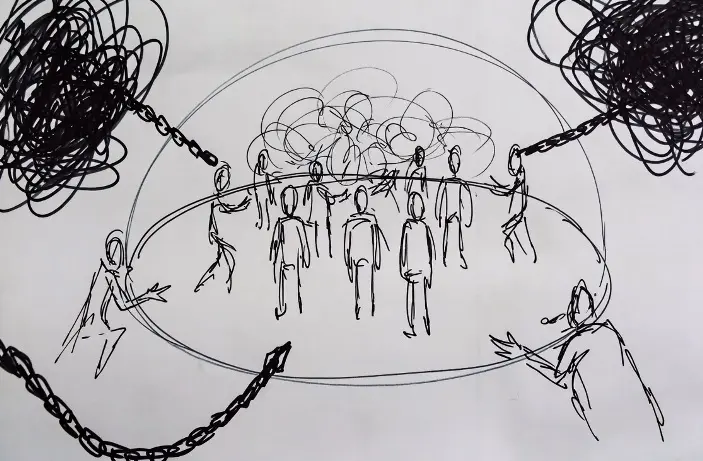
The discovery of transcendence inevitably encounters threats. On one side stands tyranny, seeking to reduce the individual to an object. On the other stands the everyday "willful malice" of the philistine, which destroys the freedom of others in pursuit of ultimately meaningless goals. The Path of the Builders emerged as a response to these dangers.
Becoming a free Builder required strict discipline: from recognizing the transcendence of one’s own presence to constructing barriers that protected autonomy. The secrecy known from the Pythagoreans to later independent intellectual circles was not an attempt to conceal, but rather "blinds for the profane" — a way of safeguarding the space of meaning from those who sought to turn it into a rally or an instrument of personal vanity.
4. A Note on the Nature of Pythagoreanism
In authoritarian societies locked in preventive stagnation, "free construction" is absent by definition, just as genuine private life is absent. What we today call "global leadership" is merely the historical outcome of the long expansion of this space of freedom.
The true "hiddenness" of the practices of free people is not secrecy in the ordinary sense. It is the inability of the profane to perceive the always-open metaphysical dimension. Those incapable of recognizing their own freedom are destined to see in the actions of the Builders nothing more than outward trappings.
Full Version
Throughout its development, Western civilization repeatedly gave rise to autonomous communities composed of individuals who attained personal freedom — freedom understood as incompleteness and non-directedness.
The primary foundation of any such community is always metaphysical inquiry. The metaphysical is inseparable from fundamental questions: What is happening? How is everything structured? Where is it heading? What is its purpose? Why does any of this exist at all?
Ultimately, it is this global questioning — this uncertain search, profound doubt, dreaming, and aspiration toward understanding — that becomes the basis for discovering ideas, formulating answers, and creating different forms of society.
The second foundation is the practice of the "search for liberation" and the "delineation of a space." This presupposes the first aspiration while extending it through the discovery of oneself as a metaphysical being and of the metaphysical nature of reality itself. A third element follows naturally: the search for meaning within what is taking place. Such a search may find expression in many forms. It may give rise to modern science, to a new political order realized in the New World, or to something entirely different.
These aspirations did not emerge solely in the modern age. Their roots can be found in the Athenian schools, in Rome, in Neoplatonism, and in numerous related traditions. Later they appeared in monastic communities. Indeed, the ancient monasteries became one of the foundations for preserving civilization during the Dark Ages — Alcuin remains the most familiar example.
The same discovery of a "space of freedom" can be found in Dutch associations, among the Independents, and in countless other forms of social life: salons, clubs, and intellectual circles.
The global result of these meta-aspirations was the emergence of modern science, economics, new political systems, commerce, warfare, and, paradoxically, the expansion of European civilization across the entire planet. At the heart of this process lies a peculiar form of thinking, a distinctive "dislocation of mind" that was first opened in Ancient Greece through the abandonment of certainty and inherited wisdom.
This process did not eliminate competition among communities. Their differing trajectories reflected not only distinct emphases in questioning but also different responses to the same metaphysical totality — a diversity that remains visible even today.
Thus we encounter first the discovery of spiritual freedom — the metaphysical nature of reality — and then the search for possibilities of expanding the world itself. It is reasonable to suggest that the historical projection of the modern West, along with much of what continues to occur today, is the outcome of this process of expansion.
Apparent Uselessness and the Space of Meaning
The discovery of the metaphysical appears useless to the ordinary person for several reasons.
First, metaphysical knowledge is impractical. It cannot be directly employed for the achievement of success or for immediate participation in political, economic, or social processes, except perhaps as a foundation upon which future achievements may later be built. In this sense, enlightenment appears as a centuries-long, self-unfolding process of evolutionary creation.
Second, metaphysical knowledge demands effort and inward orientation. Without these, access to it is nearly impossible.
Third, the pure meaning generated through such inquiry becomes the basis upon which reality can be collectively reinterpreted. The direction of these efforts may vary according to the ideas and dispositions that capture the imagination of intellectuals. Yet the power of collective effort and the possibility of connecting to a shared intellectual space significantly amplify its effects.
Werner Heisenberg expressed this phenomenon particularly well:
"Among the few people who devoted their lives to this new science, relationships developed that were not limited by national or linguistic differences. They formed a new aristocracy and were conscious of it, much as the humanists and artists of the Renaissance regarded themselves as an aristocracy..."
Within such worldviews one can discern universalism, the triumph of reason and meaning, and the value of freedom and personal autonomy.
Knowledge of Threats
The discovery of transcendence has always faced threats.
One threat comes from tyrants and absolute power, because autonomy contradicts every attempt at total incorporation and control.
Another comes from ordinary individuals incapable of recognizing their own freedom. Their willful malice directs them toward the destruction of the freedom of others in pursuit of various meaningless objectives.
Free Construction of Space
The causes and consequences are relatively clear. Every liberated individual encounters real obstacles and dangers during the process of becoming free.
The recognition of such threats required the development of methods for limiting access to particular spaces. On the one hand, these methods protected autonomy. On the other, they enabled the discovery of alternative forms of spirituality, overcoming the limitations of subjective isolation.
The Path of the Builders
The path of becoming free involved several conditions that eventually became common practices among free communities.
The first was the discovery of the transcendence of one’s own presence and of reality itself. This became the foundation of free creativity. Transcendence appears in every genuine act of discovery, including Romanticism as a particular experience of the harmony between living meaning and reality. One may think here of Rousseau, Goethe, or Byron.
The second was the recognition of the presence of other free individuals.
The third was the necessity of constructing barriers between oneself and profaneness — restricting access to those for whom participation became a means of obtaining something entirely different from the purpose for which transcendental enlightenment originally existed.
The secrecy associated with the school of Pythagoras most likely served to protect free individuals from external forces that sought to limit their self-realization. Strong autonomy implied respect not only for one’s own freedom but also for the freedom of others. Hence the emergence of degrees and stages of participation.
Those Who Attacked Autonomy
Those who threatened autonomy may be divided into several categories.
The first was ordinary banality — what Merab Mamardashvili called "vulgarity" — which never possessed any genuine interest in liberation itself.
The second consisted of the collectively irrational, who attempted to impose their own "ideas" upon others and thereby violate the autonomy of those already liberated.
The barrier was directed primarily against those who sought to transform a community into a rally or movement oriented toward some supposedly constructive objective that ultimately served personal ambition.
Thus, as early as antiquity — from the time of Pythagoras or perhaps even earlier — free individuals discovered simple methods for protecting themselves from irrationality.
Concluding Remarks
In authoritarian societies deprived of the capacity for self-development and locked into conditions of preventive stagnation and decline, free construction of any kind is absent, as is genuine private life.
The "hiddenness" of doctrine or practice, if we speak of Pythagorean philosophical gatherings, most likely implied the absence of genuine hiddenness.
Hiddenness is simply the inability to perceive the always-open metaphysical dimension.
The external symbolism displayed by builders is, more often than not, merely "blinds for the profane."
It is also worth noting that the contemporary global leader emerged precisely as the historical outcome of the expansion of this space of freedom.
Recommended Reading
- Averintsev, S.S. The Evolution of Philosophical Thought. In The Culture of Byzantium: Fourth to Early Seventh Century. Moscow: Nauka, 1984.
- Heisenberg, Werner. Physics and Beyond.
- Mamardashvili, M.K. Every Beginning Is Historical.
- Mamardashvili, M.K. Solitude Is My Profession.
- Gérard Klein. The Star Gambit.
- Clifford D. Simak. Ring Around the Sun.
Video
BBC: Civilisation: A Personal View by Kenneth Clark (Episodes 1–13).