Objectivity, or the Absence of a Dream Among the Soldiers of Renewal
A Systemic Analysis of Historical Cycles, the Crisis of Modernity, and the Nature of the “Strange Dream”
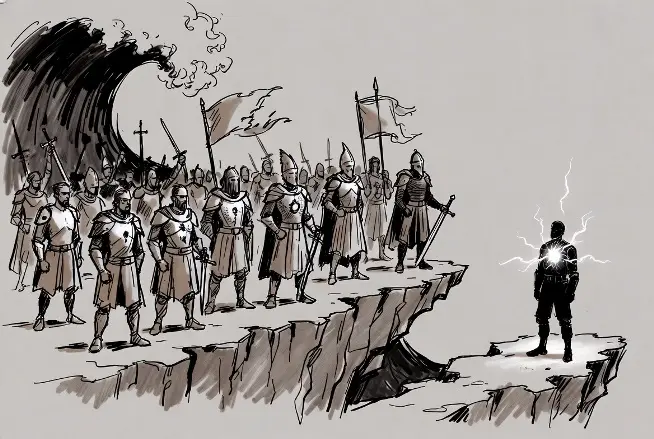
Objectivity?
What can we legitimately regard as objective? Could the First World War (1914–1919) — known as “the suicide of the European peoples” — have been avoided? Could those struggling for global hegemony have simply surrendered it?
Both those aspiring to first place — the Prussian aristocracy — and those who already occupied it — the British imperial aristocracy — faced a choice: either relinquish their position or unite in pursuit of something greater. But was such a thing ever truly possible?
The very fact of existence imposes the same brutal alternative: either you prevail, or you are consumed.
Who willingly says, “I agree — throw me overboard”? Perhaps Arjuna, before his dialogue with Krishna, thought precisely that — but only before.
It matters little that such a direct collision ultimately meant exhaustion, self-destruction, fracture, and decline for all involved. Perhaps it is precisely this kind of harsh objectivity that positivist historical science tends to ignore.
Again and again, aristocracies have surrendered what later proved essential for survival, thereby laying the foundations for future defeat and catastrophe. Such moments always end in the same objective truth: woe to the vanquished.
What follows are demographic collapse, economic disintegration, cultural decay, and other forms of systemic breakdown.
In a certain sense, this is the death of both mind and body — expressed through fragmentation, exhaustion, degradation, and dissolution. History provides numerous examples of such outcomes, not only in the collapse of empires but in the decline of entire civilizations.
The Unknown Cause of Decline and the Great Cycles
But what was the primary cause behind the death of a civilization that had become fused with other worlds?
Perhaps the decisive failure emerged in the nineteenth century, in some crucial dispute that a weary civilization proved unable to resolve in time. Or perhaps the absence of an independent Center, combined with deep integration into another world, inevitably leads toward a future defined by resource dependency.
Perhaps this degeneration represents the broader sunset of Modernity itself — the decline of the intellectual and spiritual project once embodied in Padua, Careggi, and the humanist tradition. Was it a profound blindness inherent within humanism itself — visible even in figures such as Contarini and Luther?
Yet how does one explain the End of the Whole — the completion of an entire civilization?
Was there a deeper spiritual degeneration that long preceded the project of Modernity? Was the Final Decline merely the last act of a drama whose roots stretched back into the first millennium BCE, to the Trojan War, the migrations of the Sea Peoples, or even further into an unknown past?
And did a later crisis of simplified thought ultimately bring about the dissolution of both ancient and modern historical reality?
Where, then, is the true beginning? What constitutes the beginning? And which catastrophe should serve as the real starting point for historical reckoning?
Of course, such reflections can always be dismissed as “mere speculation.” One may instead side with those who exploit historical circumstances — as the Romans repeatedly did to those who failed to remain vigilant. And later, when the Romans themselves became inattentive, they too were conquered and reinterpreted by others.
Yet it seems highly probable that the true cause of the Great Decline lay in what happened to the Spirit itself — in the erosion of its Dream, its striving, and its capacity for realization.
Perhaps it also lay in the weakening of its connection to the Strange — to a particular Center from which meaning, direction, and civilizational vitality once flowed, but which had once again fallen silent.
Such connections may easily be ignored. One may choose not to see them at all.
The Absence of “Dangerous” Successors
A declining project eventually loses the ability to reproduce a particular human type: the Greeks of Pericles and Xenophon, the Romans of the Republic, the Protestants, the Independents, Cromwell’s Ironsides, the Jesuits, the Free Builders. In other words — the Soldiers of Renewal.
Those who embody a particular form of Mind — the Mind of free individuals within a community of free individuals — people who genuinely desire to continue and extend the project they have inherited.
Throughout its expansion, Rome continually encountered peripheral elites eager to become part of the Roman world. Yet these elites remained secondary formations. They lacked the capacity for genuine self-reproduction and rarely generated what Leo Strauss identified in his reading of Xenophon’s Anabasis: a truly formidable and self-conscious political collective.
Those rulers who resisted absorption — Massinissa, Pyrrhus, Mithridates — either lost to that stronger collective organism or were eventually incorporated as provinces.
None of these peripheral ruling groups ever participated in history in quite the same manner as the Greeks and Romans. Only Carthage, and later Parthia — each connected to its own independent Center — proved capable of sustained resistance.
These societies produced something rare: a distinctive collective intelligence composed of builders, warriors, sailors, merchants, travelers, and explorers. Free participants capable of self-discipline and self-compulsion. Capable of independently formulating strategic aspirations.
Among those aspirations was often the pursuit of power — but not as an end in itself. Power was a means of realizing the Strange Dream.
Yet when the Dream itself grew stale, when it ceased to inspire striving, creation, and sacrifice, a liberated collective that had achieved material prosperity but no longer existed for anything higher gradually lost its reason. Such a society eventually descends into a moral cesspool.
The Desire for an “Objective” Explanation
There is always a temptation to explain Hitler through Wallerstein’s world-systems theory or to interpret National Socialism as little more than a reflection of German resentment after 1919.
Such explanations may contain elements of truth. Yet they often function as simplifications for those who fail to recognize their own participation in the reality they seek to explain.
One can always point to additional causes: economic crises, natural disasters, droughts, climate shifts, meteor impacts, eclipses, fires, geography… All of these undoubtedly matter.
So too do the frameworks of Montaigne, Marx, Braudel, Durkheim, Wallerstein, theories of Rimland and thalassocracy, Hegel’s conception of History as the unfolding of Spirit, Nietzsche’s reflections on the ancient irrational foundations beneath rational thought, and Jung’s suggestion that behind the facade of knowledge lies something deeper and less visible.
The Reality of Uncertainty and the Historical Schema
What we call History remains a particular mystery. Every historical school possesses its own scheme for deciphering it. The assertion that “everyone has their own truth” explains very little.
Anyone who genuinely wishes to understand must engage with the full range of available material: ancient narratives and the mental worlds that produced them, alongside modern interpretive frameworks that themselves continually age and become obsolete.
Positivist appeals to verification retain their legitimacy. So do Hegelian notions of theoretical development from simpler forms toward more comprehensive structures.
Historical science may therefore be understood as a synthesis of competing interpretations — an ongoing attempt to comprehend the phenomenon we call History.
The Absence of the Object and the Mystery
History is peculiar because it is not directly available as an object. This absence permits the construction of countless intellectual structures: patterns, dependencies, causalities, meanings, and reinterpretations.
Hence the endless proliferation of historical narratives.
Yet the historical flow itself is not an object. It is an unfolding mystery — something that has happened, is happening, and continues to happen.
Our words themselves are not objects in the simplified sense often assumed. Reality remains open to multiple descriptions while simultaneously resisting complete disclosure through articulated thought alone.
The authority granted to any particular interpretive framework therefore belongs not to the framework itself, but to the historical age that adopts it.